Creamer's Field —
Migratory Waterfowl Refuge
Area Overview
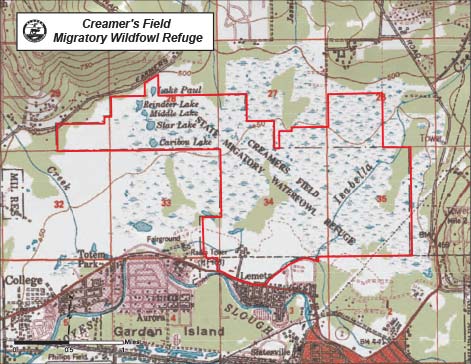
 Creamer’s Field Migratory Waterfowl Refuge spans nearly 3,000 acres in the Fairbanks North Star Borough. The refuge supports a wide range of wildlife—especially waterfowl and other migratory birds—and offers opportunities for nature viewing, photography, research, hunting, and trapping.
Visitors can explore forests, wetlands, and open fields surrounding the historic Creamer’s Dairy. More than 25 miles of trails wind through the refuge, including 4.2 miles accessible in summer. Viewing platforms provide excellent opportunities to observe migrating ducks, geese, cranes, and other wildlife in their natural habitat.
Refuge Goals
- Protect and enhance habitat for migratory birds, especially waterfowl.
- Provide opportunities to view, photograph and study various species of plants, wildlife and geological features typical to the Interior.
- Educate the public about terrestrial and aquatic ecosystems, wildlife, habitat, historical resources and other related topics.
- Allow for public uses that are consistent with the management goals.
For more information, see the Creamer's Field Management Plan (PDF 4,483 kB) and the Creamer's Field Land Status Map (PDF 259 kB). A KML file showing the refuge boundary is also available.
Modern Farming Practices
Today, farming at Creamer’s Field is designed to benefit wildlife. Plowing, planting, and mowing are timed so birds have reliable food and cover throughout migration seasons.
In early April, eight to nine acres are cleared of snow and several tons of barley are spread across exposed ground. These early-thawing patches provide resting and feeding areas for thousands of migrating waterfowl and cranes and help reduce bird strikes at Eielson Air Force Base, Ladd Army Airfield, and Fairbanks International Airport (FAI). This work is completed each spring in partnership with FAI, the Alaska Department of Transportation and Public Facilities, and the Kiwanis Club of Fairbanks.
As spring migration tapers off, preparations for fall begin. Small grains such as barley, wheat, oats, and field peas are planted in late May and early July so they mature in time to provide cover and seed in autumn. A second planting of barley in late July or early August produces tender new shoots just as fall migration peaks.
Historic Dairy and Creation of the Refuge
Creamer’s Field originated as a Gold Rush–era dairy. In 1904, Belle and Charles Hinckley arrived in Fairbanks with three cows, selling milk along the way to pay for their passage. They met the Creamer family during their travels, and in 1928 the Creamers purchased the dairy and expanded it into the largest and most successful operation in Interior Alaska.
Through the early 1900s and mid-century, the Creamer family cleared pastures, grew oats and peas, and expanded the farm to nearly 450 acres. These open fields quickly became vital resting and feeding areas for migrating waterfowl and cranes.
When the dairy went up for sale in 1966, the Fairbanks community raised $7,000 to secure an option for the State of Alaska to purchase the land. The state legislated matching funds to accompany federal Pittman-Robertson funds, generated from a federal excise tax on guns and ammunition. After acquiring 246 acres in 1968, management was assigned to ADF&G. In 1979, the original parcel and 1,500 surrounding acres were designated as Creamer’s Field Migratory Waterfowl Refuge.
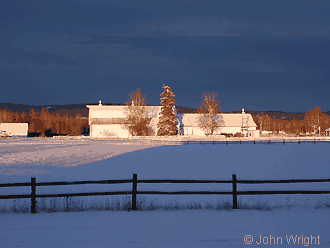
Limited farming continued into the early 1990s, and since 1994 ADF&G has managed the fields specifically for migratory birds. The historic dairy buildings—the only surviving pioneer dairy structures in Interior Alaska—are now listed on the National Register of Historic Places.
Friends of Creamer's Field
Friends of Creamer's Field is a community-based nonprofit organization that partners with ADF&G to provide educational opportunities. They staff the Farmhouse Visitor Center, lead guided nature walks in summer, and host special events throughout the year.
Research and Monitoring
Research that supports the refuge’s management goals is encouraged. During spring and fall migration, ADF&G bands ducks, geese, and cranes on the refuge. Creamer’s Field is also home to the northernmost songbird banding station in North America. Established in 1992, the station is now operated by the Alaska Songbird Institute. These banding efforts provide valuable information about migration timing, routes, and survival.