
Western River Lamprey
(Occidentis ayresii)
Printer Friendly

Did You Know?
Adult river lamprey can be distinguished from other species of lamprey by the presence of three large teeth, including a large middle tooth on the tongue and the absence of posterior teeth on the oral disc.
General Description
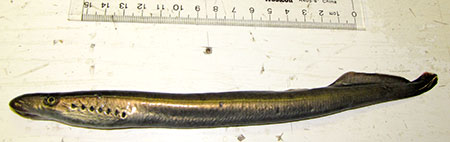
The Western River Lamprey is an eel-like fish up to 12 inches in total length. Western River Lampreys are distinguished from other Alaska lampreys by two large teeth on the supraoral bar and one large middle tooth located on the tongue.
Adult Western River Lampreys are dark yellow to silver-gray or blue-black on the dorsal side and silver to white on the ventral side. Metamorphosis of Western River Lamprey from larval to juvenile life stage occurs gradually over time as juvenile lamprey develop eyes, teeth, and the ability to swim freely.
Life History
Growth and Reproduction
Western river lampreys have two different ecotypes, or different life history strategies, regarding their feeding habits and migration behavior: an anadromous, or sea-run, predatory form and a freshwater form that has a non-feeding adult (formerly referred to as a separate species, the western brook lamprey Lampetra richardsoni). Anadromous Western River Lampreys begin migrating to cool, clear headwaters of streams during the fall and winter before nesting and spawning the following spring and summer. Both males and females participate in nest building in stream riffles by removing small rocks with their mouths and fanning smaller particles with their tails. Males and females intertwine while simultaneously depositing sperm and eggs into the nest. Depending on her size, a single female can release up to 40,000 eggs. The adults die soon after spawning. The eggs hatch in freshwater in 2 to 4 weeks depending on the water temperature. Larval forms of lampreys lack eyes and sucking mouthparts. Anadromous Western River Lampreys remain at this stage for several years before metamorphosing into juveniles, which includes the development of a sucking mouth, eyes, and teeth.
The freshwater form of Western River Lamprey transforms directly from larva to adult in up to 6 years, with no juvenile feeding stage. They have short lives (4-6 months) and short spawning migrations as adults. They spawn in spring.
Feeding Ecology
Larvae burrow into the silt, mud, or mud of shallow pools and eddies of clear streams and feed by filtering microorganisms, algae, and detritus from the water. Anadromous juvenile Western River Lampreys are considered predatory and feed on other species of fish (e.g., juvenile Pacific salmon and Pacific herring) by using their sucking mouthparts to attach themselves to fish and then tearing off chunks of flesh, fin, and bone. These juveniles are often found in nearshore coastal marine and estuarine waters.
Migration
Predatory juvenile Western river lampreys migrate to the sea after metamorphosing from larvae and tend to spend one to four years in the marine environment before returning to freshwater to eventually spawn. Anadromous lampreys return to return to fresh water in the fall and overwinter until spring when they spawn. Lampreys tend to migrate upstream in large groups and once upstream migration commences, lampreys do not feed.
Range and Habitat
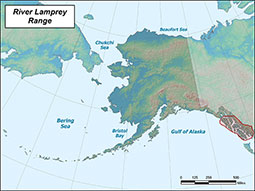
Western river lampreys are found as far north as Stephen Passage and Tee Harbor in Southeastern Alaska.
Status, Trends, and Threats
Status
Western river lamprey, along with all Alaska lamprey species, are considered a Species of Greater Conservation Need by the Alaska Department of Fish & Game. Western river lampreys do not appear to be particularly abundant anywhere within its range.
Trends
Overall strength of river lamprey returns throughout its limited range appears to be quite low.
Threats
Potential overharvest from commercial, personal use or subsistence fisheries is the main threat to the resource.
Fast Facts
-
Size
The Western river lamprey is smaller than other species of lamprey, measuring between 9 and 12 inches in length. -
Range/Distribution
Only known in Southeastern Alaska, documented as far north as Stephens Passage and Tee Harbor but perhaps ranging northward around Haines. -
Diet
Juveniles are filter feeders of detritus and occasionally diatoms and algae from the sediment. Juveniles are predators to various species of fish such as juvenile Pacific salmon and Pacific herring. -
Predators
Depending on their life stage, Western river lamprey can be prey to a variety of large fishes, sharks, sea lions, birds, and other marine mammals. -
Reproduction
River lampreys are thought to overwinter and remain in freshwater environment for approximately one year before spawning. -
Remarks
Managed by the Alaska Department of Fish & Game in Alaska state waters.
Did You Know?
- Adult lampreys are not eels but primitive fish that lack jaws and paired fins, instead they have a disk-like mouth filled with small sharp teeth
- Larval lamprey burrow, grow, and live as filter feeders for 2 – 7 years feeding primarily on detritus and microorganisms such as diatoms
- Adult river lamprey can be distinguished from other species of lamprey by the presence of three large teeth, including a large middle tooth on the tongue and the absence of posterior teeth on the oral disc.
- Western River Lamprey are Alaska's rarest and most understudied lamprey species yet recent taxonomic research based on genetics showed they are a separate genus than originally thought. They were formerly called Lampetra ayresii, lumped into the genus with the river lampreys in Europe, but now are split into the genus Occidentis (meaning 'westerly'or 'of the west') whereby Alaska is home to Occidentis ayresii.
Uses
In Alaska, harvest or use of Western river lampreys is unknown.
Management
There are presently no commercial or sport fisheries targeting Western river lamprey in Alaska.
Research
The Alaska Freshwater Fish Inventory in the Division of Sport Fish (Research & Technical Services) is conducting lamprey research in collaboration with the Knik Tribe, University of Alaska Fairbanks, and the Pacific Lamprey Conservation Initiative (a National Fish Habitat Partnership). These efforts have been exploring distributions of lamprey species in Alaska to inform the Anadromous Waters Catalog and assist in collating data from other field biologists at ADF&G, tribes, and other organizations.
Get Involved
Citizen science
If you see Western river lamprey, please photograph them. If you find an adult lamprey, a clear photo of their mouth is the best. Report observations or captures of Western river lamprey (with location and date information) to the Alaska Freshwater Fish Inventory program at dfg.dsf.affi@alaska.gov.
Alaska Board of Fisheries
Although Western river lamprey are not actively managed or monitored in Alaska, the State of Alaska is responsible for managing fisheries and you can participate by attending Alaska Board of Fisheries (BOF) meetings, local advisory committee meetings, or by writing proposals to the BOF. For more information see: Board of Fisheries
