

August 2024
Issue 80
Let’s Make Time to Get on the Water
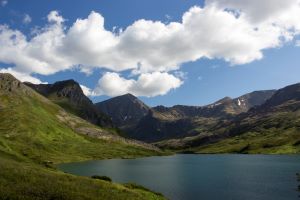
The long summer days are starting to wind down and the fall chill will be here before we know it. But there’s still plenty of time to get out and enjoy a day on the water. In this edition of Reel Times, we highlight a few opportunities for the angling adventurer.
Before you head out, be sure you have your 2024 sport fishing license. Visit our online store if you need to purchase one. Or download the ADF&G mobile app and you can store your licenses, tags and permits in your mobile device.
If you have a comment or story ideas for Reel Times, we encourage you to send them our way. You can send comments to ryan.ragan@alaska.gov.
We’ll see you on the water.
Symphony Lake: The Grayling Gem of Anchorage
By Donald Arthur, Assistant Area Management Biologist, Anchorage, Prince William Sound and the North Gulf Coast
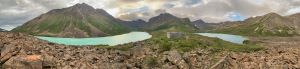
Nestled in the Chugach Mountains near Anchorage, Symphony Lake is a hidden gem offering anglers a unique opportunity to catch Arctic grayling in a setting that feels anything but urban. Frequently, we receive inquiries from anglers about where to catch grayling within a 2-hour drive of Anchorage and the classic list that we respond are: Willow Creek, Montana Creek, or pretty much any other Parks Highway Susitna tributary. Just like the anglers that we send north, we all too often pass over Symphony Lake when suggesting grayling locations. However, Symphony Lake can provide Arctic grayling action on par with Northern and Interior Alaska. It’s our own Southcentral Alaska grayling haven!
History
Symphony Lake is an alpine lake situated at an elevation of approximately 2,750 feet. Although Symphony Lake flows into South Fork Eagle River, fish passage into or out of the lake has been cut off due to its high elevation and a boulder field from a landslide that dams its outlet. So, historically the lake was devoid of fish. With its access, this made Symphony Lake an excellent candidate for fish stocking. Other alpine lakes in Southcentral Alaska had seen successful introductions of Arctic grayling: Bench (1967), Grayling (1963), and Crescent lakes (1952). These alpine lakes are typically deep, cold, and highly oxygenated, and with inlet or outlet streams that can serve as spawning habitat, they have the capability to have self-sustaining populations of grayling. Symphony Lake fit that same mold. So in 2001 and 2003, the Alaska Department of Fish and Game (ADF&G) stocked 4,239 fingerling (around 3") and 2,936 subcatchable (around 6") grayling. The introduced grayling into Symphony Lake were diploids, meaning they can reproduce and self-sustain. It didn’t take long for anglers to figure this out, and as a result, the Statewide Harvest Surveyreceived its first hit for an angler catching a grayling in 2004.
Getting There
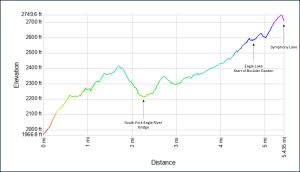
To access Symphony Lake, your journey will begin at the South Fork Eagle River (SFER) trailhead, which is reached by driving up Hiland Road near the town of Eagle River. The SFER Trail parallels and even crosses (via bridge) upper stretches of SFER for about 5.5-miles (one-way). With about 800 feet of total elevation gain over 5.5-miles, the trail is gradual, and it can be described as a mellow and easy hike. At about 4.75 miles into the hike, you will come to the outlet of Eagle Lake; hikers often confuse this for Symphony Lake. The best way to tell Eagle Lake from Symphony Lake is that Eagle is very glacially tinted whereas Symphony is much clearer water.
The most challenging part of the hike is the previously mentioned boulder field. After you reach .Eagle Lake, the boulder field begins. The boulder field should be carefully navigated, and hikers are encouraged to take their time traversing the rocks. Often times, there are cairns (piles of rocks as aids to navigate for hikers) throughout the boulder field showing the path of least of resistance, but they can be inconsistent, hard to spot, and may not lead you down the easiest path
For more information about the SFER trail, visit the Department of Natural Resources (DNR) Alaska State Parks website: southforkvalleytrail.pdf (alaska.gov).
| Approximate Distance (miles) | 0.0 | 2.25 | 4.75 | 4.80 | 5.50 |
| Location | South Fork Eagle River Trailhead | Bridge over South Fork Eagle River | Bridge at outlet of Eagle Lake | Boulder Garden | Symphony Lake |
Fishing for Grayling
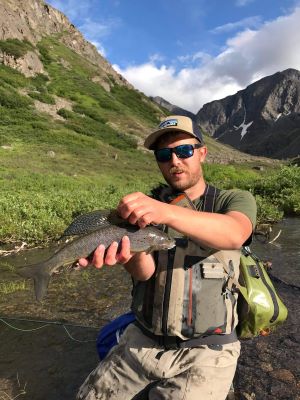
Fishing for grayling in Symphony Lake is a serene and rewarding experience for anglers of any skill level. Using lightweight flyfishing gear (2-6wt), anglers can entice these beautiful fish with dry flies or nymphs, often resulting in spectacular surface strikes and aggressive chases. When using dry flies, patterns like the Adams, Elk Hair Caddis, and Griffith's Gnat can be particularly effective. For fishing nymphs, Prince Nymphs, Hare’s Ear Nymphs, and - my personal favorite- the Bird’s Nest Nymph are deadly for Arctic grayling. I have found that stripping nymphs almost similar to streamer fishing works best compared dead drifting them. Spin fishing is another viable method, with small spinners (size 0-2) like Panther Martins, Mepps, and Rooster Tails working well. Regardless of whether you opt to spin or fly fish, my biggest advice to anglers visiting Symphony Lake is to adventure around the lake and not just the shoreline where the SFER trail meets the lake; this is how you will more and larger grayling. As a reminder to anglers, Symphony Lake opens to sportfishing on July 1 each year.
The Symphony Lake Fish Population Today
The Symphony Lake Arctic grayling is strong and healthy as ever. A mark-recapture study in 2010 indicates that Arctic grayling population in Symphony Lake is in excess of 10,000 fish in just a 90-acre lake. Symphony Lake is certainly a place where a 100-grayling day is possible! Recent data collected in 2017 and 2020 suggest that the population may have grown even since. With a growing population, the size of the fish may be decreasing. In 2010, the average size of the fish was around 12" with the largest grayling sampled was 17.5", while in 2017 and 2020, the average size was 9" with a large fish of 14" in either year. While the size of fish has decreased in recent years, Symphony Lake can still be one of the most exciting and fast action places to catch Arctic grayling and it’s only a short drive from Anchorage.
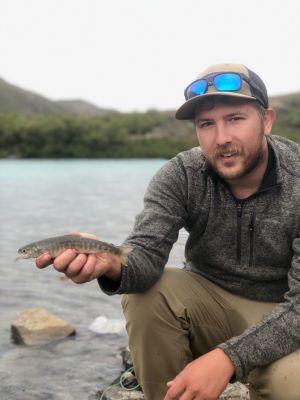
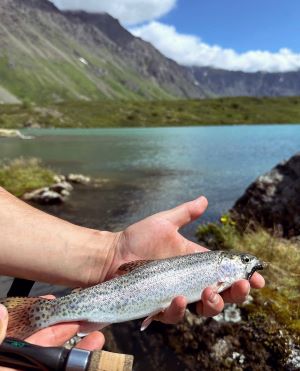
Recently, ADF&G began stocking Symphony Lake with 500 rainbow trout fingerling every other year (even years; 2020, 2022, and 2024). With rainbow trout introduced, it is expected that the rainbows will eat on juvenile grayling and reduce the grayling density, allowing the grayling to grow to larger size. With a diet of grayling, the rainbow trout should see some pretty good growth rates! Unlike the Arctic grayling that were diploids (can reproduce), the rainbow trout are triploid (sterile) and so if it is found that the rainbow trout are detrimental to the grayling population, stocking can be discontinued at any time. The rainbow trout stocking provides for a multi-species experience at Symphony Lake with an anticipated win-win scenario of big grayling and big rainbows! The photo of the rainbow trout, which was taken by Nicole Greenwell, is an example of the current size of these fish. To add, there are native Dolly Varden in Eagle Lake. I challenge any angler visiting Symphony and Eagle to catch all three species, completing what I personally call the "South Fork Eagle River Trail Grand Slam"!
Spears and Smiles
By Jake Wieliczkiewicz, Assistant Area Management Biologist, Sitka
Flippered feet cut the water as our predator cruises the reef. A marine mammal of sorts, with keen eyes and an even more clever strategy. Before long, he spots his prey, the half-asleep eyes of a halibut resting buried on the sandy ocean floor. Rather than cruising in for a bite, he keeps his distance. He marks the range and readies himself for action. In a silver flash, it’s all over. The halibut swims for freedom, unaware that it’s leashed by a shiny steel tip. Holding on for life and glory, our hunter trails behind his prey. After an exhaustive ride and a final strike to the head, he breaks the surface. A rare cold-water spearfisherman has made his kill, and joy beams from the few exposed inches of his face beneath his mask.
While the crystal-clear freshwaters of Alaska would give far too great an advantage to spearfishermen, the depth and volatility of saltwaters still pose a great challenge. Though spearfishing is prohibited in freshwaters, it is legal gear in saltwater, granted the angler is totally submerged or free swimming in the water column, and not using an explosive tip. Even SCUBA gear is allowed, as long as anglers follow all other regulations.
It is important to note that legal size limits per species still pertain. If you have trouble discerning a 28" king salmon in Southeast Alaska, it’s better to try your luck on a rod and reel where you have the opportunity to release it. Similar size limits apply to steelhead, nonresident lingcod, and guided halibut. Be aware that catch-and-release spearfishing may violate the majority of fishing ethics, responsible intentions, and fisheries laws as well.
As far as where to go, the saltwater sides of stream mouths and hatchery terminal run areas provide beautiful access areas for hunting salmon, while underwater pinnacles and kelp beds hold ground for lingcod, halibut, and rockfish. Alaska’s fish and their varied habitats lend themselves to varied gear. There are few specific gear restrictions as to the definition of speargun, or pole spears, Hawaiian slings, and conventional spearguns are all free game. In order to maximize efficiency and improve the experience, many anglers tailor their gear to the species in their sights. Hunting for lingcod or halibut that you may expect lying upon the bottom or rough substrate? Try a rock point tip that’s less likely to deform following an impact with stones on the ocean floor. Targeting an open water column fish like pelagic rockfish or salmon? Try using a tri-cut tip for greater penetration at range when the worst thing you could hit after a miss is blue water.
An added benefit of the selective approach of spearfishing is the conservation factor. Bycatch is virtually zero since a spear allows you to harvest only the targeted species. An angler in search of lingcod is unlikely to cause accidental mortality on salmon, unless he has truly poor ID skills.
In summation, spearfishing returns the artisanal essence to small scale, non-production-based fishing. YOU get to pick the fish YOU want. YOU get to pick the gear that works for YOU. And YOU control what YOU harvest. So, get close, get personal, and get YOUR fish.
Two Tales of Trophy Fish
By Tim Mowry, Information Officer, Fairbanks
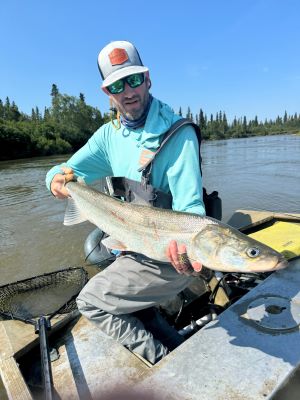
Ryan Guest – 37" sheefish on Aniak River
To say that Ryan Guest is an avid fly fisherman would be an understatement.
Guest, a 41-year-old investment banker from San Francisco, has caught 191 different species of fish on a fly rod and has set six International Game Fish Association records for redtail surfperch, Utah chub, Bonneville whitefish, Pacific Sierra mackerel, Pacific snook and European bass.
On a recent trip to Alaska, Guest caught five new species on a fly rod, including the 37-inch sheefish pictured below that he submitted to the ADF&G Trophy Fish Program for a trophy catch-and-release certificate. Guest was fishing with a guide on the Aniak River in southwest Alaska, where he spent a week at a fishing lodge.
"That was my first day catching sheefish and we were specifically targeting them," Guest, who came to Alaska on a destination fishing trip with his father, Tom, said in an email. "The 37-incher was actually the third one I caught that day."
Sheefish was the 190th fish species that Guest has caught and the 37-incher was big enough to qualify for an ADF&G trophy catch-and-release certificate. The minimum length for a trophy sheefish is 36 inches.
"I was ecstatic to catch these fish, as they are a unique catch and it was clear this was a bigger one as it came to the surface," said Guest, who was fishing with a size 2 chartreuse clouser minnow. "There was some high fiving and shouting on the boat for sure."
In addition to the six sheefish he caught during his week on the Aniak, Guest also caught Arctic grayling, Dolly Varden, northern pike, rainbow trout and sockeye salmon, the latter of which was species 191 for him on a fly rod.
He had already added three other new species to his list in Alaska during a one-day trip to Seward – Pacific halibut, kelp greenling and Copper rockfish.
The Arctic grayling fishing on the Aniak River was "outstanding," said Guest.
"I caught five on mouse patterns and expect to have a pending IGFA grayling record soon," he said.
Unfortunately, the biggest Arctic grayling he caught was just shy of 18 inches, which is the minimum length to qualify for a trophy certificate in ADF&G’s Trophy Fish Program.
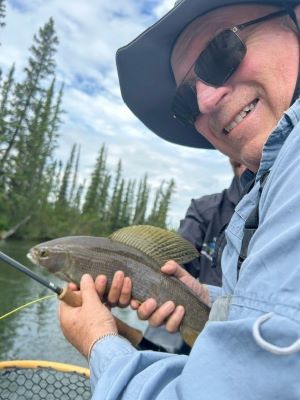
Don Provencher – 19" Arctic grayling on Delta Clearwater River
Don Provencher is a novice fly fisher who recently retired as a certified public accountant. As part of his retirement plan, Provencher, 71, wants to do more fly fishing.
He got off to a to a good start on a recent vacation to Fairbanks by landing a 19-inch Arctic grayling on July 26 during a day of fishing on the Delta Clearwater River, which he submitted to the ADF&G Trophy Fish Program for a trophy catch-and-release certificate.
"I began my vacation by booking a fly fishing guide, who took us to the Delta Clearwater to fish," Provencher said by email. "I have fished in New England mainly for trout and I consider myself a beginner fly fisher. As I am recently retired I plan on doing more fishing.
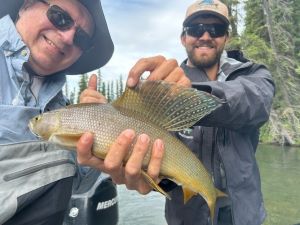
"It was the first time Provencher fished for Arctic grayling and it was a good day.
"That day I caught eight fish and was impressed every time with the fight each one gave," he said. "I was thinking the line would break on a couple of them. A couple that got away were probably bigger than the 19 incher I submitted."
Gulf of Alaska Chinook Salmon: Endangered Species Act Status Review Summary
The National Marine Fisheries Service (NMFS) has initiated a formal status review of Gulf of Alaska (GOA) Chinook salmon to determine whether the stocks should be listed as endangered or threatened under the Endangered Species Act (ESA). This review is in response to a petition submitted by the Wild Fish Conservancy, a Washington state based environmental group with little knowledge of Alaska and Alaska salmon stocks. The massive area under review includes Southeast Alaska, Prince William Sound, Cook Inlet, Kodiak, and the Alaska Peninsula.
Despite acknowledging that the petition has "numerous factual errors, omissions, incomplete references, and unsupported assertions and conclusions within the petition," the NMFS issued a positive 90-day finding, suggesting that NMFS believes state management is insufficient to protect the stocks from going extinct.
A primary driver of Alaska’s statehood was the right to manage our fisheries. Now that right threatened. An ESA listing will replace state management with federal management for any fishery impacting listed Chinook salmon and result in designation of critical habitat, with restrictions ranging from reductions in fishing opportunity to no harvest at all. This action will have a significant impact on subsistence, commercial, and recreational fisheries, causing serious economic and cultural harm to Alaskans. An ESA listing will have far-reaching implications for development projects and other activities beyond fisheries.
Sustainable management is enshrined in the State of Alaska Constitution. Pre-statehood federal management jeopardized the health of Alaska’s salmon stocks, and when Alaska assumed management authority of its salmon fisheries in 1960, we rebuilt salmon runs from abundances that were far lower than they are today. This is a profound example of the resilience of these stocks and Alaska’s sustainable management practices that have been praised around the world.
The ESA is an inappropriate tool to address a downturn in Chinook productivity. State management is designed to protect the long-term health and provide for maximum sustained yield of salmon stocks. An ESA listing is a radical and unnecessary action that Alaska opposes.
Learn more about why the Alaska Department of Fish and Game (ADF&G) opposes an ESA listing for these salmon stocks and how our current management practices ensure for long-term sustainability, here.
What you can do-Submit Public Comments
NMFS is seeking information on GOA Chinook salmon abundance, distribution, productivity, harvest, genetics, limiting factors, and environmental impacts. The public comment period ends on September 6, 2024. Comments can be submitted electronically via the Federal eRulemaking Portal at regulations.gov by searching for NOAA-NMFS-2024-0042. Click on the "Comment" icon, complete the required fields, and enter or attach your comments.
Response to Public Concerns
ADF&G acknowledges public concerns for GOA Chinook salmon and reaffirms our commitment to sustainable management practices. The recent decline can largely be attributed to changes in the marine environment. These stocks are not at risk of extinction, and populations are expected to rebound once ocean conditions become more favorable again. Management and research efforts are actively underway to help recover Chinook salmon runs to sustainable levels and better understand the underlying causes of the declines. Alaska’s salmon are resilient as our its people.
Public participation in the status review process is crucial. Share your knowledge before the comment period ends on September 6. Your voice matters!
Recipe of the month – Alaska Sockeye Salmon, Apples & Mustard
Enjoy this recipe for Alaska Sockeye Salmon, Apples & Mustard from the Alaska Seafood Marketing Institute.
Enjoy!
If you have any questions about the Reel Times newsletter, please contact Ryan Ragan at ryan.ragan@alaska.gov