
Lesser Yellowlegs
(Tringa flavipes)
Species Profile


Did You Know?
Adult Lesser Yellowlegs usually return to the same general breeding grounds each year, but the young birds flying north for their first breeding season could end up anywhere other yellowlegs are going to.
General Description
Lesser Yellowlegs are graceful, slender shorebirds who spend much of their time wading through shallow water on their long, namesake yellow legs, foraging for invertebrates in Alaska’s coastal and interior boggy wetlands. They make a loud alarm call (sounding like a car alarm) when an intruder enters their nesting area, and this will alert you to their presence during their summer breeding season. Their protective but incessant calls led the biologist William Rowan to note in 1929 that “they will be perched there as though the safety of the entire universe depended on the amount of noise they made,” in his book about Alberta’s wading birds. Similarly, the Yup’ik name for them is Nayangkayuli, meaning “the one that is really good at greeting you.” They’re fiercely protective over their brood of chicks, and admirably so, as their population has been on a steep decline in recent decades.
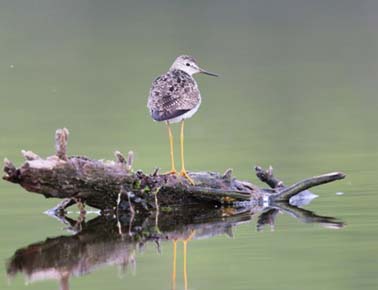
To identify Lesser Yellowlegs in the field, look for their bright yellow legs, as opposed to the shorter, duller legs of many other shorebirds. To distinguish from a Greater Yellowlegs, note Lesser Yellowlegs’ overall smaller size, shorter bill length, less barring on their white sides, and a less raspy call. Despite their striking similarities in appearance, Lesser and Greater Yellowlegs aren’t incredibly closely related; Lesser Yellowlegs instead are considered “sisters” to the Willet (a larger shorebird not found in Alaska).
The family Scolopacidae (sandpipers, phalaropes, and allies) is a large group of shorebird species with long toes and wings who are typically found near water. Scolopacids’ closest relatives are often thought to be plovers, though their fossil history is scant, with the earliest fossils dating back 40 million years. Within this family, yellowlegs are closely related to sandpipers, curlews, woodcocks, turnstones, godwits, dowitchers, snipes, and phalaropes.
Life History
Mating, gestation, birth, maturity
Most breeding pairs are formed by mid-May, at which time display flights are undulating through the skies above communal foraging areas. To display themselves to mates, males fly up to a couple hundred feet in the air and repeatedly rise by flapping their wings, then glide upwards and forwards, level off, and glide down on open wings and fanned tail feathers. Throughout this impressive rise and fall, they’re singing a song that sounds like a high-pitched trilling yodel. Courtship and copulation follow, with males dutifully guarding their mates and nest site by perching nearby on treetops, giving warning calls, and chasing away any other approaching males.
Within two weeks of arriving on breeding grounds, yellowlegs begin laying eggs—one per day until a full clutch of four is laid. The nest is a low effort “scrape” created by pressing the bird’s breast into the ground and adding nearby plant fragments. Nests are commonly located in dry, mossy places underneath low shrubs within an open meadow in a boggy spruce forest. The eggs are very well camouflaged, as are the birds. Both the male and female incubate the tan and brown-spotted eggs for 22-23 days, switching off for equal incubation shifts.
As precocial birds (young are mobile and able to leave the nest from the moment of, or soon after, birth), Lesser Yellowlegs chicks are downy upon hatching and depart the nest unaided soon after. Parents carry the eggshells away from the nest after their young have successfully hatched. Upon nest departure, the chicks follow their parents’ kip calls that encourage them to move toward them, eventually reaching foraging areas. During this clumsy walking progression, chicks often stop for brooding (incubation from parents), especially in abnormal weather, and feeding, which they can do on their own. Yellowlegs broods frequently cover over a mile through what can be thick, boggy foliage in the first day or two of their lives. Both parents are on high alert for these first few days after hatching, incessantly alarm-calling and flying at any potential threat, though this intensive care progressively fades away as the chicks quickly—within one month—gain independence.
In Alaska, the male parent remains with their brood longer than the female, as she leaves first on her southward migration. He departs about ten days later once the young can fly, and the juveniles then join shorebird flocks on coastal staging areas, flying south together shortly after. Lesser Yellowlegs return north the following year to breed. Adults generally return to the same breeding area year after year, and first-time breeders (typically at age two) may return to where they hatched or breed elsewhere across their boreal range. Interestingly, genetics work showed that the offspring of a male from Quebec, Canada was later found breeding in Alaska’s Kanuti National Wildlife Refuge, clear across the breeding range.
Diet
Invertebrates—aquatic and terrestrial, freshwater and saltwater—are eaten by Lesser Yellowlegs in shallow wetlands. Small fish and seeds are occasionally eaten as well. Lesser Yellowlegs are commonly seen walking quickly through water, picking up prey in their bill on or below the water surface.
Lifespan
It is unknown what the maximum lifespan of a Lesser Yellowlegs is; however, a mark-resight study in Anchorage detected a bird that lived to be at least nine years old.
Migration
Leaving wintering grounds in South America in early March, Lesser Yellowlegs fly north along the popular Midcontinent Americas Flyway, with some stopping in the Mississippi Alluvial Plain to rest and eat. They arrive in Alaska breeding grounds by mid-May. They migrate in large flocks together, over 1,000. Only a couple months later and shortly after rearing their chicks, female yellowlegs depart in mid-July, with males leaving shortly after, and then even later, juveniles. Southbound migration from Alaska generally follows the same route as northbound, with a seemingly mandatory stopover in the Prairie Pothole Region of Canada and the Dakotas. After this important break, yellowlegs continue their long journey, arriving in South America in mid-September or October.
Migration distance is associated with body mass and many of the larger birds migrate as far south as Argentina, totaling an 8,000-mile journey from Anchorage, Alaska to the Pampas of Argentina.
Range and Habitat
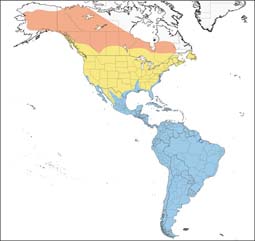
As strictly North American breeders, Lesser Yellowlegs can be found during their subarctic summers from western Alaska across much of Canada. Boreal forests habitats with bogs and ponds seem to be preferable for breeding yellowlegs. Their nest sites are often on dry, mossy elevations at the base of a shrub or small tree, where they and their eggs are excellently hidden.
In winter, they can be found in the southern U.S. and down through Mexico, and Central and South America, with many Alaska breeders settling in Argentina. Along their migratory route and at their wintering locations, if there is water—whether it be a bog pool surrounded by spruce, a flooded agricultural field, an alpine lakeshore, a salt-marsh pond, or a roadside mud puddle—it seems yellowlegs will find it a suitable foraging location. They’ve been found inhabiting wetlands from sea level to over 12,000 feet in elevation. Habitat use changes with rainfall throughout the winter; the dry season (August-December) sees Lesser Yellowlegs frequenting tidal flats or rivers and lakes, while the rainy season (December-March) pushes birds inland to shallow lagoons.
Status, Trends, and Threats
Status
Alaska State Wildlife Action Plan: Species of Greatest Conservation Need
IUCN Red List of Threatened Species: Vulnerable
Trends
Although widespread, Lesser Yellowlegs populations have steeply declined since 1970, with current data showing a cumulative decrease of 70-80% across their range. In Alaska, there was a 5-9% decline per year detected between 2003 and 2015. As of 2025, there are an estimated 660,000 Lesser Yellowlegs making up their global population, with 158,400 (24%) birds breeding in Alaska.
Threats
Habitat loss at migratory stopover locations—such as the Prairie Potholes and the Gulf Coast of the southern U.S.—and at low elevations in South America is likely the largest threat against Lesser Yellowlegs. Across the globe, the wetlands they rely on are changing through development, agriculture, deforestation, and climate-related drying, with the conversion of native grasslands and rangelands to row crops having a large negative effect.
Unsustainable harvest numbers of Lesser Yellowlegs during fall migration threatens their populations. Tens of thousands of shorebirds are hunted in the Caribbean and northeastern South America each year, both for sport, subsistence, and commercial purposes, with Lesser Yellowlegs being one of the most commonly harvested birds. Alaska yellowlegs may be avoiding the brunt of this impact though, as migration studies have shown that birds who breed farther east than Alaska are more likely than Alaska breeders to take a route that brings them to these harvest zones.
Agrochemicals, such as those used in pesticides, herbicides, and fungicides, are heavily applied in key stopover sites for yellowlegs, accumulating in wetlands and potentially in shorebirds. The presence of these pesticides has been shown to adversely impact the food web and shorebird foraging behavior. Research projects underway in North Dakota and Mississippi are investigating agricultural practices and their effects specifically on Lesser Yellowlegs.
There may be a phenological (life cycle stage) mismatch between chick hatch and invertebrate larvae emergence. The timing of mating, nesting, and rearing chicks is critically important for many migratory birds, and the emergence of the insects necessary to feed newly hatched chicks must be paralleled for nesting, and therefore the species’, success. Because different organisms use different environmental cues to signal life cycle stages, they don’t always match up the way they have in the past as our climate continues to change, and it is unknown whether or not yellowlegs could alter their migration patterns to account for these shifts.
Fast Facts
-
Size
Average length: 10.5 inches, wingspan: 24 inches, weight: 2.8 ounces. Females are larger than males. -
Lifespan
Approximately four years to nine years. -
Distribution
Northern breeders across subarctic Alaska and Canada, Lesser Yellowlegs spend their winters throughout much of South America, with a large population of Alaska birds in Argentina. -
Diet
Primarily invertebrates and sometimes small fish or seeds. -
Predators
Falcons, hawks, eagles, and owls all prey on Lesser Yellowlegs. Their eggs and chicks are taken by cranes, gulls, ravens, magpies, coyotes, bears, foxes, marten, mink, and domestic cats, in addition to the raptors who also hunt adults. -
Reproduction
They have one brood per year, generally laying four eggs. -
Remarks
Lesser Yellowlegs are discerned from various sandpipers by their tall, yellow legs, and from the Greater Yellowlegs by their shorter bill (about the length of their head), overall smaller size, and less raspy call. -
Other Names
Nayangkayuli (Yup’ik, meaning “the one that is really good at greeting you”), Sadya (Dena’ina, no distinction between Lesser and Greater), Ovingoayook / UviñÅ‹uayuuq (Iñupiaq), Séitaa (Tlingit)