
Greater Yellowlegs
(Tringa melanoleuca)
Species Profile


Did You Know?
Greater Yellowlegs begin flying north in the spring earlier than many other shorebirds, and they often linger late into the fall before departing south.
General Description
Greater Yellowlegs are elegant, slender shorebirds who spend much of their summertime chasing fish and foraging for invertebrates in Alaska’s boggy or coastal waters. The piercing alarm call they produce for an intruder to their nesting area has given them the nicknames yelper, telltale, and tattler. They are more solitary than most shorebirds and are generally seen in groups only while migrating. Although they are widespread across most of North America, Greater Yellowlegs are one of the least studied shorebirds on the continent due to their preference for swampy, mosquito-heavy habitat and their wonderfully cryptic nests.
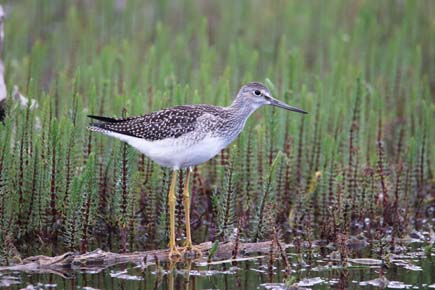
To identify Greater Yellowlegs in the field, look for their long, bright yellow legs, as opposed to the shorter, duller legs of many other shorebirds. To distinguish from a Lesser Yellowlegs, note Greater Yellowlegs’ overall larger size, longer bill length (well past the length of the head), the slight upturn to the bill, greater barring on their white sides, and a raspier call. Despite the striking similarities, Lesser and Greater Yellowlegs aren’t as closely related as they appear; Greater Yellowlegs instead are more closely related to the Spotted Redshank (a European shorebird).
The family Scolopacidae (sandpipers, phalaropes, and allies) is a large group of shorebird species with long toes and wings who are typically found near water. Scolopacids’ closest relatives are often thought to be plovers, though their fossil history is scant, with the earliest fossils dating back 40 million years. Within this family, yellowlegs are closely related to sandpipers, curlews, woodcocks, turnstones, godwits, dowitchers, snipes, and phalaropes.
Life History
Mating, gestation, birth, maturity
Most breeding pairs are formed by early May, within the first few days on breeding grounds, at which time display flights are undulating through the skies. To display themselves to potential mates, birds fly in a rolling wave pattern by repeatedly rising and falling a short distance with a fanned tail and constant song. Courtship—in which a male runs circles around a female and poses while quivering his upraised wings—and copulation follow.
Yellowlegs lay three or four eggs in their shallow scrape of a nest. The nest—generally concealed by small shrubs on three sides and lined sparingly with plant fragments—is on the ground in mossy, open areas near water. The cream-colored and brown-spotted eggs are incubated for about 23 days.
As precocial birds (young are mobile and able to leave the nest from the moment of, or soon after, birth), yellowlegs chicks are downy upon hatching and depart the nest unaided soon after. Upon nest departure, the chicks follow their parents, one usually on the ground with the chicks and the other perched above, eventually reaching foraging areas. During this clumsy walking progression, chicks often stop for brooding (incubation from parents) and feeding, which they can do on their own. Yellowlegs broods can cover a couple miles through what can be thick, boggy foliage in the first few days of their lives.
The male parent stays with the brood longer than the female, as she leaves first on her southward migration once the young are capable of weak flight. He continues to care for the young for about another week until they have fledged (young are capable of strong flight), at which point he leaves. Juveniles, independent about 35-40 days after hatching, join small flocks of Greater Yellowlegs at coastal marshes and mudflats, where they will depart together after all adults have flown south. Some juveniles then stay in the southern winter range—only making a small, local migration—during the breeding season which they appear not to participate in their first year.
Diet
Small fish and invertebrates—terrestrial and aquatic—are eaten by Greater Yellowlegs in shallow freshwater or marine wetlands. Berries and seeds are occasionally eaten as well. Yellowlegs are commonly seen walking gracefully or running through water, sometimes even swimming, chasing fish or other prey, and apparently repositioning fish headfirst before swallowing whole. They’ve been reported to forage at night just as often as during the day, though their strategies change depending on light conditions (they stab during the day and side sweep at night).
Lifespan
Precisely unknown, but their generation length (the average age of parents of newly hatched birds) is estimated to be 4.9 years.
Migration
Greater Yellowlegs depart their wintering grounds in spring before most other shorebirds, generally making it to Alaska in mid-April. They migrate in flocks up to a couple hundred Greater Yellowlegs, but don’t interact much with each other outside of travel. A few months later, they begin their prolonged migration south, with adults leaving (females first, then males) in late July. Juvenile yellowlegs often depart in October but may linger late into fall. They appear to fly on a route in the fall that is farther east than their interior spring path.
Range and Habitat
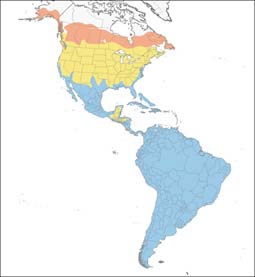
Greater Yellowlegs breed from western and southern Alaska to a central band across Canada. While migrating, they’re found throughout North America. They spend the nonbreeding season in the southern states of the U.S. and along the Pacific and Atlantic coasts, Mexico, coastal Central America, the Caribbean, and throughout South America.
Most of their time is spent in or very near water, whether it be in small ponds, mudflats, coastal marshes, alpine lakes, seasonal swamps, slow streams, or flooded rice fields. They can be found from sea level to alpine zones. Their breeding range is dominated by boreal forest, open muskegs and bogs. Mosses, lichens, sedges, and scattered small shrubs and standing trees are usually present, though they’ve been known to nest on recently burned, grassy ridges too. When coastal, they may fly between their nest site and marine foraging areas frequently.
Status, Trends, and Threats
Status
Alaska State Wildlife Action Plan: Species of Greatest Conservation Need
IUCN Red List of Threatened Species: Near Threatened
Trends
Greater Yellowlegs populations are decreasing, with an estimated 0-29% decline since 2010. Though their total population is difficult to gauge due to their hard-to-access nesting sites and cryptic nature, it's estimated that 137,000 mature birds are alive globally, with 36,990 (27%) of them breeding in Alaska.
Threats
Unsustainable harvest numbers of yellowlegs during fall migration threatens their populations. Tens of thousands of shorebirds are hunted in the Caribbean and northeastern South America each year for sport, subsistence, and commercial purposes.
Habitat loss has contributed to the decline of several other shorebird species and may be affecting yellowlegs as well, though this hasn’t been particularly well documented for this species yet. Across the globe, from their northern breeding grounds to necessary stopover sites during migration to South American wintering grounds, the wetlands they rely on are changing through development, agriculture, deforestation, and climate-related drying.
Fast Facts
-
Size
Average length: 14 inches, wingspan: 28 inches, weight: 6 ounces -
Lifespan
Unknown, but their generation length (the average age of parents of newly hatched birds) is estimated to be 4.9 years. -
Distribution
They breed in southern Alaska and throughout central Canada; they overwinter in the southern U.S. and along both the Pacific and Atlantic coasts, Mexico, the Caribbean, coastal Central America, and throughout South America. -
Diet
Small fish and invertebrates (aquatic and terrestrial), sometimes seeds and berries -
Predators
Raptors hunt adult yellowlegs, and gulls, crows, and raptors prey on their eggs and chicks. -
Reproduction
They reach maturity at the end of their second year and have one brood per year, laying three or four eggs. -
Remarks
Greater Yellowlegs are discerned from various other shorebirds by their tall, yellow legs, and from the Lesser Yellowlegs by their noticeably longer bill (beyond the length of their head), overall larger size, and a raspier call. -
Other Names
Séitaa tlein (Tlingit), Sadya (Dena’ina, no distinction between Lesser and Greater)