

January 2025
Issue 84
Get Out and Fish in 2025!
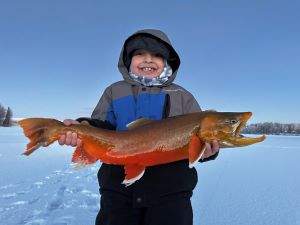
Are you ready to get out and fish in 2025? We hope it will be a good year of fishing for all anglers in Alaska. Don’t forget to purchase your 2025 sport fishing license and king salmon stamp. You will find what you need in our online store.
If you have any questions about fishing and hunting licenses in Alaska, please visit our General License Information page.
When you purchase a sport fishing license or a king salmon stamp, the money you spend helps fund resource conservation in Alaska.
The Alaska Department of Fish and Game – Division of Sport Fish.
King Salmon Roundup in Blind Slough
By Jeff Rice, Area Management Biologist, Petersburg
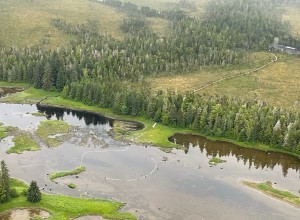
The Crystal Lake Hatchery is located near Petersburg, Alaska on Mitkof Island. The hatchery is owned by the State of Alaska and operated by the Southern Southeast Regional Aquaculture Association (SSRAA) to produce both king and coho salmon. Releases from Crystal Lake Hatchery support popular sport fisheries in Blind Slough and Wrangell Narrows. This last summer ADF&G staff worked collaboratively with SSRAA staff and members of the public to attempt a new method of collecting broodstock for the hatchery.
What are broodstock? Broodstock are the fish that will be spawned in order to produce the next generation. There are no natural runs of king salmon in Crystal Creek (or all of Mitkof island), so all the king salmon production at this location originates from the hatchery.

Crystal Lake Hatchery has struggled with collecting sufficient king salmon broodstock in recent years. While king salmon productivity has also been poor across the region in recent years, the return to Crystal Lake has additional challenges due to its physical location. Crystal Lake itself lies in the mountains high above the hatchery and feeds Crystal Creek which provides water to the hatchery and flows into Blind Slough. Blind Slough is the slow-moving body of water that connects Crystal Creek and the hatchery to saltwater. The three-mile stretch of slough leading up to the hatchery is wide and shallow with few trees to provide shade or logs and deep pools to offer resting and hiding places for fish. King salmon returning in June, July, and August can experience stress from the warm water conditions on hot summer days. Water temperatures in Blind Slough can spike as high as 80°F which, when sustained, can cause die off events and other physiological stress that may reduce the viability of the eggs. In 2013, over 1,100 king salmon died in Blind Slough due to these warm water conditions, at what is basically the hatchery’s doorstep, after surviving all other obstacles in their migration. Bears, eagles, and seals also congregate in the area and make easy meals of the sluggish kings. While king salmon are present in Blind Slough earlier in the summer, they are reluctant to move up to the hatchery until August leaving them vulnerable for several weeks.
In the spring of 2024, SSRAA introduced the idea of proactively collecting king salmon in the lower portion of Blind Slough and transporting them to the hatchery where they could be safely held until they fully mature, hopefully reducing the mortality that would have otherwise occurred. 2024 was forecasted to be the smallest run since 2013 and everyone was interested in seeing as many king salmon as possible make it to the hatchery. The plan involved capturing king salmon in the lower portion of Blind Slough, transporting them up the ¼ mile boardwalk to the Blind River Rapids parking lot, and trucking them three miles to the hatchery. ADF&G was on board with the idea and offered our help, but the number of people needed to do the work exceeded both the hatchery and Department’s available staffing. So, through a public service announcement, SSRAA informed the people of Petersburg of our need and requested volunteers… and they came.
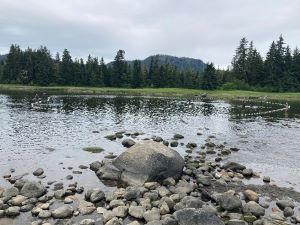
The public outpouring of assistance in this endeavor was exceptional. Many offered their help because they understood what an important resource these fish are to the community while others simply enjoyed the opportunity to handle live king salmon, one of the greatest fish in existence. This effort could not have been successful without their help.
SSRAA staff applied their expertise in fish handling and devised oxygenated coolers where a few king salmon at a time could be moved from the Slough to the parking lot and then to a waiting truck with a larger oxygenated fish tote. ADFG staff applied their expertise in fish capture using beach seines and landing nets that are gentle on fish scales. The health of each salmon was the highest priority. Four separate days of collection were made in all, with two occurring in early July and two in August.
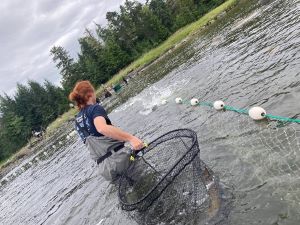
In the end, the 2024 summer season saw less than 600 adult king salmon return to Crystal Lake Hatchery. Approximately 25% were from the broodstock collection events, while the remainder arrived naturally to the hatchery around the third week in August. Much was learned in this first attempt at a remote broodstock collection and overall, the effort was deemed a success. Very few mortalities occurred in the adults that were transported to the hatchery. However, the viability of eggs from the collected fish will not be known for several months. These capture and transport methods were previously untested as we had never attempted to live capture and move large fish over difficult terrain. So, each step was performed as carefully as possible. We now know that broodstock collection is possible and, while it might not be the answer to all of the challenges present in this system, it does offer a way to get more broodstock back to the hatchery to support future releases. This proactive broodstock collection approach can be repeated and improved in future years to be used as necessary. These efforts highlight the great collaborative relationship between SSRAA, ADF&G, and the community of Petersburg.
Ice Angler Nabs Big Burbot on Birch Lake
By Tim Mowry, Region III Information Officer
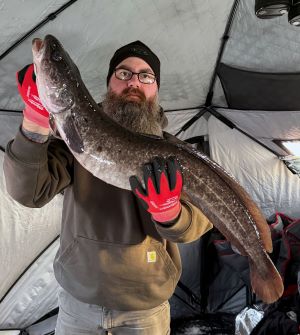
Here’s another beauty of an Interior burbot that was caught by Jesse Wandling of Fairbanks in Birch Lake on Sunday, January 5th. The fish measured 32 inches long and weighed 9 pounds, 4 ounces, big enough to qualify for a trophy certificate in ADF&G’s Trophy Fish Program.
“We actually go out there targeting burbot,” Wandling said of Birch Lake, located approximately 60 miles south of Fairbanks on the Richardson Highway. “I’ve got a spot that’s been pretty productive the last few years.
“I’ve caught a few that were a little longer, but this is probably the fattest one I’ve caught out there,” he said.
Wandling was jigging with a lighted fishing lure tipped with shrimp when he hooked the big burbot.
“I was fishing with real light tackle,” said Wandling, who was fishing with his wife, Silke. “He just about took the rod out of my hands.”
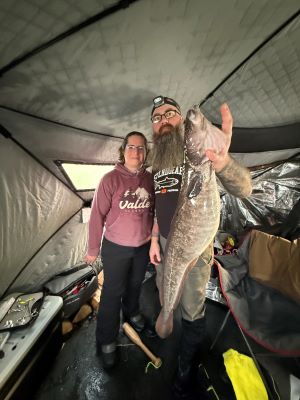
If you have pictures of trophy fish you’ve caught, or just a nice fish picture, email it to ADF&G Sport Fish Information Officer Tim Mowry at tim.mowry@alaska.gov so we can feature it on our social media platforms.
Find more information about the ADF&G Trophy Fish Program.
To learn more about fishing for burbot, check out our burbot fishing pagewhere you will find two videos about burbot fishing, one of which shows you how to set line for burbot and another that shows you how to clean and fillet a burbot.
Winter Fish Stocking in the Anchorage Bowl
By Katelyn Zonneville, Region II Information Officer

Staff at the William Jack Hernandez Sport Fish Hatchery have been busy loading fish into stocking trucks and drilling holes in the ice of local lakes to stock rainbow trout, arctic char and landlocked Chinook salmon for you and your family to fish for!
The Process of Stocking Fish Through Ice
The process of winter fish stocking begins with careful planning. Staff determine which species and quantities of fish are best suited for a given body of water based on factors such as water quality, habitat conditions, space and time in the hatchery itself and angler demand. If you are interested in learning more about the process of choosing which lakes are stocked you can read the Statewide Stocking Plan.
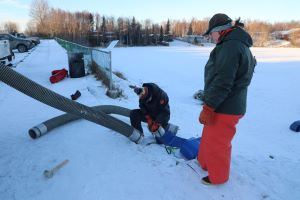
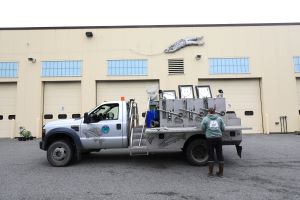
Once the fish have grown to appropriate size, specialized trucks equipped with oxygenated water tanks deliver them to the designated waterbody. A lot of the lakes in the Anchorage area are stocked with “catchable” sized fish, those 12-16 inches long, perfect to take home and fry for dinner! To stock fish through the ice, a stocking team prepares the tanks, adds hoses from the tanks out onto the ice, and drills a large hole with power augers. These openings must be large enough to fit the hoses into the ice to safely release the fish.
The fish are then released from the tanks through the hoses and into the water below the ice! The cold water temperatures ensure minimal stress on the fish, as their metabolism is naturally slower during winter. Additionally, ice cover provides a stable environment, shielding fish from predators and disturbances that are more common during open water seasons.
How can I know what lakes are stocked?
Fish and Game has a convenient page on its website so you can search the stocking database to find which locations have been stocked, with what species of fish, and when specific locations were stocked. There are multiple options for searching, check out the database here.
After looking through the stocking database you can also utilize the Alaska Lakes Database interactive mapper found here.
Here you can search for lakes in the state, see what has been stocked, learn about public access opportunities, and review bathymetric maps or depth contour maps of the lakes to better pick a place to drill your ice hole for fishing!
Fish on!
2025 Statewide Sport Fish Stocking Plan Open for Public Comment
The Alaska Department of Fish and Game—Division of Sport Fish (Division), is accepting public comment from now through January 31, 2025, on its 2025 Statewide Stocking Plan for Sport Fisheries.
The Division, with assistance from private nonprofit hatchery operators, plans to release approximately seven million fish annually into the waters of Alaska over the next five years to benefit anglers. The plan outlines the locations, numbers, and size or life stage for each species of fish that are planned for stocking.
Only fish reared from the Division’s hatchery facilities and from private nonprofit hatcheries that work in cooperation with ADF&G to improve sport fisheries are included in this plan.
The Statewide Stocking Plan is available for review on the Division’s webpage. Hard copies are also available for review at local ADF&G offices.
Please submit public comments to Marley Loomis by email marley.loomis@alaska.gov or by mail:
William Jack Hernandez Sport Fish Hatchery
c/o Marley Loomis
941 North Reeve Boulevard
Anchorage, Alaska, 99501
The public comment period is open until 5 p.m. on Friday, January 31, 2025.
New to ice fishing? Need gear?
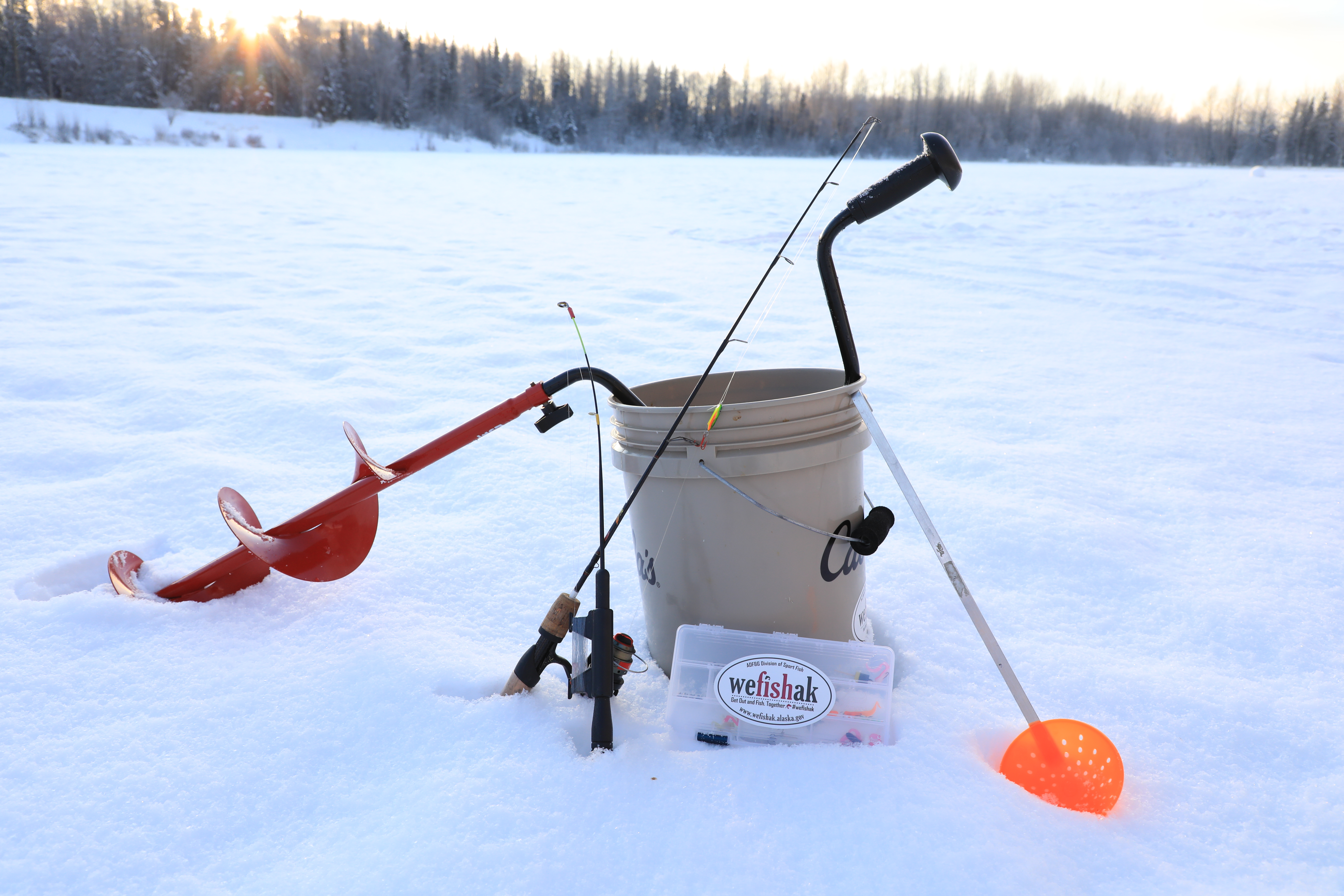
Many Alaska Department of Fish and Game offices have limited basic fishing equipment to loan anglers, free of charge! If you’re still trying to decide if you want to take the leap and buy your own fishing equipment, or have visiting family coming to town, we can help “set the hook” to becoming a lifetime angler by providing short-term loans of our fishing equipment. Depending on the time of year, anglers of any age can borrow spinning rods or ice fishing equipment. For more information, please visit our Rod Loaner Program web page.
Recipe of the month: Alaska Smoked Salmon Deckhand Pie
Enjoy this recipe for Alaska Smoked Salmon Deckhand Pie from the Alaska Seafood Marketing Institute.
Enjoy!
If you have any questions about the Reel Times newsletter, please contact Ryan Ragan at ryan.ragan@alaska.gov