

December 2024
Issue 84
Catch the Perfect Holiday Gift - A 2025 Sport Fishing License
This year is almost at a close. We hope you've had a great 2024 filled with many memories of fish and time spent on the water.
From all of us here at the Alaska Department of Fish and Game, we wish you happy holidays and great fishing.
Division of Sport Fish
Here's How to Hook Your Favorite Angler Up This Year
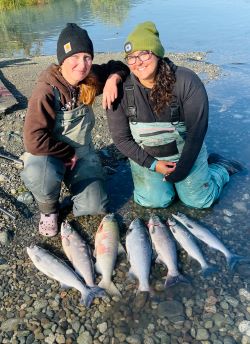
Still searching for a great gift idea for the holidays for your favorite angler? Go online and purchase them a 2025 sport fishing license. Purchasing a sport fishing license as a gift is easy and serves as the gift that truly keeps on giving.
As a reminder, 2024 sport fishing licenses will expire at the end of the day on December 31.
Interior Ice Anglers Learn New Skills at Tanana Lakes Ice Fishing Day
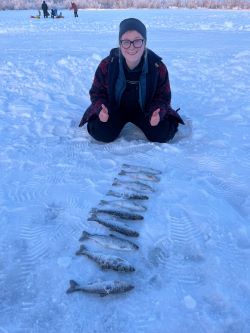
Caitlin Epstein may have been a rookie to fishing but she sounded like a pro on Saturday when she hooked a king salmon during ADF&G's Tanana Lakes Ice Fishing Day at Cushman Lake in Fairbanks.
"Fish on!" yelled Epstein, grabbing her line, just as she had been instructed, and pulling a shiny, flopping, 12-inch king salmon out of the hole in the ice she was fishing.
"I have never caught a fish before," a beaming Epstein said, her red cheeks glistening in the 5-degree cold. "This is very exciting."
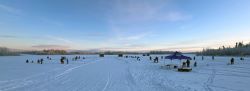
Epstein, 25, of Charlotte, N.C., was one of approximately 200 people who braved the chilly, single-digit temperatures on Saturday for ADF&G's annual Tanana Lakes Ice Fishing Day. She came to Fairbanks to see the northern lights and saw a flyer about the fishing event at the Morris Thompson Cultural & Visitors Center.
"It was perfect timing," she said. "I'm just here for a few days."
Epstein went online to buy a 1-day, nonresident fishing license the morning of the event and showed up eager for another Alaska experience. ADF&G education associate Erik Anderson greeted her, handed her an ice fishing rod, gave her a brief tutorial and directed her to one of approximately 100 holes he and other ADF&G staff had drilled in the ice that morning.
Within 15 minutes she pulled up a fish, at which point Anderson appeared on the scene.
"Are you keeping it?" Anderson asked.
"Sure, I'll keep it," Epstein responded.
Anderson showed her how to dispatch the fish by smacking it on the head with a pair of needle nose pliers.
"Do you want me to clean it, or do you want me to show you how and you give a shot?" Anderson asked, pulling out a knife.
"I was going to watch a YouTube video, but you can show me, and I'll try," Epstein said.
Anderson showed her where to slice the fish's belly open, how to remove the innards and blood line and then provided her with a plastic bag to put the fish in.
"Now you can go home and tell people you caught a king salmon in Alaska," Anderson told her.
Epstein beamed and posed for a few pictures with her fish before placing it in the bag.
"I saw the aurora last night, so this is a bonus," she said.
While Epstein was fishing by herself, Saturday's event attracted several families with small children bundled up against the cold. Like Epstein, some anglers were fishing for the first time and several others were fishing through the ice for the first time.
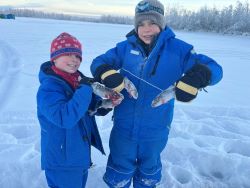
ADF&G provided ice fishing rods and bait for anglers in the form of salmon eggs, Powerbait and shrimp. First-time anglers were provided with instructions on how to bait and use the rods. ADF&G staff roamed the area helping anglers when they caught fish and providing them with plastic Ziploc bags if they wanted to take fish home with them.
The ADF&G Division of Sport Fish consistently hosts ice fishing events and clinics in the winter and spring when the temperature is warm, the sunlight comes back, and people are itching to get outside after a long, dark winter. The rub is that the ice can be 3-feet thick which makes for difficult drilling with the augers. Thankfully, since we're just a couple months into this winter, the drilling wasn't as bad. ADF&G staff members Rick Queen and Dave Stoller helped to drill approximately 100 holes early Saturday morning before the event.
"The ice was about 14 inches thick," Stoller said. "We drilled a lot of holes, but it went pretty quickly."
Cushman Lake – don't let the name Tanana Lakes Recreation Area fool you; the name of the lake that people fish in is Cushman Lake – is the perfect venue for an ice fishing event in Fairbanks, said Andy Gryska, ADF&G area management biologist for the Tanana River drainage.
The lake is located at the end of South Cushman and Lathrop Streets, only a few miles from downtown Fairbanks, so it's very accessible, he said. At almost 115 acres, it's plenty big to accommodate the event and it's stocked by ADF&G each summer and fall. ADF&G stocked more than 9,000 landlocked king salmon into the lake in mid-October, about six weeks prior to Saturday's event.
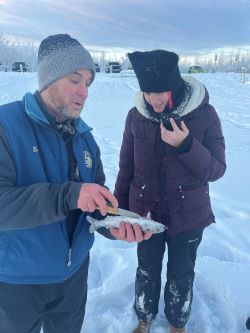
And those fish were very cooperative on Saturday. Most people caught at least one fish while some caught their limit of 10. Most of the fish caught were landlocked king salmon, with a few occasional rainbow trout being caught. All fish were caught right in front of the boat launch in the commonly fished area of the lake.
Not far from Epstein, brothers Walter and George Plocher, 9 and 13, respectively, were enjoying similar success. Each of the boys had two fish lying on the ice at their feet while they tried to hook another.
"My first catch was a monster; it bent my hook, but I let it go," Walter reported.
A third Plocher brother, Jack, also 13 and George's identical twin, was fishing nearby with family friend Eric Evans. Jack had caught seven fish, five of which he kept and two that he released. Eric had reeled in two fish.
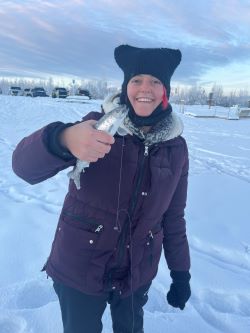
The fishing event at Cushman Lake was a perfect start to the day, said father Todd Plocher.
"A friend told us about it and we thought we would check it out," the elder Plocher said.
Jekeysha Phillips and husband, Darius Gaines, found out about the fishing event on Facebook. They brought 8-year-old son, Jaylen, and all three had caught multiple fish.
Jekeysha was sitting over an ice fishing hole in a folding camp chair, bundled up against the cold. She had already caught her daily limit of 10 fish but continued to catch and release fish, pulling one fish after another from the hole.
Each time she pulled a fish out of the hole, her husband would grab the line and release the fish, tossing it back in the hole.
"I get to fish every now and then," Gaines said with a grin, noting that he had caught four fish.
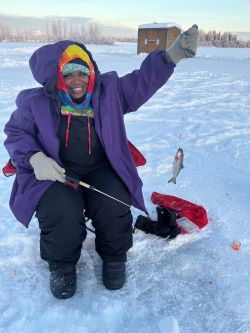
Orlando Pereyra showed up with his wife, Ruth Delacruz, and their two daughters, 3-year-old Olivia, and 1 1/2-year old Odil. The two girls shouted with glee when their father pulled up a flopping, 10-inch king salmon.
"I've never fished before," said Pereyra, who is stationed at Fort Wainwright in Fairbanks. "It's really fun."
ADF&G's Anderson, who organized the event, said that the event was a big hit.
"Just about everybody caught fish and we only lost one ice fishing rod down a hole, so I would qualify that as a success," said Anderson with a laugh. "We got to introduce a lot of people to ice fishing and that's what this is all about - getting people outside to go fishing."
How We Spawn Rainbow Trout
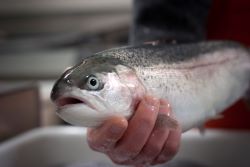
Staff at the William Jack Hernandez Sport Fish Hatchery in Anchorage recently conducted a rainbow trout egg take. For an in-depth look at what's involved in this process, check out this video on our YouTube channel.
Kenai Peninsula Angler Lands BIG Burbot on Interior River
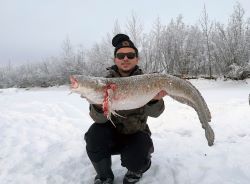
Living on the Kenai Peninsula, Tyrone McEnerney doesn't get the chance to do a lot of burbot fishing. Burbot aren't super common on the Peninsula, especially big burbot.
So when McEnerney found himself in Fairbanks in late November, he figured he might as well give Tanana River burbot fishing a try.
After arriving in town, McEnerney did some burbot fishing research on the Internet and contacted a couple of friends he knew who were experienced burbot fishermen to get some tips on where to go and to borrow an ice auger. After spending more than two hours hand drilling five fishing holes in the Tanana River, only two of which were fishable due to shallow water, McEnerney deployed two setlines, each with two Kodiak Kustom 4-inch glow tube jigs baited with whitefish.
Returning the next day to check his sets, McEnerney could feel he had a fish on the first set he checked.
"As soon as I pulled up the line I thought, 'Oh man.' I thought I had two medium-sized burbot on separate hooks and got excited for a double on my first do-it-yourself set," McEnerney said.
But instead of two medium-sized burbot, McEnerney had one gigantic burbot. "I saw a big, white belly turn and water moving and coming out of the hole," he said. "I thought, 'That's big fish action.'"
McEnerney carefully eased the fish out of the hole onto the ice and couldn't believe his eyes when he saw the massive size of the burbot.
"I was out there by myself screaming like a fool for like 15 minutes," he said.
The fish measured 40.25 inches and weighed in at 18 lbs., 6 oz. when McEnerney brought it to ADF&G to be weighed. That's twice as big as the 8-pound minimum to qualify as a trophy burbot for ADF&G's Trophy Fish Program and less than 7 pounds shy of the state record of 24 lbs., 12 oz. caught in Lake Louise in 1976.
"We don't get burbot like this down there," McEnerney said of living on the Kenai Peninsula. "This is such a stoke for me."
The Tanana River near Fairbanks is a popular sport burbot fishery and has a reputation for producing big fish, but you will be hard-pressed to find many burbot bigger than the one McEnerney pulled up, said Laura Gutierrez, a fisheries biologist with the ADF&G Division of Sport Fish in Fairbanks who studies burbot.
"There is probably at least one 20-pound fish caught every year, but generally this is about as big as they get in the Tanana River," Gutierrez said after looking at a photo of McEnerney's fish.
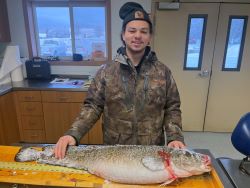
To prove her point, Gutierrez said during a telemetry study of Tanana River burbot conducted in 2018-19, biologists caught and measured more than 2,000 burbot and the longest fish they measured was 41.1 inches, just barely bigger than McEnerney's fish. Based on the size of McEnerney's fish, Gutierrez estimated it's probably around 15 years old.
The fish had at least five fish in its stomach when he cut it open, McEnerney said.
"There were so many bones in its stomach I don't fully know all species but there was one tail that was pretty forked, so it was probably either a whitefish or grayling," McEnerney said. "And it had four burbot in its stomach, one of which was 6 to 8 pounds."
McEnerney also caught an approximately 6-pound burbot on his other set and it too, had burbot in its stomach.
That shouldn't come as a surprise, said Andy Gryska, area management biologist for the Tanana River drainage. Burbot are known for their voracious appetites, he said. Just like bears, they are always searching for their next meal.
"They're predators," Gryska said. "They'll eat anything they can get their mouths on."
The fact that McEnerney caught his fish in the third week of November is probably not a coincidence, Gryska said, noting that whitefish had just finished spawning and whitefish are one of the burbot's favorite foods. "Fish are creatures of habit," he said. "Once they learn about a good feeding area, they remember it and will return to it year after year. When fish congregate for spawning, burbot are likely to be nearby."
That was evident in the telemetry study they did on burbot in the Tanana River, Gutierrez said.
"We found that burbot all over the Tanana River exhibited many different behaviors and migration strategies," she said. "That being said, there are many habitat types in the drainage and the most likely explanation, which was backed up by the migration behavior we observed through radiotelemetry, is that burbot are keyed into specific food sources and return year after year to take advantage of them."
Because burbot inhabit almost all stretches of the Tanana River, can be highly migratory and have voracious appetites, it is definitely worth taking some time in the winter to set lines for burbot, Gutierrez and Gryska said. All you need is an ice auger to drill through the ice, some line, a few hooks and sinkers and some tasty bait like whitefish or herring. While you may not catch a fish as big as McEnerney's, you stand a decent chance of pulling up a burbot or two.
"Burbot often spend most of their time lying on the bottom in slow-moving water and eddies," Gutierrez explained. "Two feet of water is deep enough catch large burbot, however you can catch burbot in fairly deep spots (16-20 ft or greater) too as long as the water is slow moving."
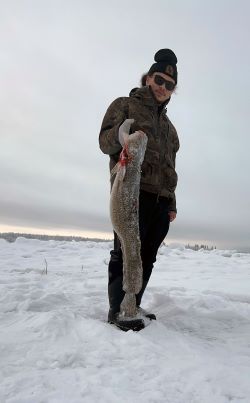
Finding the right burbot fishing spot can require a lot of trial and error and learning about the specific area where you are fishing, Gutierrez said. On the Tanana River, for example, a spot that was great one year may be completely different the following year because the river has changed and what was last year a mellow, slow-moving spot now has fast current, she said. In general, if you drill a hole and hit fast-moving water, slush, or free flowing ice, it's best not to set there and look for a different spot.
"Chances of catching a burbot in those holes are low as burbot are rarely caught in fast moving water and the ice is rough on their gills," Gutierrez said.
When she's looking for spots on a river to place setlines, Gutierrez said she looks for spots that are at least four feet deep.
"I'll do this by scanning the riverbank and making an educated guess if the drop off is steep or gradual based on the topography next to the river," she said. "Often I guess wrong, but after the first hole than you know, 'Oh, I just hit dirt, darn!, better go out further, or wow, this hole is at least 16 feet deep and ripping fast, I better move in.'"
"If I know of an area where an eddy exists in the summer, I try to set more towards the top end or bottom end of that eddy," Gutierrez added. "I've had better luck with that than right in the middle of an eddy. Bottom ends of islands or places where a slough/creek/or channel are coming in can also be good areas to put sets out."
In lakes, Gutierrez said, "Just like looking for good places to jig when fishing in the summer or in the winter, places such as points jutting out in the lake or near the shore in the middle of a bay can also be good places to put setlines."
ADF&G staff in Fairbanks produced a video titled "How to Set Line for Burbot" that can be viewed here. It shows you everything you need to know to make set lines through the ice for burbot. There is another video on the same site titled "How to Clean a Burbot," that demonstrates a nifty technique for collecting the belly meat, which is ideal for burbot tacos.
For more information about the ADF&G Trophy Fish Program, go here.
Southeast Alaska Shrimpers Reminded to Submit Harvest Reports

Sport anglers who participated in shrimp fishing in Southeast Alaska are reminded that completed harvest reports and permits must be submitted by January 15, 2025. Anglers who have concluded their shrimping activities for the year are strongly encouraged to submit their reports as soon as possible. This reporting requirement is mandatory even if you did not fish your permit.
There are multiple convenient methods available to fulfill the reporting requirement for the 2024 Southeast Alaska Sport Shrimp Permit, as outlined below.
To finalize your permit, please do one of the following:
- Report Online (https://harvest.adfg.alaska.gov/)
- Call Carly Lemieux at (907) 465-4270 to report your 2024 harvest
- Mail your 2024 permit/harvest report to Carly Lemieux at:
Southeast Sport Shrimp Permits
P.O. Box 110024
Juneau, AK 99811-0024
Permit History
Effective June 25, 2018, the Board of Fisheries requires a shrimp permit for sport users wishing to harvest shrimp in Southeast Alaska. This permitting requirement was part of a shellfish proposal to address concerns of depressed shrimp populations throughout Southeast Alaska. Permits are free and available at the ADF&G Online Store, the ADF&G Mobile App, or your local Fish & Game office.
The purpose of this permit is to estimate effort in the number of pots and harvest of whole shrimp in the Southeast Alaska sport shrimp fishery. Permit holders have the option to report harvest in either quarts or pounds, as well as in tailed or whole shrimp.
The Alaska Department of Fish and Game has the responsibility to sustainably manage the shrimp resource in Southeast Alaska. The permit and reporting requirement to participate in the sport shrimp fishery allows ADF&G managers to estimate the total harvest and harvest by district in the Southeast region. Through collecting this data over multiple years, trends in effort, harvest, and harvest per unit of effort (HPUE) can be monitored. These results, along with commercial, subsistence, and personal use harvest estimates will be used by managers to estimate total removals of the shrimp resource and help ensure that harvest does not exceed the harvestable surplus to ensure the sustainability of the shrimp resource.
Permit holders are encouraged to use the ADF&G online harvest reporting system which allows the user to enter each day’s fishing through an easy-to-use web interface. The permit holder has the option of entering this information periodically throughout the fishing season or waiting until all fishing has been completed to enter everything. The permit holder also has the option of hand-delivering the completed harvest reporting form to an ADF&G office or mailing it to the address printed on the permit. The department would like to thank those permit holders who have already completed their reporting requirements and would like to encourage those that have not reported to do so as soon as they can.
For further questions regarding the Southeast Alaska Sport Shrimp Permit please call the Region 1 Division of Sport Fish Office in Douglas at (907) 465-4270.
Recipe of the month: Alaska Salmon Osso Buco by Chef Adam Hegsted

Enjoy this recipe for Alaska Salmon Osso Buco by Chef Adam Hegsted from the Alaska Seafood Marketing Institute.
Enjoy!
If you have any questions about the Reel Times newsletter, please contact Ryan Ragan at ryan.ragan@alaska.gov