

December 2022
Issue 60

A gift that keeps on giving all year long
This year is coming to an end. And we hope it’s been a good year for all of you, filled with lasting memories of adventures, fish, and great times together.
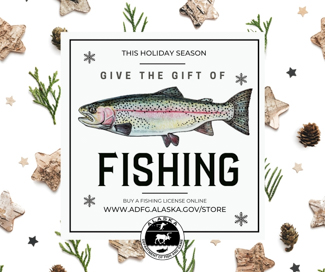
As we enter the holiday season, we want to encourage you to consider purchasing a sport fishing license and king salmon stamp as a gift for someone. The process is easy and can be done through our online store.
 Are you following us on social media? If not, be sure to check us out on Instagram @wefishak. You can also follow us on Facebook at ADF&G - wefishak . Also, visit our YouTube channel for a growing selection of “how-to” videos and much more.
If you have a comment or story ideas for Reel Times, we encourage you to send them our way. You can send comments to ryan.ragan@alaska.gov.
From all of us here at the Alaska Department of Fish and Game, we wish you happy holidays and great fishing.
Ryan Ragan
Department of Fish and Game Employees Top 10 Recommended Fishing Gifts for the Angler in your life!
The snow is falling, lakes are freezing up and the holiday season is upon us! Many Alaskans favorite past time is fishing. If you aren’t sure what gift to get your favorite angler this year, look no further! The Alaska Department of Fish and Game (ADF&G) Sport Fish staff from around the state have put together their top ten fishing gifts, complete with reviews and recommendations. The items range from simple stocking stuffers to a larger items Santa would be very proud of!
1. Fillet Knife
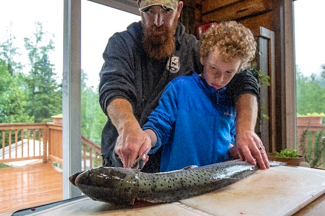 Wilson Puryear from the Anchorage Sport Fish Information Desk suggests this timeless piece of fishing equipment, “Though not often venerated to the same degree as a hunting knife, a good fillet knife is a crucial and hard-working piece of an outdoorsman’s tool kit. A well-constructed fillet knife has a long, sturdy, yet flexible blade, and will allow the angler in your life to process their catch into some of the finest table fare available and reflect on great days spent on the water as they sit down for mealtimes throughout the year.” Check out our how-to video on filleting salmon for those trying out their new fillet knives this salmon season!
2. Dry/Waterproof Backpack
During harsh conditions on the water, keeping your gear dry is essential! Fisheries Biologist, Brittany Blain from the Anchorage office suggests a waterproof backpack for any angler. “You can stash and keep everything dry, from fishing gear, extra layers of clothes, to your most important item-- snacks!”
3. Vacuum Sealer
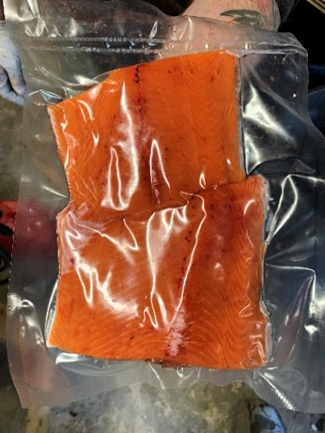 Know of someone on your gift list who loves to eat fish? What about saving their bounty for the winter months? Shane Hertzog a Sport Fish Information Officer highly recommends getting a vacuum sealer to improve preservation. “After spending countless hours and a lot of effort obtaining Alaska’s fish and game, I want the food I harvested to be in perfect condition when it comes time to feed my friends and family. I accomplish this by using my vacuum sealer to preserve and prolong my highly coveted catch. This is the gift that keeps on giving!”
4. Fleece pants, with stirrups!
Jason Dye, Fish and Game Regional Coordinator out of Anchorage, suggests getting your favorite angler a pair of fleece pants, specifically with stirrups that attach around your feet. A pair that is not too thick can be used during the summer for extra warmth into the winter months. Getting into your waders will be a breeze with the stirrups to keep your pant legs from riding up! The perfecting clothing essential for those in an out of waders all year long.
5. Mouth spreader/Hook Removal Tool for Pike Fishing
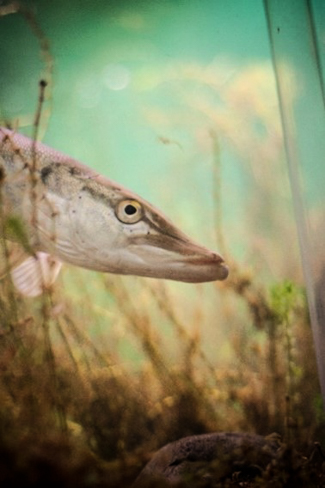 Have someone on your list who loves fishing for northern pike? Sam Ivey, Area Managing Biologist for the Mat-Su suggest a few tools of the trade. “Lately I’ve had northern pike on the brain. A mouth spreader and an assortment of pliers is a must. I get that sullen depressed stomach feeling if I forget these tools when I’m fishing for pike, so I like to have multiple spreaders and pliers stashed in various places (even the tackle box), so I can always find at least one pair.” Interested in more information on northern pike in Alaska? Check out the species profile
6. Boat Electronics
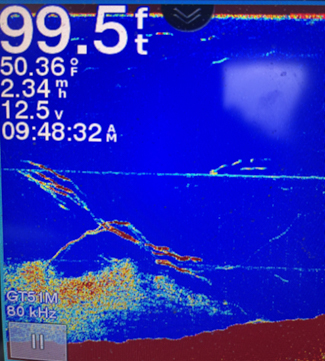 Does your favorite angler own a boat? Take advantage of the all the great advances in technology. Holly and Mike, two biologists from the Lower Cook Inlet ADF&G office suggest getting ready for open water season with an upgrade to boat electronics, saying “the technology for fish finders and chart plotters have really improved substantially in recent years. Below is a photo of fish finder with coho salmon and a school of baitfish which resulted in more salmon in the boat!”
7. Down/Insulated Jacket
Even in the summer Sam Oslund, a Fisheries Biologist from the Palmer ADF&G office suggests a down/insulated jacket for fishing! Nothing beats a good jacket that can be versatile enough for fishing cool summer evenings, all the way to cold winter days on the ice! Sam also suggests some items for moral boosters when it’s cold, including a portable, waterproof speaker and a thermos so you can have hot soup out on the water!
8. Polarized Sunglasses
Donnie Arthur, a Fisheries Biologist out of the Anchorage office, who spends lots of time on the water suggests a tried a true gift of sunglasses, specifically polarized. He says, “Polarized fishing sunglasses are an excellent gift for any angler in the family. These will help increase fishing performance by reducing glare on the water and allowing the angler to spot fish. The added benefit is that they will protect your eyes from hooks and sinkers!" Don’t forget a sunglasses lanyard to keep your friend from losing their new polarized glasses to the river!
9. Fleece Lined Duck Bill Cap
Jenny Gates, a fisheries biologist from the Kenai Peninsula suggests a good fishing hat is every angler’s best friend, specially a fleeced lined one! Jenny says a good hat, “Keeps the sun and snow out of the eyes and keeps the ears and head warm. I wear these all the time when fishing, recreating and cross-country skiing. I get cold easily, so this is my go-to. Some versions even have an opening for a ponytail for those with longer hair.”
10. Last, but most important—a 2023 Sport Fishing/Hunting License!
All the gifts listed above are fantastic, but you must possess a valid sport fishing license to get out and enjoy the water. Licenses are good for the calendar year, so this is perfect time to buy for you or as a gift! Fishing/Hunting Licenses can be purchased easily online. Be sure to choose a 2023 license! Goodluck fishing and happy holidays from Fish and Game!
Delta River Float and Fish
By Andy Gryska
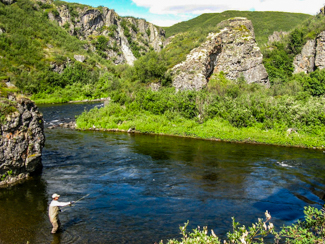 In the dead of winter, one picture of a summer fishing trip can be jolting. It is hard to believe the difference in the landscape within 6 months. Daydreams (is there a day in January?) begin and it’s easy to start thinking about a float and fish trip for the upcoming summer. With so many options to consider, it can be difficult to nail one down, especially if you are limited for time. Only have 3 or 4 days for a long weekend? Then, maybe the upper Delta River is the perfect option.
The Delta River begins at the outlet of Lower Tangle Lake in the Alaska Range about 70 miles south of Delta Junction, Alaska. A large portion of the river and drainage have been designated a wild and scenic river by the US Bureau of Land Management (BLM); specifically, the Tangle Lakes portion of the drainage is classified as scenic, the Delta River from Lower Tangle Lake to mile 212 Richardson Highway is classified as wild, and the remaining portion through Black Rapids is classified as recreational. This float and fish trip begins at BLM’s Tangle Lakes Campground on Round Tangle Lake and ends just downstream of Phalen Creek mouth at an unimproved takeout at approximately mile 212 of the Richardson Highway. The float trip is about 28 miles long and has one portage around a set of waterfalls. The portage is only about a half mile, but it uniquely has small pond about halfway that requires 200 yards of paddling as well. The put-in and take-out are 48 road miles apart, so it is essential to use 2 vehicles and leave one at the take-out to ensure your transportation. Ambitious paddlers could complete this trip during a long day under the midnight sun, but why? We are here to fish; plan on 3 or 4 days for maximizing enjoyment.
There is no greater way to learn how to ice fish in a new location then to go with someone who is experienced with the area and the gear. There are also some restrictions from area to area for example the Nancy Lake state recreation area and the Susitna Flats State Game Refuge. These areas measure the snow depth and ice, in order, to protect the habitat. Check on these areas prior to accessing. For safety you should familiarize yourself with an ice thickness diagram that shows adequate thickness of ice for various items. Always wear adequate gear to stay safe on the ice.
The Tangle Lakes and the upper Delta River are known for their Arctic grayling Thymallus arcticus and lake trout Salvelinus namaycush (primarily in the Tangle Lakes), but burbot Lota lota and round whitefish Prosopium cylindraceum are also caught to a lesser degree. Other species in the drainage include longnose sucker Catostomus catostomus, Dolly Varden Salvelinus malma, and slimy sculpin Cottus cognatus. Although Arctic grayling are found throughout the Tangle Lakes, it is best to focus on lake trout in the lakes and Arctic grayling in the Delta River where they are incredibly numerous and lake trout are not present.
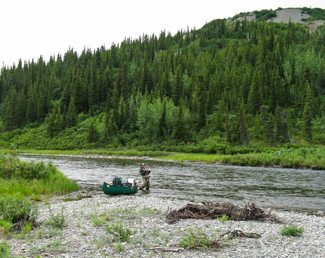 The float trip begins at Round Tangle Lake which requires paddling to traverse to the north end of the lake before current assists you intermittently through Long Tangle Lake, which has a series of wide and narrow reaches. A short stretch of flowing water connects Long Tangle Lake with Lower Tangle Lake where paddling is required again, but it is a worthwhile destination to set up the first night’s camp in one of the bays particularly if you have been fighting a headwind. The bays can provide some shelter from the wind in the nearly treeless mountain tundra while the mountains provide a scenic background while camping and fishing. Casting from shore works well for the first couple of weeks after breakup. Lake trout will head to cooler, deeper waters as the lake warms during summer, and anglers may be more successful jigging and trolling in deeper offshore water. The next day, a much shorter distance of about 2.5 miles is traveled to the Delta River below the waterfalls, and depending on your inclination, you can remain at the lake for a while fishing for lake trout or proceed to the double portage. As you approach the falls, a sign will indicate the trail head for the portage on the right (east) side. The portage is just a few hundred yards long before you must repack gear to paddle down a long narrow pond to the second portage. The second portage is quite short, but it is steep and treacherous to the base of the falls. The put-in is an ideal little back eddy cove where you can repack your canoe for floating to downstream camping spots or hang out and fish for a bit. From this cove, you cannot see around the corner down the river which has a short boulder field that can be difficult to navigate. The best strategy is to paddle to the other side of the river before heading downstream so that you can navigate more easily and there are fewer hazards. Always wear your personal floatation device (life jacket) and secure your gear in you canoe just in case in a rare instance you flip you canoe.
The Delta River is a clear stream rarely prone to high muddy water due to the buffering of the large Tangle Lakes system so you can count on great fishing for grayling for 10 miles between the waterfalls and the mouth of the Eureka Creek tributary which is the first of several glacial tributaries to render the Delta River glacially turbid for the remainder of its course to the Tanana River. The only problem with fishing for a while anywhere the next 10 miles of river is that the grayling are so numerous that you may remain in one place too long and leave yourself little time to find and set up nice camp for the night. The population of Arctic grayling in this stretch of river was estimated to be just over 23,000 grayling larger than 12 inches. So, after you have a caught a few at the put-in, it may be time to move down river closer to camp spots. There are no designated camp spots, but there are existing campsites that apparent as you float by. Pick one you like, and keep you impacts to the area minimal (please see Delta Wild and Scenic River information provided by the USBLM for information on best camping and floating practices for this popular area). Although numerous recreational floaters and anglers enjoy this trip, the level of harvest is low relative to abundance of grayling in the river, and accordingly the regulations for Arctic grayling in the Delta River drainage are liberal. The regulations are a daily bag and possession limit of 5 Arctic grayling of any size year-round. Take advantage of the situation and enjoy a meal of grayling while camping along the banks of this beautiful river.
Now for the final stage of the float. Depending on where you chose to camp, you may still have plenty of fishing to enjoy on your way downriver until Eureka Creek. Eureka Creek is a glacial tributary that clouds the clear Delta River for the remainder of the trip which effectively ends fishing for sight feeding Arctic grayling. This portion of the float has a bit steeper gradient and consequently it is slightly more swift. The float quickly winds by interesting scenery and rock formations including a coal seam exposed on a small cliff face. The river also becomes more braided as you proceed downstream but sticking to the larger channels easily floats you to the take-out. Two streams with large alluvial fans meet at the take-out which contains the delta river to a single channel. The float is complete and all that remains is a return trip to Tangle Lakes to grab your other vehicle at the put-in.
Southeast Alaska 2022 Sport Shrimp Permit and Reporting Reminder
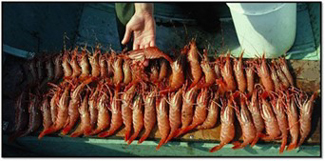 Sport shrimp anglers in Southeast Alaska are reminded to return their permits by reporting harvest as soon as they are done fishing. This is required even if the permit was not fished. The sport shrimp permit is good for the calendar year and reports are due by January 15, 2023. That said, most of the sport shrimp anglers have completed their fishing trips for the year and are encouraged to report as soon as they can. There are several ways to complete the reporting requirement for the 2022 Southeast Alaska Sport Shrimp Permit.
To finalize your permit, please do one of the following
- Quickly Report Online
- Mail your 2022 permit and harvest report to John Driscoll at: P.O. Box 110024, Juneau, AK 99811-0024
- Call John Driscoll at (907) 465-4270 to report your 2022 harvest over the phone
Permit History and Importance
Effective June 25, 2018, the Board of Fisheries requires a shrimp permit for sport users wishing to harvest shrimp in Southeast Alaska. This permitting requirement was part of a shellfish proposal to address concerns of depressed shrimp populations throughout Southeast Alaska. Permits are free and available online at the ADF&G Store or at the Alaska Department of Fish and Game (ADF&G) offices in Douglas, Yakutat, Haines, Sitka, Petersburg, Wrangell, Ketchikan, and Craig (Prince of Wales Island).
The purpose of this permit is to estimate effort in pot days and harvest of whole shrimp biomass in the Southeast Alaska sport shrimp fishery. Permit holders have the option to report harvest in either quarts or pounds, as well as in tailed or whole weight.
The Alaska Department of Fish and Game has the responsibility to sustainably manage the shrimp resource in Southeast Alaska. The permit and reporting requirement to participate in the sport shrimp fishery allows fisheries managers to estimate the total harvest and harvest by district in the Southeast region. Through collecting this data over multiple years, trends in effort, harvest, and harvest per unit effort (HPUE) can be monitored. These results, along with commercial, subsistence, and personal use harvest estimates will be used by managers to estimate total removals of the shrimp resource and help ensure that harvest does not exceed the harvestable surplus to ensure the sustainability of the shrimp resource.
Permit holders are encouraged to use the ADF&G online harvest reporting system which allows the user to enter each day’s fishing through an easy-to-use web interface. The permit holder has the option of entering this information periodically throughout the fishing season or waiting until all fishing has been completed to enter everything. The permit holder also has the option of hand-delivering the completed harvest reporting form to an ADF&G office or mailing to the address printed on the permit. The department would like to thank those permit holders who have already completed their reporting requirements and would like to encourage those that have not reported to do so as soon as they can.
For further questions regarding the Southeast Alaska Sport Shrimp Permit please call the Region 1 Division of Sport Fish Office in Douglas at (907) 465-4270.
Time to tie a few flies
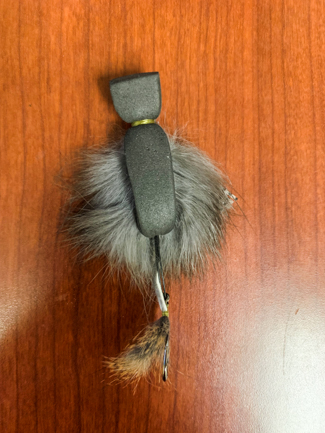 Looking for a way to pass some time during the winter? Why not head to the bench and tie a few flies? We have several fly-tying videos on our YouTube channel.
If you’re looking for a great hand-made gift for someone, be sure to check out our video demonstrating how to make earrings out of fly tying material.
Field to Plate - Recipe of the Month
Recipe of the Month – Charred Alaska Halibut Tacos with Cilantro Pesto
 Here’s a delicious recipe for Charred Alaska Halibut Tacos with Cilantro Pesto from the Alaska Seafood Marketing Institute.
Enjoy!
If you have any questions about the Reel Times newsletter, please contact Ryan Ragan at ryan.ragan@alaska.gov