

Reel Times Newsletter
June 2021
Issue 42
gofishak – Web application helps you find your next fishing spot
 If you know anything about fishing in Alaska, you know it’s a huge state with endless fishing opportunities. So how do you find your next favorite fishing spot? Check out the gofishak web application. This interactive mapper provides detailed information on multiple fishing locations. Find out more below.
If you’re planning to get out and go fishing, you don’t need to go to an ADF&G office or license selling vendor to get your fishing license or personal use permits. You can get what you need online.
In this issue of Reel Times, we will share some online resources to get you out the door and onto the water. You can purchase licenses and stamps in our online store.
Are you following us on social media? If not, be sure to check us out on Instagram @wefishak. You can also follow us on Facebook at ADF&G - wefishak. We also have a YouTube channel where there is a growing collection of fishing-related videos.
If you have a comment or story ideas for Reel Times, we encourage you to send them our way. You can send comments to ryan.ragan@alaska.gov.
We’ll see you on the water.
Division of Sport Fish
Alaska Department of Fish and Game
Check Out Statewide Fishing Spots
 The Southeast Alaska gofishak interactive maps have been expanded to a single statewide gofishak application, showcasing sport fishing and access opportunities across Alaska! If you’re like most anglers who are searching for a new spot to fish, you want to know before you go. You want to know about species present, tackle suggestions, access, amenities, parking, boat launches, run-timing, etc. The gofishak application is designed to provide anglers with all the information they need for each specific fishing spot and allow anglers to only view the information relevant to them. This application maps lakes, streams, rivers, marine and stocked waters offering prime sport fishing opportunities with in-depth information on sport fishing access trails, harbors, or boat launches. Customize the basemap to see data in the context of imagery, roads, topography and more. In addition to the mapped perspective, images of each location are included to get that 1st person perspective.
The gofishak application now hosts information on 338 fishing spots, 53 sport fishing access trails, 201 boat launches, and 55 harbors across the state, which can be explored via an interactive map. The Division of Sport Fish will continue to add locations as the application further develops.
We encourage you to access the interactive map and see if you can find new fishing locations for you and your friends and family to enjoy. We also encourage you to contact us with your comments on how to improve the application. As always, we are available to answer questions you may have related to this application or to sport fishing in the great state of Alaska. Be sure to bookmark the site and re-visit the gofishak application frequently. You may find your new secret fishing spot.
The sockeye are in!
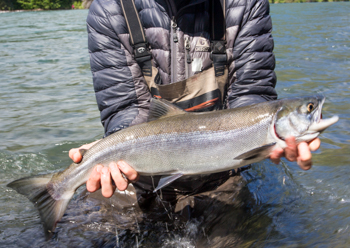 June is a great month to get out and target sockeye. Sockeye, also known as “Red” salmon are fun to fish for and are prized by many anglers for their excellent table fare. There are many rivers in Alaska that offer exceptional sockeye fishing opportunities.
Here are a few resources to help you bring more of this tasty fish to the grill.
- How to fish for Klutina River Red Salmon
- Sockeye Salmon Fishing 101
- How to Tie a Shrimp Fly for Sockeye
- Sockeye Salmon Species Profile
Good luck!
Prince William Sound: Are my shrimp pots legal?
By: Brittany Blain-Roth
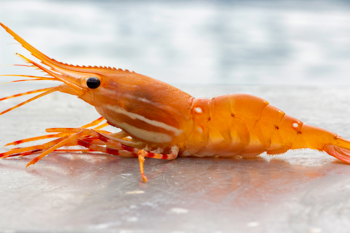 Regulations can be confusing. There, I said it! It’s one thing if it’s your hook size or whether or not you can use bait but, it’s a whole other world when it comes to pot gear used to catch shrimp. The gear requirements can vary in different areas or by the fishery type (i.e. – noncommercial versus commercial) so make sure you always look closely at your permit (check for Emergency Orders) AND have the correct permit for where you intend to shrimp. In this article I am going to touch on just a few of the common question’s regarding regulations associated with legal shrimp pot gear for the Prince William Sound NonCommercial (sport and subsistence) shrimp pot fishery.
Keep in mind, you can make your own shrimp pots, or you can pick up shrimp pots from local vendors; however, you can’t always assume store-bought gear meets the gear requirements for the area you are going to be shrimping. I recently looked at some shrimp pots to determine if they met the legal requirements and the first thing I noticed was that straight out of the shop, it was missing one of the most important parts…the escape mechanism.
The Escape Mechanism
 The last thing you want to do is cut up your new shrimp pot, but the escape mechanism is extremely important in case you lose your pots (and trust me, at some point this happens to the best shrimpers!) and it’s also a regulatory requirement. In Prince William Sound if you are fishing with a round pot also termed “a pot with no definable sides”, your pot must have an opening that is at least 6 inches long, parallel to the bottom of the pot, and be within 6 inches of the bottom of the pot. Once you have this opening you can sew it closed with 100% untreated cotton twine, no larger than 30-thread count.
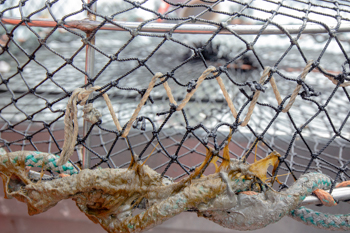 At each end of where you thread the twine through you may only tie one single knot to the net mesh on the pot. You can’t tie it to any metal bars, only the mesh. Remember, the twine won’t last the whole season in the water so be sure to check before you set your pots to makes sure it hasn’t degraded and left a big hole for shrimp to escape. The goal is for there to be a big hole but ONLY if you lose your gear, not while you are actively using your gear.
It's a little different on rigid mesh pots. These are typically your square pots with the hard plastic versus the net mesh. On these pots you must have a 4-inch by 4-inch square cut that can fall off if you lose your gear. Similar to the net mesh pot requirements, it must be within 6 inches of the bottom of the pot. For the 4x4 square you can tie 4 single looped knots to hold it on.
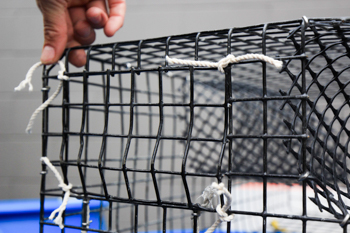
So that’s it for the escape mechanism! Pretty simple right? Just remember:
- Six inches from the bottom of your pot and parallel to the bottom of the pot
- No definable sides/round pots needs to be six inches long with a single knots at each end.
- Rigid mesh pot needs a 4x4-inch square with 4 single knots.
Mesh size
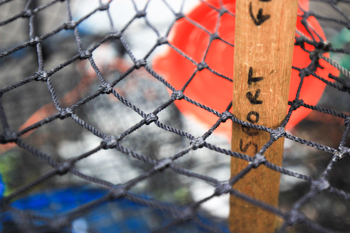 The net mesh size is the next thing you want to remember to check on your pot. On the rigid mesh, typically square pots, you must have two vertical sides of all the shrimp pot made of webbing big enough to allow a 7/8” dowl to go through, unrestricted. These two vertical sides must be touching. The other two vertical sides and, the top and bottom of the pot can be made of any material. For round pots, 50% of the vertical sides must be made of a mesh size that a 7/8” dowl can fit through.
A good rule of thumb, regardless of pot type, is that half of the vertical sides of your pot needs to have mesh large enough for the 7/8” dowl to go through. Most store-bought pots come with all sides, including the top and bottom, the same size. If it’s all made of 7/8” mesh size then you totally have yourself covered under the regulations regarding mesh size!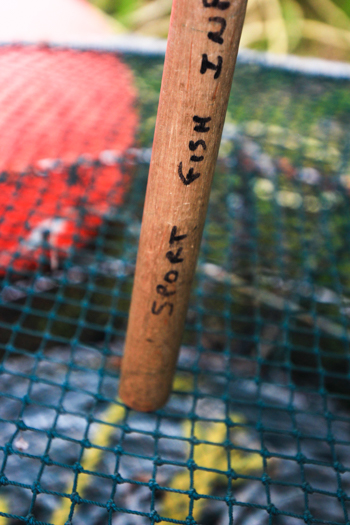
Why 7/8-inch mesh? Good question! This mesh size is used so that undersized and juvenile shrimp are allowed to escape from the pot and not be harvested. This helps to maintain a healthy, productive shrimp population by not harvesting the small shrimp.
So here’s your quick checklist to go through when participating in the Prince William Sound Noncommercial (sport and subsistence) shrimp pot fishery:
- Do I have the right permit?
- Do I have an escapement mechanism opening that is correct for my pot type?
- Is my escapement mechanism tied on right? Single knots!
- Is the mesh on my pots the right size?
- Don’t forget to properly label your buoy!
Please check the back of your permit or the 2021 Southcentral Sport Fishing Regulations Summary booklet if you want more details on pot specifications. If you ever want your shrimp pots checked feel free to email us a photo to check it out or, contact Alaska Wildlife Troopers.
Also, do not forget when participating in this fishery, you must report your harvest online when you wrap up shrimping for the season. Your harvest report is due by October 15, 2021!
Questions?
Contact Prince William Sound, Division of Sport Fish Area Manager Jay Baumer (907) 267-2265 or Assistant Area Manager Brittany Blain-Roth (907) 267-2186
All of your permits in one place
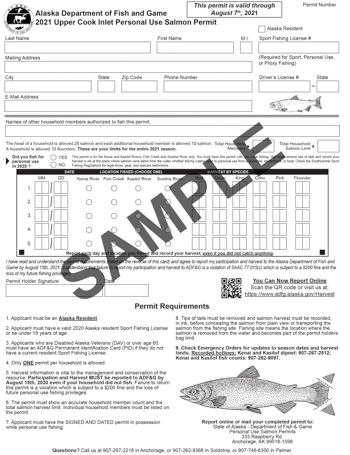 Participation in some sport, personal use or subsistence fisheries requires a permit. There are a number of such permits available for fisheries across the state.
Southcentral:
The Southcentral region hosts some of the most popular personal use fisheries in the state. The most popular personal use fishery in Southcentral is the Upper Cook Inlet personal use salmon fishery. This permit allows residents of Alaska to participate in PU fisheries on the Kenai River, Kasliof River, Fish Creek and the Susitna River.
Information about the Prince William Sound shrimp fishery and PWS shrimp permits can be found online.
Interior:
The popular Chitina personal use and subsistence fishery occurs in the Interior region. In addition to this fishery, there are other permits available to anglers.
Southeast:
You’ll find sport, personal use and subsistence fisheries in Southeast Alaska that cover fish and shellfish. More information on available permits in this expansive and remote area.
Alaska residents who are 60 years of age or older – apply for your PID online!
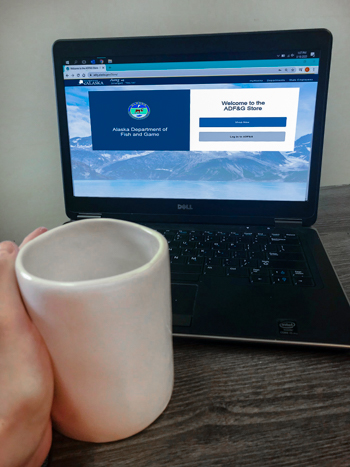 Are you a resident of Alaska who is 60 years of age or older? You can apply for an Alaska Department of Fish & Game Senior Resident Permanent Identification Card (PID). The PID is a free sport fishing, hunting, and trapping license. The best news is you can apply for a PID from the comfort of your own home. Apply today
In order to be eligible, you must be an Alaskan resident 60 years of age or older and meet the Department of Fish and Game’s residency definition. If you received the most recent Permanent Fund Dividend, you should be able to print your PID right away. If you did not receive the most recent PFD and are an Alaska resident, you can still apply for your PID but additional documentation establishing your residency is required. Also, if at any time a senior resident card holder is no longer a resident of the State of Alaska, their card is immediately void.
The following situations disqualify applicants from receiving the senior resident card; there may be others:
- Having a resident hunting/fishing license in another state.
- Being registered to vote in another state.
- Receiving a tax break on property tax in another state (homestead exemption).
- Receiving benefits under a claim of residency in another state, territory, or country.
Please note that PID holders planning to participate in sport fisheries that have annual harvest limits must obtain and carry on them a free Sport Fishing Harvest Record Card in order to record their harvest of those fish.
If you are having issues applying online or questions about residency requirements, please give the ADF&G Licensing office a call at (907) 465-2376.
Are you an Alaskan resident and military veteran who is at least 50% disabled – you can apply online for the DAV license
The State of Alaska honors our resident disabled veterans (DV) by providing a complimentary hunting and fishing license/card to those who meet the Department of Fish and Game’s residency definition and who are certified 50% disabled or greater.
Apply through the Online store
If at any time a DV license holder is no longer a resident of the State of Alaska, their DV license is immediately void.
The following are common situations that disqualify applicants from receiving the DV License:
- Having a resident hunting/fishing license in another state.
- Being registered to vote in another state.
- Receiving a tax break on property tax in another state (homestead exemption).
- Receiving benefits under a claim of residency in another state, territory, or country.
Instructions: Apply online. You also need to provide your letter of disability certification by email, fax (907) 465-2440, or mail to Alaska Department of Fish and Game, Licensing Section, P.O. Box 115525, Juneau, Alaska, 99811-5525.
Please note that PID holders planning to participate in sport fisheries that have annual harvest limits must obtain and carry on them a free Sport Fishing Harvest Record Card in order to record their harvest of those fish.
Please see the Department of Fish and Game’s residency definition to determine eligibility. This privilege provided under AS 16.05.341.
Field to Plate - Recipe of the month
Recipe of the month: Grilled Alaska Sockeye Salmon with Compound Butter
 Try this delicious recipe for Grilled Alaska Sockeye Salmon with Compound Butter from our friends at the Alaska Seafood Marketing Institute.
Enjoy!
If you have any questions about the Reel Times newsletter, please contact Ryan Ragan at ryan.ragan@alaska.gov