
Violet-green Swallow
(Tachycineta thalassina)
Species Profile


Did You Know?
Where other swallow species have adapted to human development by using our infrastructure (bridges, culverts, nest boxes, pipes) to nest in, Violet-green Swallows still rely mostly on natural nesting sites. They have been known to occupy nest boxes, though not as readily as Tree Swallows do.
General Description
Gregarious songbirds, Violet-green Swallows are often seen foraging and migrating with other swallows and swifts and are known to nest in small colonies. Despite their large distribution across most of western North America, Violet-green Swallows are the least studied swallow species in the country. They live in relatively inaccessible sites, making their study difficult.
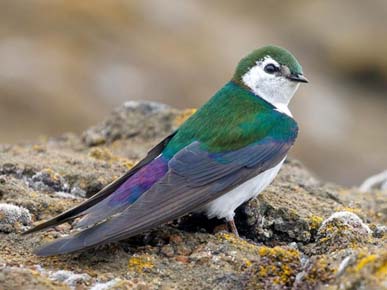
Similar ecologically and visually, Violet-green and Tree Swallows are easy to confuse in flight and in bad light. To tell them apart, look for the Violet-greens’ white “saddlebags” that wrap around its violet rump and the white curling around their eyes. When the sun is shining, mature birds are vibrantly different in color; Tree swallows showcase bright blue backs, while Violet-green Swallows’ backs shine green with purple rumps.
The family Hirundinidae (swallows) consists of small- to medium-sized passerine songbirds who are aerial insectivores. Swallows are often seen swooping and turning suddenly in the air on their long, pointed wings, foraging for insects in open meadows and above water. There are more than 90 species of swallow, but only five species are commonly found in Alaska: Violet-green Swallows, Tree, Bank, Cliff, and Barn Swallows. Each species’ location seems to reflect their nesting requirements more than food availability or other factors. Among Violet-green Swallows, there are three recognized subspecies, Tachycineta thalassina lepida, T. t. brachyptera, and T. t. thalassina, with the latter two principally breeding in Mexico.
Life History
Mating, gestation, birth, maturity
Violet-green Swallows appear to be monogamous, with the male defending his mate actively and the female accepting, and sometimes soliciting, extra-pair copulations. Both birds in a pair participate in selecting a nest site, but it’s believed the female ultimately decides the location and does most of the nest construction. Violet-green Swallow nests have been observed in natural cavities in trees, cliffs and banks, and sometimes in nest boxes, and often successively return to the same breeding site year after year.
The females lay four to six eggs, beginning the generally 14-15 days-long incubation period once the final egg has been laid. Upon hatching, as altricial birds (helpless at birth), swallow chicks have sparsely downy pink skin, closed eyes, and are completely reliant upon their parents for food and thermoregulation, which seems to be done mostly by the mother.
Swallows are fully developed at 23 or 24 days old, and they depart the nest. Juveniles may perch nearby on exposed branches, still calling for and receiving food from parents.
Female Violet-green Swallows’ plumage only occasionally rivals the vibrancy of the males’. Females are often told apart from males by their dusty faces, whereas males have clean white cheeks and undersides, grown into in their first year.
Diet
Exclusively insectivores, Violet-green Swallows swoop through the air, often at higher altitudes than other swallows, catching and eating insects acrobatically. They drink by flying low over the water and skimming the surface briefly with their beaks.
Lifespan
The oldest known Violet-green Swallow was nearly seven years old. The average age is unknown.
Migration
Violet-green Swallows usually arrive in Alaska in early May from their wintering grounds in central and southern Mexico and northern Central America. There is little information on their migratory routes, but they apparently move to water during their travels. Some flocks form just before migration. In autumn, they depart from Alaska in late August, heading south.
Range and Habitat
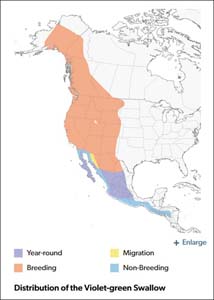
Violet-green Swallows are found throughout western North America, not straying much further east than the Rocky Mountains. Their breeding range spans from northern Mexico to Interior Alaska, generally excluding the Far North and western regions of the state. In winter, they spread south down Mexico and into northern Central America.
Violet-green Swallows tend to breed in open deciduous woodlands, especially where standing dead trees are present as they nest in natural cavities. They are found anywhere from sea level up to 11,500 feet in elevation as long as there is nearby water to provide food. While migrating, they are found at waterways. In the winter, they inhabit tidal flats, cloud and pine forests in interior mountain ranges, and open plains—anywhere the insects are.
Status, Trends, and Threats
Status
Alaska State Wildlife Action Plan: Species of Greatest Conservation Need
IUCN Red List of Threatened Species: Least Concern
NatureServe: globally G5 (Secure)
Trends
Violet-green Swallow populations from 1966 to 2015 seemed to have declined by 28% but are currently considered stable. These declines appear to parallel larger aerial insectivore declines across the continent. In 2025, their global population estimate was 7.2 million birds, with 410,000 (5.8%) of them breeding in Alaska.
Threats
Global insect decline, caused by insecticides, habitat destruction, and climate change, is a likely driver for aerial insectivore decline. Violet-green Swallows’ sole food source is insects, so there are no other options for them to fall back on as insect numbers drop.
The loss and degradation of nesting habitat also affects these birds. Whether it be for managing wetlands, removing dead trees, or logging, the natural cavities Violet-green Swallows need to nest in have drastically disappeared with the trees over the past 200 years. The addition of nest boxes helps to increase local populations, but these only account for a small fraction of nest sites.
Because of their association with riparian ecosystems and insectivorous diet, Violet-green Swallows could be bioaccumulating aquatic contaminants like mercury and PCBs, harming their health and fitness, such as has been shown in closely-related Tree Swallows.
Fast Facts
-
Size
Average length: 5.25 inches, wingspan: 13.5 inches, weight: 0.5 ounces -
Lifespan
The oldest recorded Violet-green Swallow was nearly seven years old. -
Distribution
Their breeding range sticks to western North America, extending from central Alaska to northern Mexico. They overwinter primarily in Mexico and northern Central America. -
Diet
Violet-green Swallows fly acrobatically over land or water to eat swarms of insects. -
Predators
House Wrens (not found in Alaska) have destroyed swallow eggs when they have nested near one another. There is little information on other specific predation events. -
Reproduction
They have one brood per year, laying four to six eggs. -
Remarks
Very similar to Tree Swallows—but a bit smaller and with more white showing on their rump (these are their “saddlebags”) and around the eyes, and with a more restricted range—Violet-green Swallows are impressive fliers as they hunt for insects mid-flight, flashing their iridescent green and violet backs in the sun.