
Tree Swallow
(Tachycineta bicolor)
Species Profile


Did You Know?
The construction of their nests is almost entirely done by female Tree Swallows during the morning. She gathers grass and vegetation to build the structure of the nest. Later, often once the eggs are laid, feathers are collected from other species that have fallen near the nest, orienting the quills beneath the grass under the nest cup, so the soft ends curl up and cover the eggs when unattended.
General Description
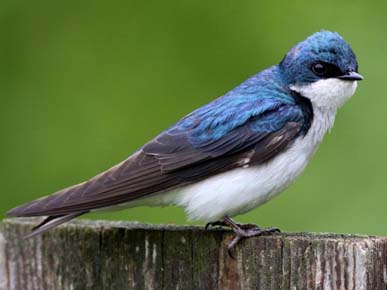
Tree Swallows are highly social passerine (perching) songbirds, commonly seen flashing their bright blue backs and heads and white undersides as they acrobatically fly through the air catching insects. The white does not extend to their eye as in Violet-green Swallows. They inhabit wetlands across most of North America, excluding the far north regions where trees aren’t present. They are true to their name in nesting behavior; Tree Swallows are secondary cavity nesters, requiring a pre-existing open tree cavity (formed by primary cavity nesters (woodpeckers), broken branches, or decaying wood). More recently with the help of people, artificial nest boxes attached to trees have become important nest sites for Tree Swallows. They appear to be relatively adaptable to changes in climate, shown by adjusting flexibly to warmer spring temperatures by moving forward their breeding timeframe by nine days over a 32-year span, though many other effects are not known. The issue of the steep population decline of aerial insectivores in general is a complex one and not completely understood.
The family Hirundinidae (swallows) consists of small to medium passerine songbirds who are aerial insectivores. Swallows are often seen swooping and turning suddenly in the air on their long, pointed wings foraging for insects in open meadows and above water. There are more than 90 species of swallows, but only five species are frequently found in Alaska. Other than Tree Swallows, which are the most common in Alaska, there are also Violet-green, Bank, Cliff, and Barn Swallows found in the state.
Life History
Mating, gestation, birth, maturity
Tree Swallows can reach maturity as yearlings, but many wait until their second year to breed. Males arrive to their breeding grounds a few days prior to females, finding and defending their highly sought-after nesting cavity, and perform mating displays and pairing as soon as females arrive. They build their nest several weeks later, with females often entirely doing the construction, though this has been observed differently depending on location.
Alaska-breeding birds’ median egg laying date is June 1st. The female lays four to seven eggs, beginning the 11-20 days-long incubation period once the final egg has been laid. During the final few days of incubation, the male parent often enters the nesting cavity and vocalizes a “chirp” or “gurgle” call, which is thought to communicate to the unhatched chicks to stimulate pipping out of the egg.
Upon hatching, as altricial birds (underdeveloped at birth), swallow chicks have sparsely downy pink skin, closed eyes, and are completely reliant upon their parents for food and thermoregulation. They mature after birth with the help of their parents, and at about 15 days old, the nestlings move about the cavity, exercising their wings, and come to the entrance to be fed.
Most nestlings depart their nest at 18-22 days old by flying out for their first flight, sometimes landing on a nearby perch and sometimes disappearing over the horizon. Upon nest departure, some chicks may still receive feedings from parents, but the extent of such parental care varies greatly. They then depart towards their wintering grounds in central and southern North America in the autumn.
Diet
Primarily insectivores, Tree Swallows swoop near water bodies to catch insects in the air, turning abruptly and acrobatically. During the non-breeding season and other insect-scarce times, Tree Swallows eat bayberries (Myrica species) and other vegetable matter. In fact, Tree Swallows are one of the few species who can digest the wax in bayberries. They drink by flying low over the water and contacting the surface briefly.
Lifespan
Tree Swallows live to be 2.7 years on average, but maximum life spans are recorded to be eight to 12 years. It’s estimated that only about 20% of nestlings who leave the nest survive their first year.
Migration
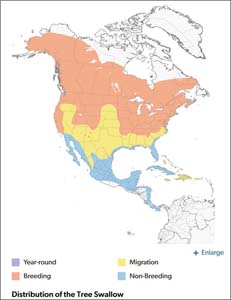
From their wintering grounds in the southern U.S., Mexico, the Caribbean, and Central America, Tree Swallows fly to northern North America for the breeding season. The spring arrival times of Tree Swallows are much earlier than other swallow species, arriving to breeding grounds generally in early April in their northern ranges, but can be as early as mid-March.
Range and Habitat
Tree Swallows’ breeding range is spread throughout central and northern North America, with especially high densities across sub-arctic Canada and Alaska, the Pacific coast, the Rocky Mountains, the Great Lakes and New England. Their northern limit generally overlaps with the boreal forest’s northern limit, though the presence of nest boxes in the north where no trees are present has been known to attract nesting swallows. Their winter range curves along the Gulf of Mexico down to Honduras, and across Mexico and the southern parts of the southern U.S. to the Pacific coast.
Tree Swallows occupy wetlands. These habitats—marshes, wooded bogs, ponds, and fields—provide the insects they eat and are frequently scattered in standing dead trees, which hold the open cavities needed to keep their nest and eggs safe. While migrating, they require large reed beds over water to roost at night, but will roost in trees or on wires if necessary.
Status, Trends, and Threats
Status
Alaska State Wildlife Action Plan: Species of Greatest Conservation Need
IUCN Red List of Threatened Species: Least Concern
NatureServe: globally G5 (Secure)
Trends
Though Tree Swallows are common and, thanks to nest boxes, their range is increasing in some areas, their population in North America has declined as much as 50% in the last 50 years, which appears to parallel larger aerial insectivore declines. In 2025, their global population was estimated at 19 million birds, with 990,000 (5.3%) of them breeding in Alaska.
Threats
The loss and degradation of nesting habitat directly affects these birds. Whether it be for managing wetlands, removing dead trees, or logging, the natural cavities tree swallows need for nesting have drastically disappeared with the trees over the past 200 years. The addition of nest boxes helps to increase local populations, but these only account for a small fraction of nest sites. Tree Swallows are sensitive to climate change, showing responses to warmer spring temperatures by shifting their timing of reproduction. Since the 1960s, their average egg lay date in the spring has advanced nine days earlier.
Because of their association with riparian ecosystems and insectivorous diet, Tree Swallows have been shown to bioaccumulate aquatic contaminants like mercury and PCBs, harming their health and fitness.
Fast Facts
-
Size
Average length: 5.5 inches, wingspan: 14.5 inches, weight: 0.7 ounces -
Lifespan
The oldest recorded Tree Swallow was 12 years old, but they live on average nearly three years. -
Distribution
Present throughout northern North America while breeding, and during winter, primarily in the southern parts of the southern U.S. states and along the Gulf of Mexico. -
Diet
Tree Swallows wheel around acrobatically in the air to catch insects over water, or perch on branches to eat berries off bushes. -
Predators
Bears, weasels, chipmunks, squirrels, owls, feral cats, flickers, crows, and falcons predate on swallow nests; the adults are hunted beyond the nest by falcons, hawks, magpies, and owls. -
Reproduction
Most Tree Swallows begin breeding at two years old and generally have one brood per year (though southwestern populations occasionally have two broods per year), laying four to seven eggs. -
Remarks
Impressive fliers above water, Tree Swallows spend much of their time hunting insects mid-flight, flashing their iridescent blue backs in the sun. -
Other Names
White-bellied Swallow, Darting Wings, Tulugagnauraq (Iñupiaq), Egugmelnguq or Kauturyaraq (Yupik), Tl’aÅ‚ghak’a (Dena’ina)