
Solitary Sandpiper
(Tringa solitaria)
Species Profile

Did You Know?
Solitary Sandpipers are the only tringine sandpipers to nest up in trees, often reusing old Rusty Blackbird, robin, or jay nests.
General Description
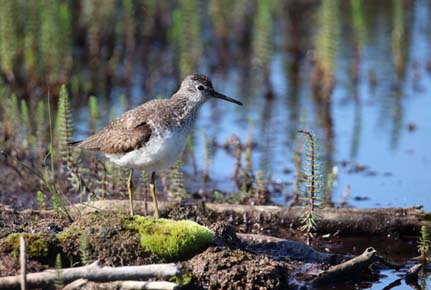
Solitary Sandpipers are sneaky summer inhabitants of boreal forest wetlands, remaining poorly understood due to their remote nature and generally quiet behavior. Their plumage shows a dark olive-gray back and wings with white or cinnamon spots, white belly and distinctive eye ring, and dull greenish legs. When flying, they show a dark stripe from the rump to the tail and spots that make it look like there are dark horizontal stripes on the tail feather edges. In nonbreeding plumage, the white spots on the back are diminished and the breast is browner. Their habit of bobbing the rear end of their body helps distinguish them from other similar looking shorebirds, as does the fact that they’re usually inland from the flocks of shorebirds on coastal flats, enjoying aquatic invertebrate snacks in wooded ponds in solitude.
The family Scolopacidae (sandpipers, phalaropes, and allies) is a large group of shorebird species with long toes and wings who are typically found near water. Scolopacids’ closest relatives are often thought to be plovers, though their fossil history is scant, with the earliest fossils dating back 40 million years. Within this family, Solitary Sandpipers are closely related to yellowlegs, curlews, woodcocks, turnstones, godwits, dowitchers, snipes, and phalaropes. Among Solitary Sandpipers, there are two subspecies: T. s. solitaria—who breed east of the Rocky Mountains and shows heavy, buffy white dorsal spots—and T. s. cinnamomea—breeding more northwestern and wintering further south, with sparser, cinnamon-colored dorsal spots—though their distinctions are subtle and often go unnoticed if overlapped.
Life History
Mating, gestation, birth, maturity
It all begins with a twittering whistle – part of the male’s courtship display, then he beats his wings to lift himself up a few meters into the air to show off his outer tail feathers to the female, followed shortly by a slow descent back to the ground. If impressed, copulation occurs, and the male finds a suitable nest, often an old Rusty Blackbird, robin, or jay nest near the trunk of a tree and very close to a muskeg. The female accepts the commandeered nest structure as-is but often scrapes out the old nest lining. About five days later the first of four eggs is laid. These pale green eggs with reddish-brown splotches are incubated by both parents for about 23-24 days.
As precocial birds (young are mobile and able to leave the nest from the moment of, or soon after, birth), Solitary Sandpiper chicks are downy upon hatching and depart the nest unaided soon after. Parents carry the eggshells away from the nest after their young have hatched. It is unknown whether one or both parents take care of the chicks while they’re very young, but presumably one of them accompanies the chicks for at least a few days. There is little information on when these sandpipers reach complete independence and sexual maturity.
Diet
In stagnant pools of water Solitary Sandpipers hunt mostly insects, but also mollusks, crustaceans, and frogs. They occasionally probe in the mud for food and commonly wade in belly-deep waters. During winter, they seem to eat more terrestrial invertebrates than during their aquatic-insect-heavy diet during the breeding season.
Lifespan
Precisely unknown, but their generation length (the average age of parents of newly hatched birds) is estimated to be 3 years.
Migration
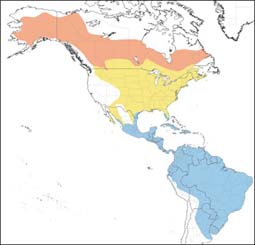
Solitary Sandpipers get the best of both worlds: boreal forest bogs in the summer and tropical rivers and lakes in the winter. In spring, most leave their wintering grounds in South and Central America and northern Mexico in March to early April. While migrating, they travel mostly at night either alone, as their name suggests, in pairs, or in small groups of up to six sandpipers. This behavior is unlike the large-flocking tendencies of many other shorebirds. They arrive in their breeding grounds in Alaska and Canada in late May or early June, and head back to the tropics in August. Non-breeding sandpipers spend the summer in South America, not making the long, energetically expensive trip north.
Range and Habitat
From central and south-central Alaska to northern Yukon and central Canada, Solitary Sandpipers spend their summers in boreal forest bogs at any elevation, surrounded by spruce trees and small, stagnant water sources. Unlike other shorebirds, Solitary Sandpipers aren't often found on marine coasts, as they mainly forage in wooded freshwater areas. In migration and non-breeding habitat, the common denominator is a freshwater source. In any puddle, flooded field, shrubby pond, muddy lake edge or ditch, Solitary Sandpipers can be found. They're found throughout South America in winter, as well as Central America and northern Mexico.
Status, Trends, and Threats
Status
Alaska State Wildlife Action Plan: Species of Greatest Conservation Need
IUCN Red List of Threatened Species: Least Concern
Trends
Solitary Sandpipers are common, but due to their remote locations and solitary nature, they're hard to study and track. In 2025, their global population estimate was 63,000 individuals, with 49,770 (79%) birds breeding in Alaska.
Threats
Habitat destruction and development are most likely the largest threats to Solitary Sandpipers, as these affect both their breeding and nonbreeding habitats.
Fast Facts
-
Size
Average length: 8.5 inches, wingspan: 22 inches, weight: 1.8 ounces. Female is usually slightly larger than male. -
Lifespan
Unknown, but their generation length (the average age of parents of newly hatched birds) is estimated to be 3 years. -
Distribution
They breed throughout south-central and central Alaska and Canada, and winter from northern Mexico throughout South America. -
Diet
Invertebrates, crustaceans, mollusks, small frogs and fish -
Predators
Falcons will prey on Solitary Sandpipers and jays have taken their eggs. When threatened, they may fake injury, swim and dive to get away, hide in holes underground, and give alarm calls. -
Reproduction
They have one brood per year, generally laying four eggs. -
Remarks
Unlike other shorebirds, Solitary Sandpipers are found inland in wooded bogs, nest up in trees, and migrate singly or in very small (up to six birds) groups.