
Rusty Blackbird
(Euphagus carolinus)
Species Profile

Did You Know?
The nests that female rusty blackbirds build are so robust that they often remain in place for years, allowing other birds, such as the solitary sandpiper, to reuse the nest in later breeding seasons.
General Description
The family Icteridae (blackbirds, meadowlarks, orioles) consists of medium to large sized songbirds with strong, pointed bills. This group has generally adapted very well to human-caused changes to their open grassland or marsh habitats throughout North America. They readily flock in agricultural fields and nest in our infrastructure. Rusty blackbirds are on the outskirts of this claim, as they are one of North America's most rapidly declining species, though biologists aren't completely sure why.
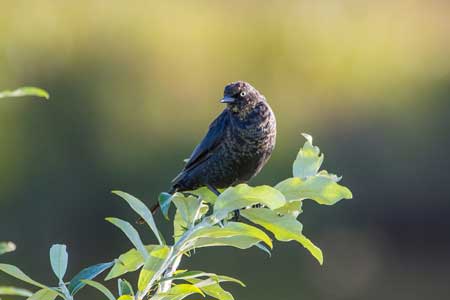
Rusty blackbirds are true to their name in both sound and appearance; their song sounds something like a rusty door hinge squeaking and their feathers are tipped in a handsome rusty brown in the fall and winter, before the colored tips wear off to reveal a subtle iridescent blueish shine on the black feathers below. Their eyes always remain a stark pale yellow. Uncommonly found in boggy forests, they forage for insects in shallow water and pond edges, flinging leaves and twigs into the air to reveal bugs below. They are gregarious songbirds, congregating in noisy flocks with other blackbirds to travel or roost over winter.
Life History
Mating, gestation, birth, maturity
In mid-May rusty blackbirds are paired and in their northern breeding habitat. The female builds their large, robust nest made of dense branches in small trees or shrubs very near to water, beginning the construction about four days before laying her first of three to six eggs.
Incubation then begins with the first egg and lasts 10-13 days, with only the female on the nest. The male blackbird feeds the incubating female, meeting on a conspicuous perch near the nest.
Over one or two days, the eggs hatch, bringing wide-eyed, downy blackbird chicks into the boreal forest. The nestlings are brooded by their mother and fed whole prey—dragonfly larvae being a very important food—by both parents.
Rusty blackbirds grow rapidly, fledging the nest only two weeks after hatching. Fledglings have been observed to remain with their parents for at least four more weeks.
Diet
As opportunistic feeders, rusty blackbirds take what they can get over an ever-changing diet year-round. During the breeding season, they mainly eat aquatic insects. Dragonfly larvae have been shown to make up 90% of the food that chicks received in summer in the Copper River Delta, Alaska. They search along the water's edge for prey, often wading, and plunge their bill and head underwater once insect larvae or crustaceans are found. Rusty blackbirds are often seen flipping over leaves and debris on the ground, gleaning hiding insects.
In the winter, they feed on pine seeds, acorns, grains, and fruit, often in large mixed flocks with other blackbirds, grackles, starlings, and cowbirds. In times of food scarcity, they have been recorded killing and eating sparrows, robins, and snipes.
Lifespan
The oldest recorded rusty blackbird was at least 8.5 years old.
Migration
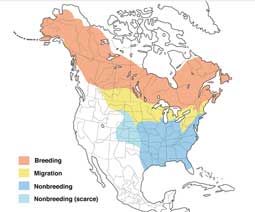
Rusty blackbirds are annual migrants between northern North America and the southeastern U.S., most taking a route east of the Rocky Mountains. In spring, they arrive to their breeding grounds in Alaska, Canada, and the northeastern U.S. by early May. They remain in the northern regions until early September, arriving at their wintering grounds by mid-October. The fall rusty blackbird migration consists of mixed-age flocks, and in both spring and fall, they join other blackbird species' flocks, sometimes exceeding 1,000 birds. Just a few decades ago, rusty blackbirds' spring migration was characterized as "spectacular, noisy, and ubiquitous" by Bent in 1958.
Range and Habitat
Rusty blackbirds breed across the boreal zone of North America from Alaska through Canada, excluding the arctic regions, to New England. They winter in the southeastern United States.
Favoring bogs, swamps, and muskegs, rusty blackbirds are found breeding in openings in wet coniferous and mixed forests near the northern tundra and southward to where the deciduous forests take over. While migrating, they forage in pastures and swamp edges, and roost in wooded areas. Over winter, they stick near marshlands, foraging in bottomland forests or flooded fields.
Status, Trends, and Threats
Status
The IUCN Red List of Threatened Species has listed the rusty blackbird as "Vulnerable."
Trends
The rusty blackbird population has decreased drastically and alarmingly, with an estimated 85-99% loss over the last forty years.
Threats
The loss of wetlands, in both breeding and wintering grounds, is one possible reason for rusty blackbirds' worrying decline. The land in the southeastern United States continues to be developed out of its natural state and climate change is drying up wetlands in their northern breeding range. The boreal wetlands they rely on are becoming increasingly disturbed.
There may be a phenological mismatch between rusty blackbird chick hatch and dragonfly larvae emergence, though these details have not been confirmed. In the Copper River Delta of Alaska, it has been found that 90% of what rusty blackbirds feed to their rapidly growing chicks is dragonfly larvae. The timing of mating, nesting, and rearing chicks is critically important for many migratory birds, and the emergence of the aquatic insects necessary to feed newly hatched chicks must be paralleled for nesting, and therefore the species', success. But because different organisms use different environmental cues to signal phenological life cycle stages, they don't always match up like they have in the past. Because rusty blackbirds' nestling period is so short (only two weeks!), the parents must find a lot of food for their nest full of hungry chicks, otherwise they won't make it.
Contaminants, especially mercury, may be bioaccumulating in rusty blackbirds. The bogs they inhabit are acidic and tend to make mercury bioavailable, whether its source be naturally occurring or an unnatural addition from mining and power plants.
In the southeast, many blackbirds, magpies, and cowbirds congregate in great flocks in winter, often exceeding one million birds, and are considered nuisances. They're subject to lethal control to reduce health hazards, nuisance, and crop damage. While rusty blackbirds are a tiny percentage of those winter roosts, some are likely affected by these efforts.
Fast Facts
-
Size
Average length: 9 inches, wingspan: 14 inches, weight: 2 ounces -
Lifespan
The oldest recorded rusty blackbird was at least 8.5 years old. -
Distribution
Rusty blackbirds breed across the boreal zone of North America from Alaska through Canada to New England, and winter in the southeastern United States. -
Diet
Mostly insects, especially dragonfly larvae, in summer; seeds, nuts, and fruits are added to their winter diet -
Predators
Hawks, falcons, and owls prey on blackbirds. Squirrels, jays, magpies, ravens, eagles, hawks, and falcons are all nest predators of rusty blackbirds. -
Reproduction
They have one brood per year, laying three to six eggs. -
Remarks
The rusty blackbird is one of North America's quickest declining species and the furthest-northern breeder in its family. -
Other names
Rusty grackle (an older name; they're now distinguished as a blackbird, not a grackle)