
Red-throated Loon
(Gavia stellata)
Species Profile

Did You Know?
Unlike other loons, the Red-throated Loon doesn't carry chicks on their back, possibly because of their smaller size.
General Description
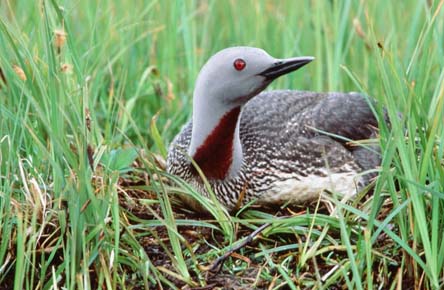
Red-throated Loons are slender, fish-eating waterbirds known for their striking appearance and distinct differences from other loons. They are the smallest species of loon and they habitually hold their slender bill at an upward angle. During breeding season (April-November), they’re commonly seen nesting on arctic tundra lakes, showing off their distinctive plumage of a gray head and neck, sharp black bill, red eyes, rusty red throat patch, white breast, and thin black and white stripes on the neck running into a dark back. They winter in shallow coastal waters looking drabber with a starry speckled back and a white breast, throat, and cheeks with a sharp border to their dark crown and neck. Most of a loon’s life is spent on the water. Their webbed feet are far back on their body, making them very efficient swimmers and divers, catching fish in fast underwater chases, but very awkward walkers. Unless they are ashore on their nest, it is rare to see a loon on land.
The family Gaviidae includes all five worldwide species of loons: all five species can be found in Alaska. Besides the Red-throated Loon, there are also Common, Yellow-billed, Pacific and Arctic Loons. Outside of North America, loons are called “divers.” This family of birds has one of the most ancient bird lineages, with fossil evidence of modern loons occurring 20 million years ago and fossils of predecessor loon-like birds dating back to over 70 million years ago.
Life History
Mating, gestation, birth, maturity
Loons are monogamous, but little is known about the duration or longevity of the pair bond between Red-throated Loons. Some have claimed they may mate for life. Their courtship displays include rapid bill-dipping in the water toward one another followed by noisy splashing and swimming quickly back and forth past each other.
A pair of loons have one brood of chicks per year, typically laying two eggs which both parents take turns to incubate for 24-29 days.
As semi-precocial birds (young are relatively mobile and able to explore outside the nest soon after birth), the chicks can leave the nest and swim within hours of hatching. They practice diving within a day of hatching, though their buoyant downy covering only allows them a few seconds under water before they pop back up to the surface. Within a week, though, the chicks are diving to the bottom and trying to catch small prey.
A family may move to a different lake or pond once the young are several weeks old. Then, in preparation for migration, they move closer to coastlines.
Diet
Primarily fish-eaters, loons use their excellent underwater vision to locate prey as they float on the surface with their eyes completely submerged. They dive down to hunt fish in speedy chases, usually swallowing their prey underwater. They also eat crustaceans, leeches, insect larvae, snails, and other invertebrates. Red-throated Loons are unique in that they can also hunt prey from the air, diving from flight. They also are the only species of loon to feed on bodies of water away from their nesting lake or pond, flying to hunt for food and bringing it back to their young.
Lifespan
Precisely unknown, but some sources suggest that Red-throated Loons live to be nine years old, on average.
Migration
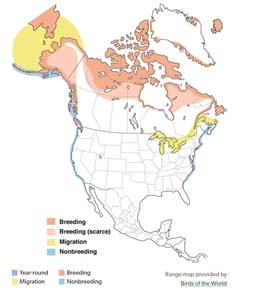
Occurring at least partly at night, Red-throated Loons migrate along marine coasts in small groups or singly. They utilize large bays, and, in the case of Atlantic birds, the Great Lakes, as stop-over sites on their migration route.
Range and Habitat
Red-throated Loons nest on small ponds and lakes in rugged tundra wetlands up to about 3,500 feet elevation. As opposed to other loons who require more open water space to take off into flight, Red-throated Loons are smaller and able to fly into the air from anywhere. Where other loons are absent, though, Red-throated Loons do use larger lakes to breed.
Found across the northern hemisphere, Red-throated Loons are the most widely distributed loon, globally. Breeding Red-throated Loons are circumpolar in arctic and sub-arctic habitats, sticking close to the coasts. Their nonbreeding range is in coastal marine areas of the northwest and northeast Pacific and Atlantic Oceans.
Status, Trends, and Threats
Status
Alaska State Wildlife Action Plan: Species of Greatest Conservation Need
IUCN Red List of Threatened Species: Least Concern
Trends
Red-throated Loon populations have appeared to stabilize after a long-term 50% decline was detected in the late twentieth century. There are an estimated 10,000 individual birds making up Alaska's statewide population, with up to 1 million globally.
Threats
Development and pollution pose immediate risks to loons, pushing them out of their once-pristine habitats. Because of their dependance upon riparian ecosystems and their piscivorous diet, loons have been shown to bioaccumulate aquatic contaminants like mercury, harming their health and fitness. Lead, oil spills, acid rain, and other pollutants all pose similar risks, as well.
Fishing brings threats directly to loons as fishing lines and lead tackle are littered, leading to entanglement and poisoning. A quick killer to loons and grebes, lead fishing tackle are ingested either by eating a fish who ingested a broken fishing line or by mistaking lead weights for small pebbles that they normally eat to aid digestion. Either way, lead poisoning is usually fatal within two to four weeks of its ingestion. Commercial and subsistence fishing nets can lead to loon bycatch, and the possibility of overfishing can decrease loons’ prey populations.
Climate change brings a host of threats to loon survival, including water level fluctuations, seasonal shifts affecting migration and breeding times, habitat shifts upward in latitude and altitude, and water acidification.
Fast Facts
-
Size
Average length: 25 inches, wingspan: 36 inches, weight: 3.1 pounds -
Lifespan
Unknown, but estimated to be an average of nine years old -
Distribution
Circumpolar in the arctic and sub-arctic while breeding, down to the northwest and northeast coasts of the Pacific and Atlantic Oceans while nonbreeding -
Diet
Freshwater and marine organisms, such as fish, snails, leeches, insect larvae, and crustaceans -
Predators
Scavengers such as eagles, gulls, ravens, foxes, and bears predate on loon eggs and chicks. -
Reproduction
They reach sexual maturity at a few years old, having one brood of chicks per year, laying one to two eggs -
Remarks
Red-throated Loons are the least similar to the other four species of loons, from size to breeding habitat to behavior. -
Other Names
Red-throated Diver, Qaqsrauq (Iñupiaq), Qaqataq (Yupik)