
Red-necked Grebe
(Podiceps grisegena)
Species Profile

Did You Know?
Grebes have complex and fascinating courtship ceremonies to reunite or bond with a mating partner. These distinct behaviors have caught attention and been named: Whinny-Braying, Weed Dance, Ghostly Penguin Posture, Cat Display, and Bouncy Dive, among others.
General Description
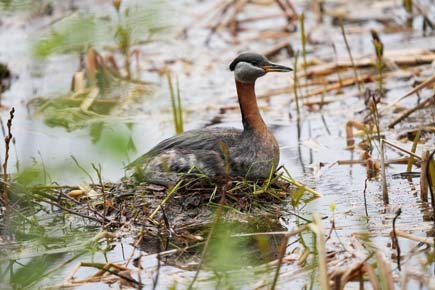
Red-necked Grebes are sleek diving waterbirds with crested black caps, pale gray cheeks, chestnut-red necks and breasts fading into dark gray backs and whitish undersides in breeding season. In winter, they’re dingier gray overall while retaining whitish cheeks. They nest on small, wooded lakes, across a nearly circumpolar northern range. The pair aggressively defends their nesting territory together, sometimes showcasing their dense-boned ability to sink all but their eyes below the water’s surface to sneakily attack intruders or hide from predators. Almost all of a grebe’s life is spent on the water. Their lobed feet are far back on their body, making them very efficient swimmers and agile divers, catching fish in chases and snatching invertebrates off plants underwater, but very awkward walkers. Like airplanes and most loons, Red-necked Grebes must have ample open water for a running take-off into flight.
The family Podicipedidae (grebes) includes 22 species worldwide and seven in North America, two of which reside in Alaska: Red-necked and Horned Grebes. Red-necked Grebes are made up of two subspecies which are geographically separate; Alaska is home to the larger P. g. holbollii, while Europe and western Asia host P. g. grisegena birds. This family of birds has a very ancient lineage, with fossil evidence of modern grebes occurring more than 30 million years ago and fossils of predecessor grebe-like birds dating back to over 80 million years ago in modern-day Chile. Though similar to loons in appearance and lifestyle, grebes aren’t that closely related to loons.
Life History
Mating, gestation, birth, maturity
Many grebes arrive at the breeding grounds already paired, having formed a bond either on the coastal wintering grounds or during migration at a stopover location. Pair bonds may last beyond one mating season. They choose their mating partners and establish bonds through complex courtship displays (a spectacular behavior shared with other grebe species), including diving, feather splaying, parallel swimming, raising and kinking necks, head turning, and giving their notable whinny-braying calls throughout their seemingly choreographed dances.
In similar flair, grebes have distinct displays for copulation and nest selection. A pair begins building their nest as soon as they arrive on the breeding lake, creating a floating platform on top of emergent vegetation. A pair often builds multiple nest-like platforms for copulation, later choosing one to lay their four to five eggs in. The eggs are laid a pale blue color, changing to white within a day and then may be discolored tan by wet nest material. Incubation by both male and female lasts for about a month.
As semi-precocial birds (fully precocial means they can swim, feed and survive independently, altricial means they are helpless and entirely dependent) grebe chicks are downy upon hatching and immediately climb onto parent’s back, snuggling between their wings in a typical brooding posture. The eggs hatch about a day apart. A young Red-necked Grebe’s head is adorned in white down with bold black stripes and a red, bare-of-down patch in front of their eyes. They’re able to swim for short periods of time within an hour of hatching. After the last egg hatches, the family departs the nest, the chicks riding valiantly on a parent’s back out into the water.
Young grebes begin diving exploratorily by their second week and are successfully feeding themselves beginning about their fourth week, though they continue being reliant upon their parents for food until their eighth week. As the chicks are fully gaining independence, the parents fly off, leaving behind a lake full of immature grebes who gather loosely together. Shortly after, by nine weeks old, they can fly. The young fly away by themselves, sometimes joining molting adults on the migration route towards the coast. Red-necked Grebes are thought to reach sexual maturity after two years of age.
Diet
Red-necked Grebes eat aquatic insects, fish, and crustaceans. They dive down below the water surface to search for prey, though they occasionally do a preliminary search by peering underwater with their eyes submerged (like loons). They pluck crustaceans, insects, and sometimes amphibians from the lake bottom or vegetation and eat their prey underwater. They chase fish and eat them headfirst, sometimes bringing them to the surface to orient them before swallowing. When feeding their chicks, the parents first bring small invertebrates, then fish as the young grow. As with all other species of grebe, Red-necked Grebes eat their feathers, a practice thought to aid in digestion or protect the stomach.
Lifespan
Average age is unknown due to limited study, but the oldest recorded Red-necked Grebe was at least six years old.
Migration
In small flocks in spring, Red-necked Grebes fly from coastal wintering areas east to inland lakes to breed. Unlike many other migratory birds, Red-necked Grebes’ flight routes are more east-west than the typical north-south migration. When migrating over land they strictly travel at night, but when along coastlines they may fly in the daytime. In Alaska, it isn’t uncommon to see grebes floating alongside break-up ice chunks during their arrival period of late April to mid-May. Once their chicks have been raised to independence in August or September, the adults fly towards marine areas with the juveniles following later.
During fall migration, grebes stop and congregate at lakes for a few flightless weeks while they molt all their feathers simultaneously. They’re still capable of fishing during this time and, where there are enough birds in one water body, they can significantly impact the prey resources, with each bird eating up to a pound of fish per day. Without exercise in flight, their muscles atrophy, losing up to half their mass. The obese grebes begin flapping and exercising their wings. By the time their feathers have grown back in, they are in shape to continue their journey to the seas.
Range and Habitat
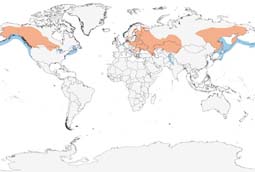
Red-necked Grebes are nearly circumpolar in northern waters, with three main populations: North America, Europe/western Asia, and eastern Asia. The North American population breeds near the northern tree line in Alaska and Canada, south to some northern continental U.S. states. In both the Eastern and Western Hemisphere populations, grebes winter primarily along Pacific and Atlantic coasts, with some on large inland lakes or other bays and seas.
They primarily breed on small, shallow lakes with emergent (rooted at lake bottom) vegetation surrounded by woods. At low elevation, secluded bays of large lakes, bogs, and marshes are all used. During the nonbreeding season, they float around in coastal waters, often in inlets or protected estuaries, but also on shallow waters offshore. Large freshwater lakes, such as the Great Lakes (though it is thought Alaska-breeding grebes don’t fly this far east), host grebes in winter.
Status, Trends, and Threats
Status
Alaska State Wildlife Action Plan: Species of Greatest Conservation Need
IUCN Red List of Threatened Species: Least Concern
Trends
The Red-necked Grebe population is apparently stable but has shown declines in certain locales. Their global population is estimated to be 190,000-290,000 individuals, with 12,000 breeding in Alaska.
Threats
Development and pollution pose immediate risks to grebes, pushing them out of their once-pristine habitats. Because of their dependance upon riparian ecosystems and their piscivorous diet, grebes have been shown to bioaccumulate aquatic contaminants like mercury, harming their health and fitness. Lead, oil spills, acid rain, and other pollutants all pose similar risks to adults, chicks, and grebe eggs.
Fishing brings threats directly to grebes on their wintering grounds. Fishing lines and lead tackle are littered, leading to entanglement and poisoning; grebes often perish as bycatch in commercial fishing nets; and the possibility of overfishing can decrease grebes’ prey populations.
Climate change brings a host of threats to grebe survival, including water level fluctuations, seasonal shifts affecting timing of life cycles, range shifts, water acidification, and introduction of diseases and pathogens.
Fast Facts
-
Size
Average length: 18 inches, wingspan: 24 inches, weight: 2.2 pounds -
Lifespan
Average age is unknown due to limited study, but the oldest recorded Red-necked Grebe was at least six years old. -
Distribution
A nearly circumpolar resident of northern waters, Red-Necked Grebes have three general populations: North America, Europe/western Asia, and eastern Asia. -
Diet
Grebes eat fish, aquatic insects, and crustaceans. -
Predators
Owls, falcons, and mink all prey on adult grebes, which are most susceptible to attacks while incubating eggs. Ravens, crows, gulls, eagles, raccoons, mink, and large fish are known to eat grebe chicks and/or eggs. -
Reproduction
They have one brood of chicks per year, laying four to five eggs. -
Remarks
With distinctive plumage of their namesake red neck and large size, Red-necked Grebes are unlikely to be confused with other species during breeding season; their nonbreeding plumage is similar to the drab look of wintering loons, though. -
Other Names
Hoelbell’s Grebe (called this in North America until 1957), Hell-divers (grebes in general), Taqa’a (Dena’ina), Aqpaqsruayuuq or SuÄ¡litchauraq (Iñupiaq)