
Pacific Loon
(Gavia pacifica)
Species Profile


Did You Know?
Despite being about the same size, Pacific Loons are heavier than Red-throated Loons, allowing them to dive more efficiently and catch fish in deeper waters.
General Description
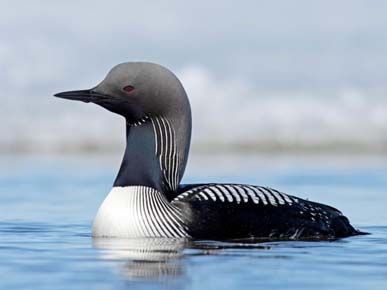
Pacific Loons are striking, fish-eating waterbirds with a thick gray head and nape, handsome vertical black and white striping on the sides of the neck and breast, an iridescent black or purple neck, red eyes, and white patches on the black back while breeding. They nest on tundra lakes, where their wailing calls echo across the arctic and sub-arctic waters. Winters are spent on the Pacific coast in marine areas. Most of a loon’s life is spent on the water. Their webbed feet are far back on their body, making them very efficient swimmers and agile divers, catching fish in fast underwater chases, but very awkward walkers. Unless they are ashore on their nest, it is unlikely to see a loon on land.
The loon family Gaviidae includes only five species worldwide and all are found in Alaska. The family includes Common, Red-throated, Yellow-billed, and Arctic Loons. Pacific Loons are very closely related to Arctic Loons and until recently they were considered the same species.
This loon family has one of the most ancient bird lineages, with fossil evidence of modern loons occurring 20 million years ago and fossils of predecessor loon-like birds dating back to over 70 million years ago.
Outside of North America, loons are called “divers.”
Life History
Mating, gestation, birth, maturity
Sexual maturity is thought to be at least two years old for Pacific Loons. Before maturity is reached, nonbreeding loons may over-summer in the southern, coastal winter range or migrate north with others.
In spring, when Pacific Loons are waiting on salt water for the inland waters to thaw and melt, it is thought that they find their mate, arriving together to their breeding area. While courting, they face each other on the water and dip their bills at one another before diving down and continuing to establish their bond below the surface. As soon as the nesting pond has sufficient open water, the loons begin copulating and nest building, followed shortly after by incubating their one to two eggs for 23-29 days.
Most chicks hatch in late June or early July, emerging downy and a day or two apart. As semi-precocial birds (young are relatively mobile and able to explore outside the nest soon after birth), the chicks explore outside the nest within hours of hatching but rely on their parents for food.
After 50 days, the young loons are learning to fly near the nesting pond. Upon autumn’s approach, the juveniles follow their parents to salt water. Here, loons gather in noisy, screaming flocks and fly south together.
Diet
Primarily fish-eaters, Pacific Loons use their excellent underwater vision to locate prey as they float on the surface with their eyes completely submerged. They dive down to hunt fish in speedy chases, usually swallowing their prey underwater. They also eat crustaceans, leeches, insect larvae, and other invertebrates.
Lifespan
It is unknown how long Pacific Loons live.
Migration
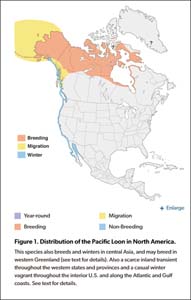
In the spring Pacific Loons fly north, following the Pacific coast loosely. They’ve been shown to “short-cut” the coastline by travelling farther out at sea. They arrive in the arctic around early June, waiting in the salt water for the breeding grounds’ wetlands and lakes to thaw and melt. This ocean wait is thought to be when loons find their mates.
After a few summer months in their nesting habitats, loons fly back south, sometimes stopping over in sheltered bays or on open ocean but remaining concentrated along the coastline. They winter in marine areas from southeast Alaska to Mexico’s Gulf of California.
Range and Habitat
Pacific Loons are found in marine areas of Alaska and Canada during migration seasons. They nest on large and deep freshwater lakes, generally preferring either treeless or wooded lakes with less emergent vegetation in the arctic and sub-arctic tundra and taiga of Alaska, Canada, and Siberia.
Their winters are spent on the eastern Pacific Ocean, all along North America’s west coast from the Gulf of Alaska to Mexico’s Gulf of California. Pacific Loons are often found farther out at sea than other loon species.
Status, Trends, and Threats
Status
IUCN Red List of Threatened Species: Least Concern
NatureServe: globally G5 (Secure), though their state/provincial status is more dire in specific locations, such as Alaska’s S4 (Apparently Secure)
Trends
The Alaska-wide population of Pacific Loons appears to be stable, though they may be declining in some parts of their breeding range. Globally, there are an estimated 100,000 to 1 million individual birds (2025).
Threats
Development and pollution pose immediate risks to loons, pushing them out of their once-pristine habitats. Because of their dependance upon riparian ecosystems and their piscivorous diet, loons have been shown to bioaccumulate aquatic contaminants like mercury, harming their health and fitness. Lead, oil spills, acid rain, and other pollutants all pose similar risks to adults, chicks, and loon eggs.
Fishing brings threats directly to loons. Fishing lines and lead tackle are littered, leading to entanglement and poisoning; loons often perish as bycatch in commercial fishing nets; and the possibility of overfishing can decrease loons’ prey populations.
Climate change brings a host of threats to loon survival, including water level fluctuations, seasonal shifts affecting timing of life cycles, range shifts, water acidification, and introduction of diseases and pathogens.
Fast Facts
-
Size
Average length: 25 inches, wingspan: 3 feet & 11 inches, weight: 3.9 pounds -
Lifespan
Unknown -
Distrubution
Pacific Loons breed in the northern parts of North America, Siberia, and possibly western Greenland. They winter on the Pacific coast down to Mexico’s Gulf of California and in central Asia. -
Diet
Freshwater and marine organisms, such as fish, snails, leeches, insect larvae, and crustaceans -
Predators
Scavengers such as eagles, gulls, ravens, foxes, pike, and bears prey on loon eggs and chicks. -
Reproduction
They are thought to reach sexual maturity past two years old and have one brood of chicks per year, laying one to two eggs. -
Other Names
Pacific Diver, Tunucellek or Yaqulekpak (Yupik), MalÄ¡i (Iñupiaq)