
Horned Grebe
(Podiceps auritus)
Species Profile

Did You Know?
Horned Grebes feed their young for about two weeks after hatching and the parents can bring over 450 food items an hour to their chicks.
General Description
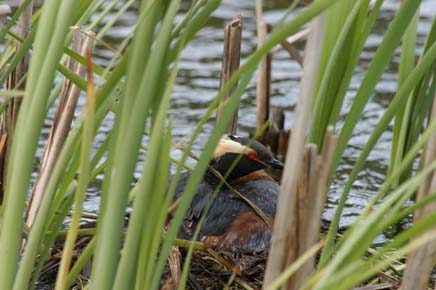
Horned Grebes are small diving waterbirds with chestnut necks, breasts, and flanks; black backs, cheek tufts, and beaks; and bright tawny yellow feather tufts behind their red eyes (“horns”) during breeding season. Their appearances remain distinct in their nonbreeding plumage as well, with black caps; dark gray napes and backs; white cheeks and breasts; and mottled gray and white underparts. Though they’re intensely territorial to other grebes while breeding, they’re relatively approachable for humans. Their distribution is nearly circumpolar. They breed in low densities at high latitudes and overwinter in a wide range in North America. They are well-studied in Europe.
Most of a grebe’s life is spent on the water. Their lobed feet are far back on their body, making them efficient swimmers and agile divers, catching fish in chases and snatching invertebrates off plants underwater, but very awkward walkers. Like airplanes and most loons, Horned Grebes must have ample open water for a running take-off into flight.
The family Podicipedidae (grebes) includes 22 species worldwide and seven in North America, two of which reside in Alaska: Horned and Red-necked Grebes. Horned Grebes are made up of two subspecies which are generally geographically separate; Alaska and Canada are home to P. a. cornutus (called the Horned Grebe) who have yellow plumes or ”horns,” while Eurasia hosts the darker-backed, chestnut-plumed P. a. auritus (called the Slavonian Grebe). This family of birds has a very ancient lineage, with fossil evidence of modern grebes occurring more than 30 million years ago and fossils of predecessor grebe-like birds dating back to over 80 million years ago in modern-day Chile. Though similar to loons in appearance and lifestyle, grebes aren’t incredibly closely related.
Life History
Mating, gestation, birth, maturity
Many grebes arrive at the breeding grounds already paired, having formed a bond either on the coastal wintering grounds or during migration at a stopover location. Horned Grebes can breed at one year old and pair bonds may last beyond one mating season. They choose their mating partners and establish bonds through complex courtship displays (a spectacular behavior shared with other grebe species), including four distinct ceremonies: Discovery Ceremony, Weed Ceremony, Head-Shaking Ceremony, and the Triumph Ceremony. These seemingly choreographed duets include diving, feather splaying, parallel swimming, head turning, and raising and kinking necks.
A pair begins building their nest as soon as they arrive on the breeding lake, creating a floating platform on top of emergent vegetation within a few feet of open water. A pair often builds multiple nest-like platforms for copulation, later choosing one to lay their five to seven eggs in. Incubation by both male and female lasts for 22-25 days.
As semi-precocial at hatching (somewhat independent as opposed to totally helpless and naked “altricial” species), grebe chicks are downy upon hatching and can swim. The eggs hatch about a day apart. After the last egg hatches, the family departs the nest, the chicks often riding on a parent’s back out into the water. They remain almost constantly on their backs during the first three days of life, snuggling between their wings in a typical brooding posture.
Young are fed by adults for up to two weeks after hatching, then the family remains together but forages independently. Before the young reach independence—marked by fledging—the parents disperse from the breeding lake, beginning their southward movements. Horned Grebes usually achieve their first flight when they are between 40 and 50 days old. In their first migration Alaska Grebes fly (generally west) to the coast, where other grebes are staging for migration departure.
Diet
In summer, Horned Grebes eat mostly aquatic insects, switching the bulk of their diet to deep-water fish and crustaceans in winter. They dive down below the water surface to search for prey, though they occasionally do a preliminary search by peering underwater with their eyes submerged (like loons). They pluck crustaceans, insects, and sometimes amphibians from the shallow lake bottom or vegetation and eat their prey underwater. They chase fish and eat them headfirst, sometimes bringing them to the surface to position them headfirst before swallowing. When feeding their chicks, the parents first bring small invertebrates, but they replace these with fish as the young grow. As with all other species of grebe, Horned Grebes eat their feathers, a practice thought to aid in digestion or protect the stomach.
Lifespan
Horned Grebes generally live for five years, with the oldest recorded to be five years and 11 months old.
Migration
Horned Grebes migrate in flocks, sometimes amounting to several hundred birds, at night. Most birds fly over 600 miles between their breeding and wintering sites, but some fly much less, only moving to nearby seas. The timing of grebes’ movements are greatly influenced by weather, often being delayed until ice break-up in spring and accelerated by freezing in fall. In spring, the Horned Grebes on North America’s West Coast leave California by mid-April, moving north as the waters thaw; in fall, they return back to southern California by mid-November.
Range and Habitat
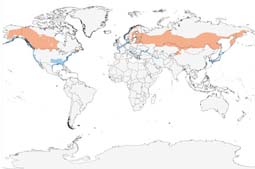
Horned Grebes are nearly circumpolar inhabitants of northern waters, with two general populations: one is spread through central Alaska and Canada, and the other from northwestern Europe through Russia (where they’re called Slavonian Grebes). In both the Eastern and Western Hemisphere populations, grebes winter primarily along Pacific and Atlantic coasts, with some on large inland lakes or other bays and seas.
They primarily breed on large, shallow lakes with emergent (rooted at lake bottom) vegetation surrounded by forest, with secluded bays of large lakes, bogs, and marshes also used. While migrating, they’re found on coasts and large inland water bodies, including rivers. During the nonbreeding season, they float around in coastal waters, often in inlets, protected estuaries or archipelagos.
Status, Trends, and Threats
Status
Alaska State Wildlife Action Plan: Species of Greatest Conservation Need
IUCN Red List of Threatened Species: Vulnerable
Trends
The Horned Grebe population has decreased over 75% in the last four decades, with an expectation for this decline to continue. Their global population is estimated to be 239,000-583,000 birds (though this is a difficult number to obtain due to their low densities in high latitudes in North America).
Threats
Development and pollution pose immediate risks to grebes, pushing them out of their once-pristine habitats. Because of their dependance upon riparian ecosystems and their piscivorous diet, grebes have been shown to bioaccumulate aquatic contaminants like mercury, harming their health and fitness. Lead, oil spills, acid rain, and other pollutants all pose similar risks to adults, chicks, and grebe eggs.
Fishing brings threats directly to grebes on their wintering grounds. Fishing lines and lead tackle are littered, leading to entanglement and poisoning; grebes often perish as bycatch in commercial fishing nets; and the possibility of overfishing can decrease grebes’ prey populations.
Climate change brings a host of threats to grebe survival, including water level fluctuations, seasonal shifts affecting timing of life cycles, range shifts, water acidification, and introduction of diseases and pathogens.
Fast Facts
-
Size
Average length: 14 inches, wingspan: 18 inches, weight: 1 pound -
Lifespan
Horned Grebes generally live for five years. -
Distribution
A nearly circumpolar inhabitant of northern waters, Horned Grebes have two general populations: one is spread through central Alaska and Canada, and the other from northwestern Europe through Russia. -
Diet
Grebes eat fish, aquatic insects, and crustaceans. -
Predators
Crows, ravens, gulls, foxes, raccoons, mink, falcons, and large fish are known to eat grebe chicks and/or eggs. Herons, gulls, and falcons have predated on adult Horned Grebes. -
Reproduction
They may begin breeding at one year old, have one brood of chicks per year, and lay about five to seven eggs (in North America; the Eurasian subspecies only lays four or five). -
Remarks
Horned Grebes are named for their yellow feathered “horns� they display during breeding, though they're known to most field observers by their distinctive, contrasting black and white nonbreeding plumage. -
Other Names
Slavonian Grebe (Eurasian subspecies), Hell-divers (grebes in general)