
Common Loon
(Gavia immer)
Species Profile


Did You Know?
Common Loons who breed coastally have an increased body size and vocalize at a lower frequency compared to those who breed in the interior regions.
General Description
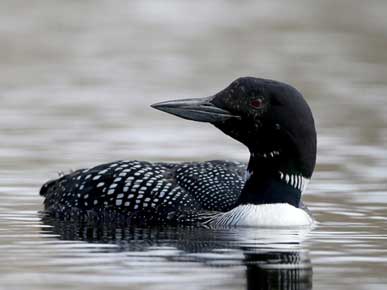
Common Loons are bulky, fish-eating waterbirds best known for their eerie, wailing calls and yodels that echo across lakes. They are the second largest species of loon, being a bit smaller on average than the Yellow-billed Loon. During breeding season (March-October), they’re commonly seen nesting on wooded freshwater lakes, showcasing their distinctive plumage of a black head, heavy black bill, red eyes, white striped collar on the throat, white breast, and extensive white checkering on their back. They winter in coastal bays, ocean coasts, and open lakes. Most of a loon’s life is spent on the water. Their webbed feet are far back on their body, making them very efficient swimmers and agile divers, catching fish in fast underwater chases, but very awkward walkers. Unless they are ashore on their nest, it is unlikely to see a loon on land.
The loon family Gaviidae includes only five species worldwide and all can be found in Alaska. The Common Loon is the most widespread in Alaska, but there are also Pacific, Red-throated, Yellow-billed, and Arctic Loons. This family of birds has one of the most ancient bird lineages, with fossil evidence of modern loons occurring 20 million years ago and fossils of predecessor loon-like birds dating back more than 70 million years. The Common Loon seems to be most closely related to the Arctic Yellow-billed Loon, with some cases of hybridization between the two species. Outside of North America, loons are called “divers.”
Life History
Mating, gestation, birth, maturity
Loons start to breed when they’re about six (males) or seven (females) years old, though they begin migrating north at about three years old. Pair bonds last on average six to seven years, but often change depending on challenges to territory, nest success, and mate mortality. The male arrive first at their nesting territory, very soon after ice-out, and asserts his claim, defending it against any challengers. When they female arrives they immediately begin establishing or reestablishing pair bonds. A pair of loons have one brood of chicks per year, typically laying two dark brown eggs which both parents take turns to incubate for 27 days. The chicks hatch about a day apart.
Loon chicks are semi-precocial birds, relatively mobile and able to explore outside the nest soon after birth, but depend on their parents for food for about eight weeks. They practice diving within a day of hatching, though their buoyant downy covering only allows them a few seconds under water before they’re popped back up to the surface. Within a week, though, the chicks are diving to the bottom and trying to catch small prey. It is not uncommon to see loon chicks riding on their parents’ backs while floating, as they readily rest there during their first weeks of life.
Upon autumn’s approach, one parent loon flies from their breeding territory about 10 weeks after hatch, leaving the other to stay with the chicks for a couple more weeks until they are independent. A few weeks after the last parent departs, when the juveniles are about three months old and the natal lake is nearing freeze-up, they eventually leave for wintering areas on a coast farther south. Immature loons generally remain in the marine wintering areas for two more years before they migrate back north, though they may not breed for several more years (on average they’re three years old when they fly north for the summer and six or seven years old when they begin breeding).
Diet
Primarily fish-eaters, Common Loons use their excellent underwater vision to locate prey as they float on the surface with their eyes completely submerged. They dive down to hunt fish in speedy chases, usually swallowing their prey underwater. Sharp projections on the roof of loon mouths help them hold slippery prey. They also eat crustaceans, leeches, insect larvae, and other invertebrates.
Lifespan
Loons live to be 20 years old on average. As of 2025, there was a 39-year-old female loon in Michigan who was still returning to the same lake she was banded at in 1989 (at which point she had been at least five).
Migration
Each spring, adults migrate from their coastal wintering waters and fly to their northern lake habitats. Breeding pairs don’t always overwinter in the same location, sometimes wintering hundreds of miles apart. Come autumn, after their offspring can feed and care for themselves, the adults begin molting into their drab brown and white nonbreeding plumage and fly south to mild marine environments to spend their winters feeding. Their offspring fly south a few weeks later.
Range and Habitat
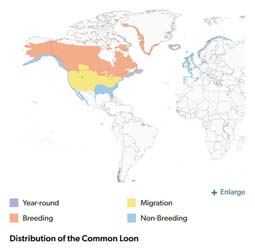
Common Loons are found across much of North America during migration seasons. They spend their summers on clear, northern lakes in parts of the northern lower 48 states, Alaska, Canada, and coastal Greenland and Iceland, though they aren’t usually found in the far north arctic regions. They breed on low-nutrient freshwater lakes, often with small islands, floating bogs, and bays surrounded by rocky and forested shorelines.
They spend their winters along the west and east coasts of North America, spanning from the Gulf of Alaska and down to northern Mexico’s Sea of Cortez in the Pacific, and from Newfoundland to the Gulf of Mexico in the Atlantic.
Status, Trends, and Threats
Status
NatureServe: globally G5 (Secure), though their state/provincial status is more dire in specific locations such as Alaska’s S4 (Apparently Secure) ranking
IUCN Red List of Threatened Species: Least Concern
Trends
Common Loon populations appear to be remaining stable or slightly increasing in Alaska, as well as in other northern breeding habitats. There are an estimated 100,000-1,000,000 individual birds making up their global population (2025).
Threats
Recreational fishing brings threats directly to loons, as fishing lines and lead tackle are lost and littered in loon habitat. Fishing lines have been found entangling the birds, inhibiting their ability to eat, swim, and fly. Lead poisoning is a common and quick killer among loons and grebes. They ingest lead fishing tackle either by eating a fish who ingested a broken fishing line, or by mistaking lead weights for small pebbles that they normally eat to aid digestion. Either way, lead poisoning is usually fatal within two to four weeks of its ingestion.
Water level fluctuations pose risks to loon survival. Nests are built right at the water’s edge because loons cannot walk well on land, which leaves nests vulnerable to water level changes. Excessive precipitation or boat/plane wakes could flood the nest, leading to lost eggs or drowned chicks. Water drop events could leave the nest stranded on land out of reach of the incubating parents, increasing risk of egg predation, overheating, or freezing.
Because of their dependance upon riparian ecosystems and their piscivorous diet, loons have been shown to bioaccumulate aquatic contaminants like mercury, harming their health and fitness. Impacts on reproduction, behavior, and survivorship have all been documented in loons with mercury in their blood. Lead, oil spills, acid rain, and other pollutants all pose similar risks, as well.
Fast Facts
-
Size
Average length: 2 feet & 8 inches, wingspan: 3 feet & 10 inches, weight: 9 pounds -
Lifespan
Most Common Loons live to be around 20 years old, but the oldest known bird is 39! -
Distribution/Range
From sub-arctic Alaska and Canada to northern Mexican and western European coasts -
Diet
Freshwater and marine organisms, such as fish, snails, leeches, insect larvae, and crustaceans -
Predators
Scavengers such as eagles, gulls, ravens, and bears prey on loon eggs and chicks. -
Reproduction
They reach sexual maturity after nearly six (males) or seven years (females), and have one brood of chicks per year, laying two eggs. -
Remarks
Quite the stunning bird, Common Loons have captivated people for a long time with their intricate checkered and striped plumage, dagger-like bill, and wailing calls across northern waters. -
Other Names
Great Northern Diver, Great Northern Loon, Big Loon, Black-billed Loon, Greenhead, Tuullek (Yupik), Taasiniq (Iñupiaq), Dujemi (Dena’ina), Kagit (Tlingit)