

July 2023
Issue 67
Peak Summer Fishing Opportunities Await
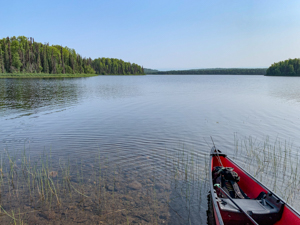 There are endless fishing opportunities in Alaska. From remote stretches of water to areas where “combat” fishing is the norm – July is when many anglers take to the water in pursuit of fish. So, grab your gear and head out.
In this edition of Reel Times, we share content aimed at helping you plan your next adventure.
Have you purchased your 2023 sport fishing license yet? If not, be sure to do so before you head out on your next fishing adventure. Visit our online store to get started.
If you have a comment for Reel Times, we encourage you to reach out to us. You can send comments to ryan.ragan@alaska.gov.
We'll see you on the water
Southeast Dungeness Crab Fishing
Dungeness crab (Metacarcinus magister), often caught in Southeast Alaska, are an especially delicious member of the Cancridae family.
Setting a few Dungeness pots makes a great addition to a day of sport fishing. While you are busy dragging a line for some salmon, jigging for halibut, or just enjoying a picnic on the beach, your Dungeness pot is at work. Next time you go out on the water try setting a few Dungeness pots at the start of your day and enjoy the surprise of seeing what emerges from the water when you pull the pots at the end of the day.
What equipment is needed?
Dungeness are most commonly caught using baited pots attached with a line to single buoy.
There are many styles and shapes of Dungeness crab pots ranging from heavy steel pots, commonly used in commercial fishing, to lightweight collapsible pots that can be folded down and stored. Any of these pots can be used as long as they are in compliance with a few criteria:
- Properly marked buoy;
- Proper biodegradable escape mechanism;
- Escape rings are the correct size and in the correct location.
For more information and examples of shellfish pot requirements there is a helpful video on the ADF&G YouTube channel.
Some of the most common violations we see in SEAK are pots manufactured in other states which don’t always comply with Alaska regulations. These pots can usually be easily modified to be in compliance by installing new escape rings on the vertical side of the pot. If you are ever in doubt, bring your shellfish pot into your local ADF&G office or to your local Alaska Wildlife Trooper for advice.
An initial investment in a pot, bait jar, lead line, and buoy can provide years of crabbing opportunity. Unlike rod and reel fishing where you need to put the lure in front of the fish, crab will come to the scent of fresh bait. Keep in mind that the better the bait smells to the crab and the larger the scent profile, the better your chance of success. Fresh fish carcasses, herring, and even canned cat food are commonly used. While pots are designed to make it difficult for Dungeness to climb out, after the bait has been consumed, Dungeness will be less motivated to crawl into the pot. Checking your pots on a regular basis and keeping them stocked with a good quantity of bait will maximize catch rates.
Where to set the pots?
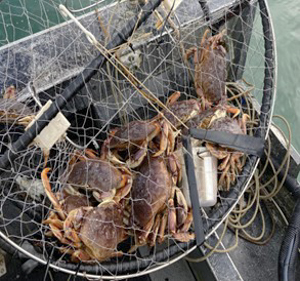 Dungeness prefer a sandy or muddy bottom. They may also be found near a stream feeding on dead and decaying fish washing out into the saltwater. Dungeness crab are generally found in water depths of less than 90 feet. However, 40-60 feet can be deep enough, and in some places as shallow as 20 feet or less. As with many fishing spots, places where Dungeness are commonly found are often heavily guarded secrets that those in the know return to year after year. One thing to keep in mind is ocean currents and tides can be strong enough to move a lightweight pot and can result in lost pots if the pot is pushed into deeper water and the buoy becomes submerged. If using a lightweight pot, consider adding additional weight or fishing in areas with minimal current. If a pot is lost don’t simply give up if you cannot locate it immediately. Instead, come back to the location at a low tide and you might be surprised to find your buoy on the surface again. Occasionally drifting seaweed can get caught on a buoy line and submerge the buoy but frees itself after a tide cycle. It is important to consider tide changes and have enough buoy line to keep your buoy afloat through the highest point of the tide. Also avoid too much line floating on the surface. A weighted buoy line works best keeping it slightly submerged to avoid most seaweed and outboard motors.
What are the bag and possession limits and pot limits?
Sport fishing regulations allow for 4 crab pots per person and 10 pots per vessel in Southeast Alaska, however residents of Alaska usually fish for Dungeness under Personal Use shellfish regulations which allow for 5 crab pots person and 10 pots per vessel. Personal Use also allows for a daily bag and possession limit of 20 legal-sized male Dungeness crab. Nonresidents of Alaska fish under sport fishing regulations where the daily bag and possession limit are 3 legal-sized male Dungeness crab. If fishing near Prince of Wales Island or in the Yakutat area, please refer to page 35 of the 2023 Sport Fishing Regulations Summary for Southeast Alaska for specific information as the bag limit is more restricted in selected areas while other areas are closed altogether to Dungeness fishing.
 What crab can be kept?
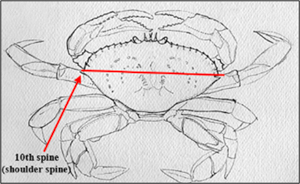
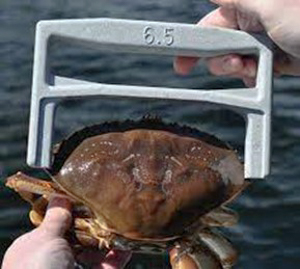
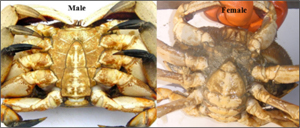
In order to be harvested a Dungeness crab needs to be male and be a minimum of 6 ½ inches across their carapace. A crab stick is an easy way to determine if your crab is legal. Measure the straight-line distance across the carapace, immediately in front of the 10th spine (shoulder spine), not including the spine. Only male crab may be kept. It is easy to discern the difference by looking at the abdominal flap on the underside of the Dungeness crab. The abdominal flap on a female is U-shaped and slightly domed while a male’s abdominal flap is V-shaped and relatively flat. All females and undersized (less than 6 ½ inches in width) crab should be immediately returned to the water.
How to prepare Dungeness to eat?
Two basic methods are used to prepare the crab. The first method involves submerging the whole live crab into a pot of boiling water, which kills the crab instantly. After boiling for at least 15 minutes remove and split the crab, dispose of the guts and gills, and serve the two leg sections or clusters. The second method starts with cracking open the crab while alive and removing the guts and gills, then boiling just the two leg sections or clusters. Crab should always be cooked soon after harvesting. They can be transported live from the fishing grounds in a cooler with some ice. Dungeness can be delicious in crab cakes, seafood chowder, or enjoyed straight out of the pot after boiling.
While Dungeness meat is generally safe to eat, it is not advised to eat the vital organs as Dungeness may be exposed to the algae that causes Paralytic Shellfish Poisoning. For more information, see the Alaska Department of Environmental Conservation Paralytic Shellfish Poisoning document(PDF - ADEC)
The Picturesque Beauty of Upper Tanana Lakes along the Denali Highway
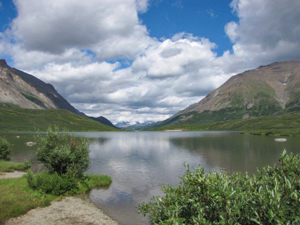 The Denali Highway (Alaska Route 8) is one of the most picturesque drives in Alaska, and perhaps in the world.
Open seasonally from mid-May to October, the mostly-gravel route cuts 135 miles through the heart of the Alaska Range from Paxson to Cantwell. It connects the Richardson Highway on the east and the Parks Highway on the west. When it was built in 1957, the Denali Highway was the only road link to what was once Mount McKinley National Park and is now Denali National Park and Preserve.
Much of the road – it’s more of a road than a highway –lies above timberline, offering majestic views of snow-capped mountains, glaciers and endless miles of rolling tundra dotted with shallow lakes.
And while the Denali Highway is famous for its spectacular vistas, it also offers fantastic sport fishing opportunities in several lakes on the east side of the highway. These lakes have healthy populations of lake trout, Arctic grayling and burbot that can be targeted from shore or in a boat, raft or canoe.
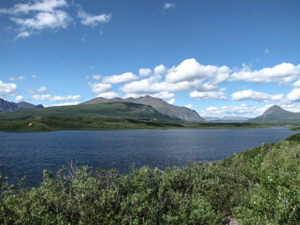 Starting at the junction of the Richardson and Denali Highways at Paxson, the first lake you will run into is Sevenmile Lake, which contrary to its name, is actually located at Milepost 6.5. A ¼-mile gravel road leads down to the lake where you will find a cleared gravel area for launching small watercraft as well as two flat spots where tents or small travel trailers can be set up. The lake contains lake trout and burbot, and can easily be fished by shore if you don’t have some kind of boat.
Continuing west along the highway you will find 16.8 Mile Lake, which as it’s name implies, is located at Milepost 16.8. There is a pull-off on the north side of the highway and a 5-foot wide trail leads about 200 feet to the lake. At the lake there is a cleared area to launch a canoe or small raft. The lake contains Arctic grayling and lake trout, and like Sevenmile Lake, can be easily fished from shore.
Next up is the Tangle Lakes area starting at approximately Milepost 20. Tangle Lakes is a series of long, narrow lakes that are connected by the Tangle River and form the headwaters of the Delta River. Included in this series of lakes are Long Tangle Lake, Lower Tangle Lake, Round Tangle Lake and Upper Tangle Lake. This is a popular fishing spot for lake trout anglers, especially immediately after the ice goes out in late May or early June.
The Tangles Lake Campground is a great place to set up a base camp, especially if you have a canoe or boat. The BLM campground features 30 tent and RV sites, as well as a boat launch. The campground offers direct access to Round Tangle Lake, which contains Arctic grayling, burbot and lake trout. Shore fishing for Arctic grayling is best near the inlet stream while a boat is better suited if you intend to target lake trout.
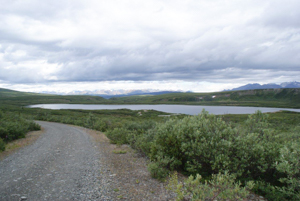 Just a few miles down the road to the west is Landmark Gap Lake at Milepost 25. Landmark Gap is a glacially-scoured cut in the mountains that formed during the Ice Age more than 10,000 years ago. A three-mile ATV trail leads you to the lake where you can fish for Arctic grayling and lake trout from the shore. Packing in a canoe or small, inflatable raft will broaden your fishing opportunities by getting through the Gap into the deeper basin of Landmark Gap Lake. Even if you don’t catch a fish, the views will take your breath away.
Equally as impressive is the scenery on Glacier Lake at Milepost 31. There is a pull-off on the north side of the highway with parking and a trailhead. A four-mile ATV trail will take you to the lake, which contains Arctic grayling, burbot and lake trout. There is good shoreline access for fishing.
A day or two – or three or four – spent fishing in the lakes on the east side of the Denali Highway is well worth the effort. Even if the fishing isn’t great, the scenery will take your breath away.
Featured Stocked Lakes of the Mat-Su Valley
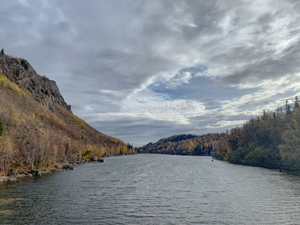 Did you know the Mat-Su Valley has over 80 stocked lakes? You can drive in any direction from Palmer or Wasilla and find stocked waters to fish in. This time of year, lake fishing is excellent. The William Jack Hernandez Sport Fish Hatchery in Anchorage has been busy moving all the fish that they have been growing over the winter into their forever homes. Stocked lakes provide opportunities for harvest and reduces pressure on our wild fish.
There is a lake for every angler in the Mat-Su. If you have kids and want to take them to places where they have plenty of shoreline and enough room to cast off the shoreline without getting tangled in the trees you can try your hand at a few different places. Alaska State Parks offers some of the more user-friendly places. Finger Lake State Recreation Site is a great place for little ones or new anglers wishing to practice some casting from shore. This location has a boat launch, sand beach for swimming a dock and lots of room for anglers to fish from shore at the park, in addition to vault latrines for necessary breaks.
Matanuska Lake State Recreation Site also has a lot of shoreline to fish and this lake becomes deep, fast, providing lots of structure and depths for shoreline anglers to practice on. This location also has hiking trails, and you will see people hiking, biking, and fishing all in one day.
Kepler/Bradley is part of the Matanuska Lakes Complex and has good shoreline access as well. A bridge separates the two lakes which becomes a natural place for fish viewing as well as angling. There is a private campground and boat rental on location as well for folks wanting to get offshore. Bradley lake has a small boat launch, and you will see many canoes, kayaks, float tubes, and small boats with electric motors fishing all summer long. This lake is one of the busiest in the Mat-Su and is aggressively stocked to keep up with the traffic during the summer and winter months.
If you are a little more on the adventurous side and want to take a 4-wheeler ride or hike in, try Ruby or Wishbone Lakes. Both these lakes are beautiful in destination once you get out to them. You will need waders or a float tube to get out and catch some fish. This is a popular time of year before hunting season starts to try your luck in a more remote location. Wishbone is a single hook, catch and release lake, which can provide a chance at some nice big rainbows!
Some of the prettiest lakes in the Mat-Su are up the Glenn Highway. If you want to spend a day fishing with awesome mountain views head that direction! Knob and North Knob lakes off the Alascom tower road will get you away from the sound of traffic and give you a chance to take in the beautiful landscape in the Eureka area. Both lakes are right off the gravel road, and you will want a canoe, kayak, small raft, or float tube to fish them. Lakes also in this vicinity that are stocked include Ravine, Weiner, and Long Lake at mile 86 off the Glenn Highway. Long Lake has an un-improved boat launch and power boats are allowed. This lake has many different species stocked, including rainbows, grayling, Arctic char, and Lake Trout.
One of the newer stocked lakes to the Mat-Su is Summit Lake in Hatcher Pass. Summit still has some ice on it and the hatchery staff will soon stock it with rainbow trout again for the summer. This is a beautiful little lake with hiking opportunities and a trail with minimal plants all the way around it since it’s at the top of the pass. This is a great place to hike, free public access, and you can fish and take incredible photos with amazing backdrops.
Finally on our tour of highlighted stocked lakes is Reflections Lake off the Glenn highway. This lake is heavily used with people traveling on the Glenn Highway. It’s a great place to get off the road, stretch your legs and take a walk and do some fishing. There is a one-mile loop all the way around the lake providing great access and easy walking.
For more information on any of our stocked or wild lakes please visit the Alaska Lake Database, this site provides stocking data, driving directions to public access, and lake depths.
Did you know some ADF&G Offices loan sport fishing gear free of charge? For more information, check out our Rod Loaner Program. If you need to borrow a fishing rod, stop in and see us and we can talk with you about our free program. Get out and Fish!
What is barotrauma?
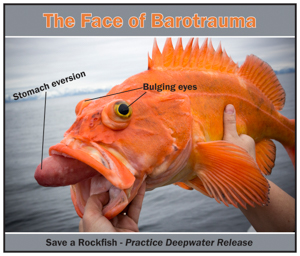 Rockfish caught in deep water often sustain injuries — referred to as barotrauma — caused by rapid decompression and expansion of gases in the swim bladder. Outward signs of barotrauma include the stomach protruding from the mouth of the fish, everted eyes and a taught abdomen.
Fish suffering from barotrauma that are released on the surface are often unable to resubmerge on their own. Think of it as if the fish were wearing a life jacket. When released, the fish may try to swim down but is not always successful. They will then float on the surface which makes them susceptible to predation by birds, marine mammals or other fish.
Alaska anglers can best prevent wasteful rockfish mortality by avoiding waters where unwanted catches of rockfish are likely. When rockfish are caught incidentally despite avoidance efforts, proper deepwater release techniques can reduce discard mortality. An ADF&G study found that survival of yelloweye released at depth was far higher (98 percent) than survival of fish released at the surface (22 percent).
There are various ways to return a rockfish to depth of capture or 100 feet using a deepwater release mechanism. Deepwater release mechanisms are sold commercially or can be manufactured by anglers using a few simple items.
ADF&G has posted a few videos showing how to use a deepwater release.
How to use a deepwater release device to release a silvergray rockfish
How to use a deepwater release device - release of a yelloweye rockfish
Online Resource to Help ID Rockfish
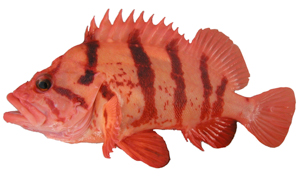 With over 40 different species of rockfish found in Alaska, identifying each species can be challenging. We’ve added a rockfish identification section to our website to help you in your rockfish ID efforts.
You’ll find pictures and descriptions of rockfish species here.
Field to Plate - Recipe of the Month
Recipe of the Month – Wild Alaska Firecracker Salmon
 Here’s a delicious recipe for Wild Alaska Firecracker Salmon from the Alaska Seafood Marketing Institute.
Enjoy!
If you have any questions about the Reel Times newsletter, please contact Ryan Ragan at ryan.ragan@alaska.gov