

April 2023
Issue 64
Exploring the Beautiful and Bountiful Waters of Alaska
 Spring is here and warmer, longer days are upon us. For many, this is the time when we begin planning our next fishing adventure.
You don’t often have to go too far from home to find great fishing. However, there are many of us who opt to take advantage of all the great fishing opportunities Alaska has to offer and we make plans to seek out a fishing trip that is a little more remote and adventurous.
Ever wanted to fish for sheefish in the northern part of the state? Or go collect scallops in Southeast Alaska? Scroll down and enjoy some exciting and informative content.
Before you head out, be sure you have your 2023 sport fishing license. Visit our online store if you need to purchase one. Or download the ADF&G mobile app and you can store your licenses, tags and permits in your mobile device.
Are you following us on social media? If not, be sure to check us out on Instagram @wefishak. You can also follow us on Facebook at ADF&G - wefishak . Also, visit our YouTube channel for a growing selection of "how-to" videos and much more.
If you have a comment or story ideas for Reel Times, we encourage you to send them our way. You can send comments to ryan.ragan@alaska.gov.
We'll see you on the water
Kobuk Dreams: Fishing for Sheefish in the Arctic
By Brendan Scanlon and Tim Mowry
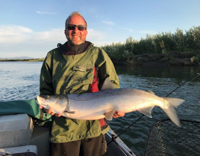 Years after the fact, fisheries biologist Brendan Scanlon still vividly remembers the evening that he and fellow biologists were setting minnow traps and stumbled onto a fishing hole full of huge sheefish.
It was mid-July and Scanlon’s crew was sampling Dolly Varden for a genetics stock identification project on a tributary of the Kobuk River when they entered the lower reaches of the Hunt River and saw a cloud of big white shapes stirring under the boat.
"It was midnight, and it was sunny and 70 degrees," said Scanlon, the Alaska Department of Fish and Game area biologist for the Northwest and North Slope management areas. "We found a pod of sheefish in a cold tributary and just caught fish until we were too tired to fish anymore."
"It was amazing," he recalled.
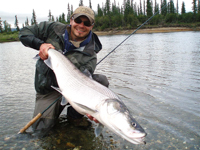 Typically, members of the whitefish family don’t attract much attention from Alaska sport anglers but that’s not the case when it comes to Kobuk River sheefish. When you are a large, predatory whitefish species that can reach 50 pounds and aggressively attack spoons and flies, sport anglers tend to take notice.
Located in the Arctic region of northwest Alaska, Kobuk River sheefish attract anglers from Alaska and around the world while also supporting an important subsistence fishery for residents of the Kotzebue Sound area.
"It’s a destination fishery for sport anglers who can afford it," Scanlon said, referring to the high cost associated with accessing the remote river.
 The Kobuk River originates in the Endicott Mountains of the Brooks Range and flows more than 400 miles from Walker Lake to the Kotzebue Sound in the Chukchi Sea. It flows south from the mountains through two spectacular canyons (Upper and Lower Kobuk Canyon) before turning west along the southern flank of the western Brooks Range in a broad wetlands valley. There are five villages along the river (Noorvik, Kiana, Ambler, Shungnak, and Kobuk) accessible by air from Kotzebue or Bettles, or by boat from Kotzebue.
The high cost of getting there is well worth it, Scanlon said. The Kobuk River offers world-class fishing for sheefish fish (inconnu), which is the largest member of the whitefish subfamily (family Salmonidae; subfamily Coregoninae). Their tremendous size, fighting ability, and fine eating qualities make the sheefish one of the most unique fish in North America. Sheefish have a white, flaky meat that is similar to the taste and texture of halibut or ling cod, Scanlon said.
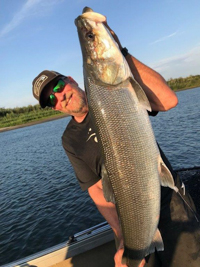
Fish up to 50 pounds can be caught in the Kobuk - the Alaska state record sheefish (53 pounds) was caught near the mouth of the Pah River, a tributary of the Kobuk, in 1987 – but fish in the 15- to 25-pound range are more common. In other areas of Alaska, such as the Yukon and Kuskokwim River drainages, they tend to be much smaller, rarely reaching 30 pounds. In Canada, they are also found in large, land-locked lakes such and Great Bear and Great Slave Lakes.
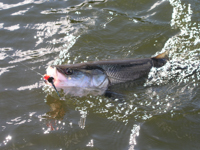 Sheefish are white or silvery in color without spots or other markings and have very large scales. The lower jaw extends beyond the upper jaw and the mouth is full of small densely packed teeth. A large population of sheefish migrate up the Kobuk River from Hotham Inlet in Kotzebue Sound beginning in late-June. Fish travel over 300 miles to their spawning grounds, and spawn in September. The nearby Selawik River also has a large population of sheefish, but telemetry research has shown that these are two distinct populations and that there is no evidence that Kobuk River sheefish enter the Selawik River, or vice versa.
Anglers typically fly in by float plane from Fairbanks or Bettles to the river’s headwaters in Walker or Minakokosa Lakes and float 50-80 miles before getting picked up or flying out commercially from one of the villages located along the river. The best fishing occurs in a 40-mile stretch of river between the Maneluk and Selby Rivers. There is a section of rapids just below Walker Lake that requires portaging about ¼ mile, and several sections of Class III and IV water that may require lining, depending on water levels.
"Once you get below (the rapids) it’s pretty mellow," Scanlon said. "Some of the gravel bars are like giant, sand beaches. It’s not like you’re camping in a bunch of willows on a cutbank."
Fishing is good throughout July in the lower river and is good upstream of Kobuk from mid-August to mid-September. Large spoons fished deep work best, and large soft baits work well too. Sheefish aren’t picky, Scanlon said.
"They hit everything," he said.
Flies can be productive in shallow water but should be large and flashy with a strong hook and fished close to the bottom. Fly anglers should use a weighted-tip line, as sheefish normally do not hit surface lures.
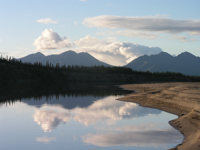 Many of the anglers who target sheefish in the Kobuk River are caribou hunters who float the river in September, Scanlon said.
"September is a good time to fish because that’s when they’re spawning," he said, adding that there is not much better than a shore lunch of grilled sheefish.
In addition to sheefish, anglers can also target large Arctic grayling and northern pike in the Kobuk River. In the summer months, expect temperatures anywhere between 40 and 80 degrees, with both bears and mosquitoes stopping by your camp for a visit, so preparation in this out-of-the-way place is essential. However, the long, sunny days and fantastic fishing in such a special place will be what you remember the most.
Rock Scallops in Southeast Alaska
By Troy Tydingco
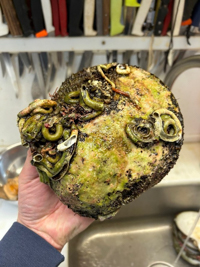
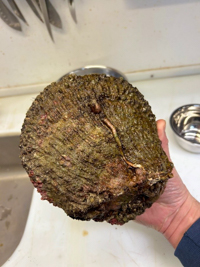 The Purple Hinged Rock Scallop (Crassadoma gigantea) named for the brilliant purple "hinge" that attaches the two shell halves together is an overlooked Alaskan delicacy. They typically are found from Mexico to Southeast Alaska and inhabit shallow waters exposed to good currents, often near an outer coast. Although not the largest scallop, they are the heaviest as they are slow growing, and have thick, protective shells. Juvenile rock scallops are free swimming, occasionally attaching themselves to a substrate with byssal threads, but it is not until they reach approximately 1.5-2" that they attach themselves permanently. Whatever surface the scallop has chosen will be home for up to 20 years.
Scallops develop excellent camouflage over time. Their shells host a variety of organisms such as algae, sponges, barnacles, tubeworms, etc. They look just like a rock, except for the orange or white fleshy ring around the perimeter of the shell that is exposed when the clam is relaxed and breathing/feeding. Scallops are filter feeders that trap small planktonic organisms in the mucous of the exposed fleshy ring. Cilia then serves to deliver these organisms to the scallops’ mouth. When threatened, the adductor mussel of the scallop (the meaty part you eat) slams the shell halves closed making it difficult to open.
 Unlike many critters in Alaska that must be stalked or chased down, rock scallops rely on good camouflage, and rely on their protective shell while they stay in place. While harvesters can sometimes get lucky and find rock scallops exposed above the water line on a low tide, a surer bet is to explore the shallow waters at low tide with a wet or dry suit. A drysuit is comfortable even in the winter, when the visibility is best, but a 7millimeter thickness wetsuit will also work for short snorkel trips in the winter. During the warmer summer months (which is also when the best low tides are during daylight hours) a lighter wetsuit will suffice. Most anglers will also wear a lead weight belt to allow them dive to depth (usually only a few feet). Besides your snorkel or dive gear, you’ll also need a bag to put your catch in and a good tool (like an abalone iron) to pry scallops out of the rocks. Keep in mind that just because you’ve found a scallop doesn’t mean that you will be able to harvest it. Sometimes they are so embedded in the rocks, they cannot be pried out. Best to leave these in place.
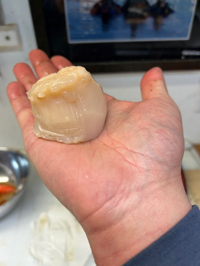
Rock scallop adductor muscle is large compared to other scallops. It can be used like any other scallop meat. It’s sweet and firm and is often enjoyed raw or in ceviche. It is also frequently pan-seared, baked, or broiled.
 A word of caution about PSP. Like most other shellfish, rock scallops can and do absorb the dinoflagellate that causes paralytic shellfish poisoning (PSP) and there isn’t widescale testing for these, so harvesters do so at their own risk. The toxin appears to concentrate more in the guts than in the adductor mussels.
Rock scallop harvesters in Southeast Alaska are allowed five per day and it’s open year-round.
A Story of Rockfish Survival
By Brittany Blain-Roth
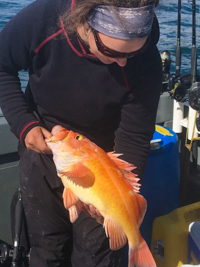 Rockfish management is not simple. There isn’t a weir to count fish through, a peak run timing to monitor, or cameras under the ocean to count every fish. Many rockfish species congregate together, share similar habitats, and tend to have similar feeding habits. Did I mention there are over 40 different species of rockfish found in Alaska?
Most of the rockfish studies I have conducted for ADF&G over the last 15 years have been related to the use of a deepwater release mechanism. Maybe you have heard of deepwater release? If you haven’t, check out the ADF&G YouTube channel How to videos. Many people have had a hard time with releasing a rockfish back down to depth of capture. A common question I have gotten over the years is, "How do you know they survive?" And as a Fisheries Biologist, I feel lucky to be able to say that I have been a part of studies focused on short term survival following deepwater release, and these studies have proven that rockfish released at depth can and DO survive.
I began working for the Division of Sportfish during the summer months between 2008–2010, and I spent (SO MANY!) hours with 1–2 other individuals, sampling rockfish in Eastern Prince William Sound. This is the same bay where the Department conducted a mark-recapture project to determine the survival probability of yelloweye rockfish released at the depth of capture using a deepwater release mechanism (Hochhalter and Reed 2011). This study found that survival of yelloweye rockfish returned to depth of capture to be greater than 98%! This same sampling site was also used for my Master’s Thesis work where I determined that yelloweye rockfish could reproduce 1-2 years after being subjected to deepwater release (Blain and Sutton 2016). For perspective, we didn’t just sample a dozen fish or so, we sampled and tagged over 300 yelloweye rockfish (and a few other rockfish species).
"But what about long-term survival?"
Valid question.
"These fish live a long time, so what if they are alive after 2 days or 2 weeks in your studies."
Ok, you can show they live for two years after being released with a deepwater release mechanism… that’s pretty neat…I’m pretty much sold, but what about beyond that? I mean, yelloweye rockfish can live for over 100 YEARS!"
 Can anyone guess how many times I have been asked about long-term survival of rockfish? I can’t because I have lost count, so that tells you just how many times! Until a few years ago, I didn’t have much of an answer about what long-term survival looked like, but now I can share a story of the longest living yelloweye rockfish following deepwater release (that I know of) and just what can happen when you use deepwater release to release a rockfish.
It was the summer of 2018… it had been 10 years (almost to the day!) from when I first used deepwater release to release one particular rockfish. I had started my job as a Fish and Wildlife Technician with the Division of Sportfish with my job priorities directed at tagging and releasing rockfish. That’s right, I was to spend hours upon hours fishing for rockfish (don’t be jealous, it was HARD work), tagging them, then dropping them back down to depth of capture or 100 feet (whichever was less). And guess what?!! ... now those near exact words are in REGULATIONS STATEWIDE per the Board of Fisheries direction. My apologies, I digress from the amazing story I would like to share.
But back to 2018; it was June 9th when fisheries biologists Donnie Arthur, Phill Stacey and I were fishing a super secret spot in Prince William Sound where these PIT tagged yelloweye rockfish were HOPEFULLY still alive. It was on that day that after a short time of fishing we found out that at least one was alive!
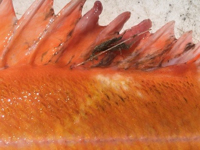
Donnie was reeling in the lines to end the day and I was feeling disappointed that we hadn’t caught a tagged yelloweye rockfish. As he reeled in the last two fish, I looked down and couldn’t believe what I saw… It looked like what could be a piece of a Floy tag near the dorsal fin of the fish (we did Floy and PIT tag fish in 2009 and 2010). Could it actually be a recapture??!
I got out the PIT tag scanner and heard the "beep-beep" of a positive read, looked down and scrambled to write down the numbers identifying this fish. I had all the data back in the office and couldn’t wait to see what kind of information would be gleaned from this recapture!
Back in the office I pulled up the data, and this yelloweye rockfish had originally been caught on June 1, 2010. A staggering 8 years and 8 days between captures! In those 8 years it grew just over 5 inches. In 2010 it had been identified as an immature fish and in 2018 we identified it as a male. The fish exhibited the effects of barotrauma after both captures with its stomach protruding from its mouth and in 2010 this fish also exhibited the barotrauma effect of protruding eyes, which was not present in 2018.
The takeaway message? Rockfish can and do survive when released at depth of capture (or 100 feet) when using a deepwater release mechanism. We can continue to reduce discard mortality of rockfish when we use a deepwater release to release rockfish you can’t or don’t want to keep. So, remember to carry a deepwater release mechanism on your boat when fishing whether you are targeting rockfish or not. In case you incidentally catch one, you can release it knowing it will survive to potentially be caught again!
2023 Sport Fish Regulation Summary Books Now Available
The 2023 Sport Fish Regulation Summary Books are now available online, at ADF&G offices, and at vendors across the state.
There are four separate books that outline sport fishing regulations by region:
Be sure to check the regulations for the area you plan to fish before going fishing. If you have questions, please contact an ADF&G office. You’ll find contact information here.
Field to Plate - Recipe of the Month
Recipe of the Month – Wild Alaska Salmon with Tortellini in Cream Sauce
 Here’s a delicious recipe for Wild Alaska Salmon with Tortellini in Cream Sauce from the Alaska Seafood Marketing Institute.
Enjoy!
If you have any questions about the Reel Times newsletter, please contact Ryan Ragan at ryan.ragan@alaska.gov