
Alaska Fish & Wildlife News
August 2026
Ammo and Eagles: Falconers on the Frontlines

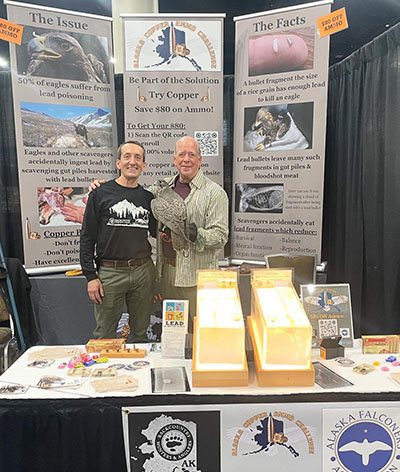
Wandering the halls of the Alaska Federation of Natives (AFN) Convention in 2025, passersby were often stopped short by the sight of a live bird at one of the many booths. A closer look revealed a beautiful juvenile Gyrfalcon with pale blue feet, black eyes and silvery dappled plumage perched on a man’s gloved fist. Across the table at his side was a collection of ballistics gels and x-rays, posters of eagles at his back.
This was Ron Clarke, the founding member of the Alaska Falconer’s Association, alongside Travis Booms of ADF&G’s Threatened, Endangered, and Diversity (TED) Program. They were running the booth for a program that Clarke originated and leads with the support of the Backcountry Hunters and Anglers (BHA) and ADF&G. This is the Alaska Copper Ammo Challenge.
Get the Lead Out
The Copper Ammo Challenge aims to address an ongoing conservation concern for raptors. Hunting with lead ammunition, which fragments considerably on impact, can lead to small pieces of lead being unintentionally left in gut piles. It only takes a piece of lead smaller than a grain of rice to kill an adult eagle and recent studies have shown that nearly half of the country’s eagle population has chronic lead poisoning from lead ammunition use. Solid copper ammunition (not copper-jacketed lead) is an alternative option that prevents lead exposure to eagles, and other scavengers like chickadees, ravens, and foxes. Copper does not fragment as much as lead, is not as toxic, and is an alternative option that can make a difference for local wildlife.
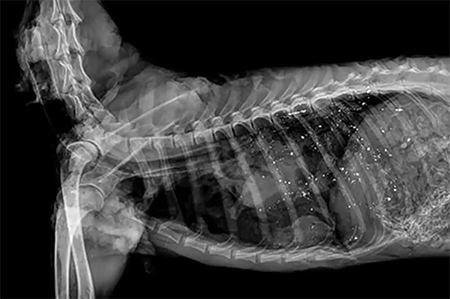
In 2022 when the extent of lead poisoning in the country’s eagle population was published, Clarke was inspired to investigate the realities of how the benefits of shooting copper could be employed in Alaska. The higher cost was the most common barrier to hunters trying copper, and so Clarke organized the Alaska Copper Ammo Challenge which offered licensed hunters with a mailing address in Alaska a rebate of up to $80 off two boxes of copper rifle ammunition or up to $50 off two boxes of bullets for reloading. The Copper Ammo Challenge combines the efforts of BHA, ADF&G, and local falconers and hunters.

“It’s a multi-fronted partnership and I’m just absolutely thrilled with the way it’s worked out” says Clarke.
Falconry and raptor conservation have often gone hand in hand, with falconer Tom Cade famously founding the Peregrine Fund in Idaho in the 1970s and acting as a leader in bringing Peregrine Falcons back from the brink of extinction using expertise that only a falconer would have. As a falconer and biologist himself, Clarke also pairs raptor conservation with falconry and hunting, helping to write the Alaska Falconry Manual and founding the Alaska Copper Ammo Challenge. It has taken off in the last few years, giving out over 1,500 rebates to local hunters who have signed onto the program. Outdoor shows across the state are a great prospect to spread awareness of this opportunity for hunters to participate in hands-on conservation. The events have grown over time as well and local falconer, farmer, and hunter Courtney French has recently volunteered at many of these shows with Clarke. She describes the Copper Ammo Challenge as “a voluntary movement by hunters for hunters to spread education and awareness about the dangers of lead poisoning in our bird friends.”
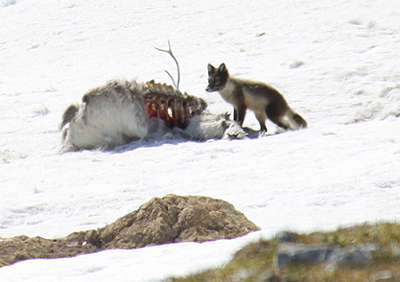
Clarke, French, and Booms employ visual aids at the event booths, often accompanied by French’s Red-tailed Hawk Clementine. “If you can show somebody that…only this much lead, this tiny little bit of lead [affects an eagle], it really drives home the severity of it. We’ve talked to over 3,000 people just this year alone.”
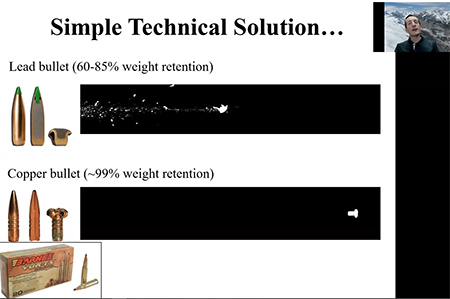
These aids include the ballistics gel, shot with lead bullets and copper bullets, demonstrating how the lead bullet fragments while the copper bullet retains its mass. This highlights another benefit of copper - that many hunters prefer it based on performance alone.
“It’s precise,” says Clarke, “it’s consistent, it’s accurate...it mushrooms well and stays in one piece.”
Clarke has noticed a significant difference in public perception of the conservation issue over the last few years. At the first outdoor shows Clarke would ask people if they had ever shot copper and often got questioning responses, people not knowing about the benefits or the conservation issue of raptors. These days, people know about copper, they like it, and they use it. “It’s really a cool project, I just love it. There really aren’t any downsides to it…It’s a win win win win win situation.”
As the program grows, more Alaskan hunters shoot copper, and more rebates encourage people to give copper a try. That’s thousands of gut piles free of lead over the years and more eagles in the sky. Alaska is home to some 30 species of raptor, including the entire country’s breeding population of Gyrfalcon, Snowy Owl, and Northern Hawk Owl, and over 75% of Bald Eagles. It’s incredible habitat for raptors and small changes in the community, like shooting copper, can help sustain the populations for generations to come.
More on Eagles and lead
Ammo and Eagles from Alaska Fish and Wildlife News, December 2022
20-minute presentation, The Effects of Lead Hunting Ammunition on Wildlife, summarizing the findings and highlighting the Alaska component of the research.
Blood levels of common ravens with access to big-game offal, Journal of wildlife Management.
Good News about Golden Eagles: Alaska is Home to a Quarter of the US Population
Population-level effects of lead fishing tackle on common loons
Subscribe to be notified about new issues
Receive a monthly notice about new issues and articles.