
Alaska Fish & Wildlife News
August 2026
Wrong Place at the Wrong Time
A Dall sheep mortality site analysis
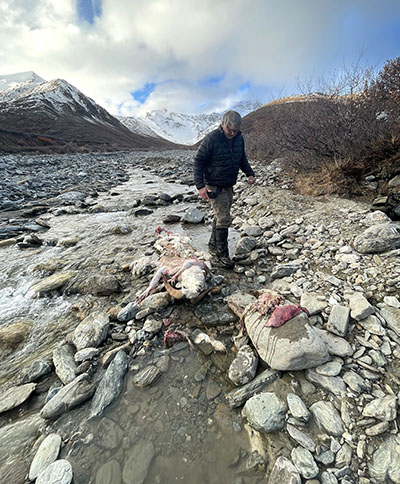
There aren’t many things that I’d rather be doing on a cool autumn evening in Interior Alaska than jumping in a helicopter to go investigate a wildlife mortality site.
Fortunately, that’s where I found myself; flying across the Tanana Flats and up a river valley into the foothills of the Alaska Range with ADF&G’s Northern Region Dall Sheep biologist, Brad Wendling.
Brad is currently orchestrating one of the largest Dall sheep research studies ever undertaken in Alaska, prompted by concerns over the widespread decline of Dall sheep populations throughout their range. As part of his research, Brad has deployed close to 300 GPS/VHF radio collars on Dall sheep in multiple study sites around the state, from the Brooks Range to the Alaska Range. Amongst other data, he is opportunistically investigating causes of sheep mortality.
About 24 hours prior to us flying, Brad received a mortality signal from one of his radio-collared rams in the Alaska Range. Because little time had elapsed since the sheep died, and the animal was relatively accessible, this was an ideal opportunity for a timely mortality site investigation. The death of a prime-aged ram in the fall time is not what he expects to see.
The amount of time that passes between a mortality event and the site investigation is a large factor in determining an accurate cause of death. The more time that passes, the less clear the evidence becomes and the less confidence in accurate determination. Scavengers and weather have an impact on the scene and lessen the ability to determine primary vs. secondary signs of mortality and muddy the waters. Predators also scavenge so care must be taken not to attribute cause of mortality with correlation from tracks and sign in the area.
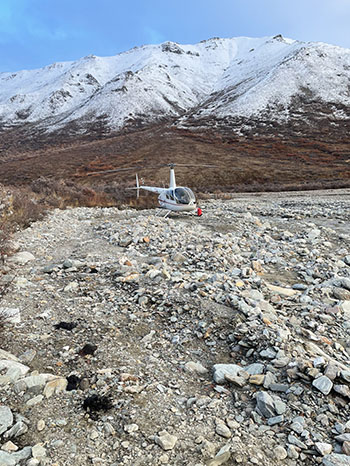
In our case it was the best scenario; fresh kill, little time passage. This is rarely the case with mortality investigations, especially in Alaska. Many of these animals are in remote locations, making it difficult or sometimes impossible to access them in a timely manner. The time of year, remoteness, weather, helicopter availability, and funds available all play a role in accessing dead animals.
We reached the alpine and homed in on the radio signal, hovering over a wide, rocky creek bed which flowed into another rocky creek between the rounded hills of a shallow alpine valley. As we approached, a bald eagle flew away - a sure sign that there was a carcass nearby. Even with a radio signal it can be challenging to spot a carcass amongst the rocks and vegetation. We hovered, circled and looked, finally seeing the cryptic remains lying in the in the shallow creek below us.
We landed on a gravel bar and the pilot shut down the helicopter, giving us time to investigate.
Approaching a site slowly and gathering evidence as you approach is important. It is natural to want to go right to the dead animal and start examining it. However, if you approach the kill site right away, you may miss (or destroy) signs that provide evidence of how the scene unfolded. Stay back, approach slowly, and gather evidence as you cautiously proceed.
As soon as we landed, I noticed multiple bear scats along the narrow gravel bar which butted up to a two-foot bluff grading into vast alpine shrub and tundra. The scats were full of crow berries, bear berries, and leaves, and there were several of them. One bear scat closer to the sheep carcass was dark and liquid with little vegetation in it – a meat and organ scat. The bear had fed on the recently deceased sheep.
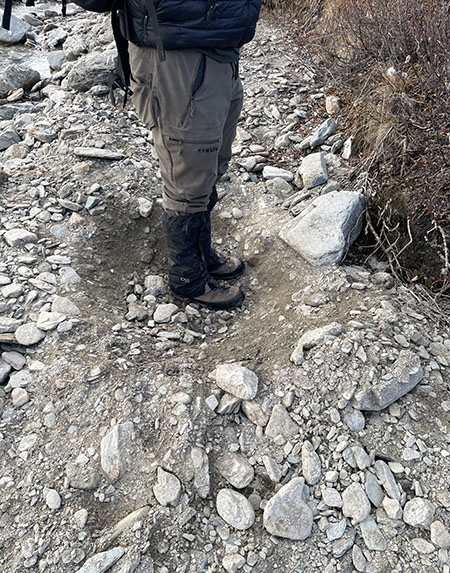
There were also two shallow round depressions dug into the gravel bar below the bluff. These were bear beds, and they indicated that the bear(s) had been using this area for a while as a feeding site. Pre-denning bears enter a state of feeding called hyperphagia. This means that they have an insatiable appetite, leading them to gorge on any food possible to gain enough fat to make it through the long winter in their den. This bear was gorging on alpine berries but certainly wasn’t going to turn down a large, bonus protein meal.
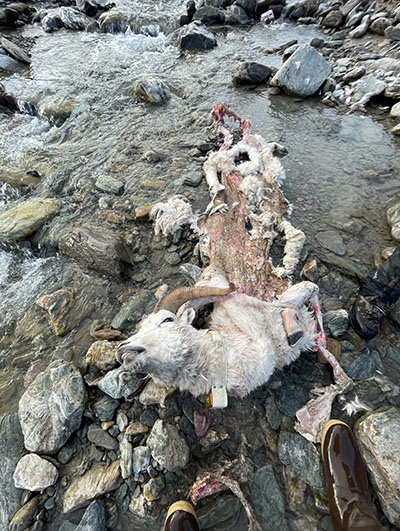
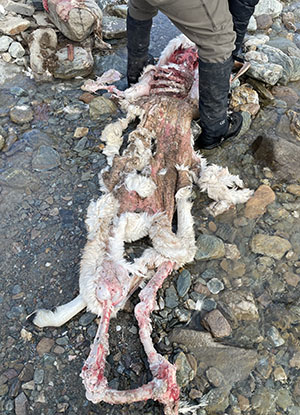
Down in the creek in a couple of inches of water flowing over gravel and rocks lay the stretched-out sheep carcass. Its head and neck were intact down to the radio collar. From the radio collar rearward, it appeared as though someone had skinned the animal and removed everything from inside. Indeed, the only thing remaining of the sheep below the neck were some cleaned long bones, some cleaned ribs, the feet and hooves, and the remains of the broken spine. It is common for bears to skin the hide of their prey back as they feed on the meat. It appears uncannily delicate for such a powerful creature and leaves the carcass looking like a person could have skinned the animal.
All the meat was consumed, and the guts and rumen were gone. Bears are one of the few large predators that regularly eat the rumen of their prey. There were a couple of pieces of lung left (lung tissue looked normal) but that’s about it. What the bear didn’t eat the scavengers were cleaning up.
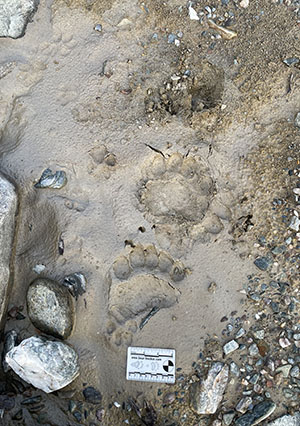
We searched the area around the carcass. Up and down the creek and around the brushy area of the tundra. The scene was surprisingly contained in a small zone around the carcass in the creek. There was not much to be found in the sand along the creek other than grizzly bear tracks (it appeared as though they were from one bear only), a few coyote tracks, and a red fox track. There were no sheep tracks. There was no evidence of a struggle, which supported my developing hypothesis.
What happened to the sheep? We can’t be 100 percent sure, but I feel good that we came to the best conclusion based on the evidence. Piecing the sign together (and lack of sign) led to one likely conclusion.
Because the event happened in the creek it explained the lack of tracks and evidence of a fight or a struggle. The water flowing over the rocks and gravel quickly erased any signs of a struggle and the kill. In different substrates the tracks and signs would be more revealing. But this is what we had.
An otherwise healthy 5-year-old ram (bone marrow examination looked good) was crossing the drainage from one rocky mountain to another. He was quite exposed in this area with no escape cover from predators. The sheep walked into the valley and came to the confluence of the creeks where the bear was bedded down. As the sheep walked down the creek bed (explaining the lack of tracks in the surrounding area), it literally walked right in front of the bear beds and no doubt the bear was waiting there to ambush it. It likely happened quickly as the sheep was only a few yards from where the bear had cover to remain hidden. The bear pounced on the sheep and quickly dispatched it with brute force. The spine of the sheep was broken (this could have occurred after the fact) and the neck area showed significant hemorrhaging when it was skinned back.
It then proceeded to gorge on the sheep over the next day or so. The bear was done feeding on the sheep and had moved elsewhere before we arrived. We searched the area around the carcass before we landed and found no trace of the bear. Often when bears have a large meal, they will drag it into some cover and bury it with debris if it is more than they can eat in one sitting. This bear didn’t move the carcass out of the creek but fed on it where it lay. Scavengers came by and ate or departed with some of the remains. And they surely returned to the scene to scavenge more once we departed, taking the collar with us, as it can be refurbished and reused.
This was an exciting find. While grizzlies may not kill and feed on adult ungulates often, they are opportunistic and will not look a gift horse in the mouth so to speak. And while they are fast animals, they rely more on short bursts of speed and/or ambush to catch larger prey.
A friend of mine was bow hunting on the north slope of Alaska some time ago. He was on a knoll and was watching a few caribou walking through the brush approaching his direction. All a sudden a grizzly appeared from the brush and quickly took down one of the caribou. He had no idea that the bear was there, waiting in ambush, and the speed at which the whole event occurred was shocking.
We don’t get to see these dramatic events play out often even though they occur on a regular basis. But with a bit of patience and careful examination we can piece together events from the tracks and signs. In my mind I can clearly see this grizzly bursting from the brush on that gravel bank and violently grabbing and dispatching the Dall sheep ram. And for me, seeing the evidence and piecing together what occurred is just as exciting as seeing the event itself.
Mike Taras is ADF&G’s Wildlife Education Specialist for Interior and Northeast Arctic Alaska. He is passionate about natural history study, particularly wildlife tracking.
Subscribe to be notified about new issues
Receive a monthly notice about new issues and articles.