
Alaska Fish & Wildlife News
June 2026
New Research Highlights Alaska’s Iconic Geese
Rocket nets & solar-powered collars offer insights
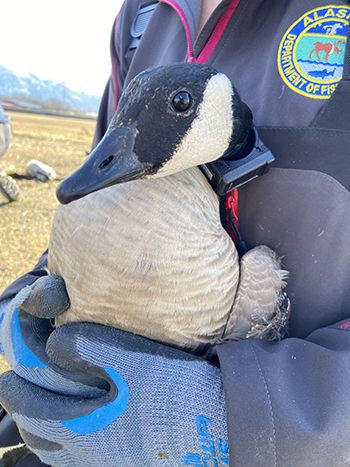
The honk of migrating geese is one of the great harbingers of spring throughout much of Alaska. Lesser Canada and Taverner’s cackling geese are two of the most ubiquitous species across the state – occupying large lakes, small ponds, black spruce forests, urban lawns, agricultural fields, and tundra, from Utqiagvik to Cold Bay to Cordova. Despite being classified as separate species, these geese are virtually indistinguishable – causing frequent debate amongst birders, waterfowl enthusiasts, and biologists across Alaska and beyond.
Since 2022, biologists with the ADFG Statewide Waterfowl Program have been studying these two species of geese to gain a better understanding of their seasonal distributions, migratory pathways, and survival. Pursuit of these birds has taken biologists across Alaska, from Teshekpuk Lake to Innoko National Wildlife Refuge, to downtown Anchorage, and to locations in Oregon and Washington where the majority of these geese spend their winters.
Catching geese
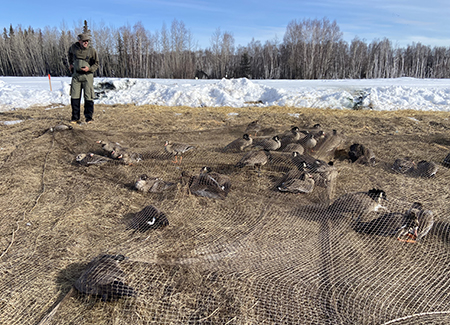
Geese are primarily captured using rocket nets or corralling them into funnel traps during summer when they have molted their flight feathers, though biologists occasionally employ less conventional means such as cast nets and hand capture. When a goose is captured, a DNA sample is collected for species determination, the bird receives a metal leg band with a unique number for identifying the individual, and some are fitted with light-weight solar-powered GPS collars. These collect hourly location data and then transmit the data to biologists via cell phone towers. Once a goose is marked with a GPS collar, biologists can monitor that bird’s movements in near-real-time, allowing them to anticipate the arrival of migrating birds, locate nesting females, and see the effects of birds encountering severe weather systems.
In April 2026, ADFG Waterfowl Biologists again took to the field, traveling to Delta Junction, Fairbanks, and Palmer where, with the assistance of local ADFG staff and volunteers, they intercepted geese just arriving on their way to their breeding grounds in interior, western, and northern Alaska. The success of this effort, like many before, depended on the generosity of private citizens who allowed biologists to trap on their property and, in some cases, went so far as to use their personal equipment to clear away snow to create areas of bare ground for trapping. Such altruistic actions speak volumes about the appreciation Alaskans have for their wildlife resources and enable agency biologists to complete the work required to successfully manage wildlife.
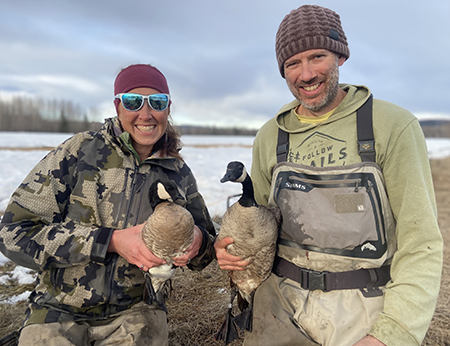
Using large rocket nets and many bags of grain as bait, biologists were able to deploy an additional 24 collars, many of which had been previously deployed on geese and subsequently recovered by hunters and volunteers throughout western North America. Data from these collars has allowed biologists to identify nest sites, molt locations, staging and stop-over sites, migratory pathways, and winter distribution. To date, over 230 geese have been marked with GPS collars, resulting in over 4,000,000 location data points.
Answers and surprises
Data from this project are validating some long-standing assumptions about these goose species while also revealing aspects of their lives that were heretofore unknown. Biologists have long believed Lesser Canada geese to be distributed throughout the boreal forests of interior Alaska during the breeding season. Conversely, 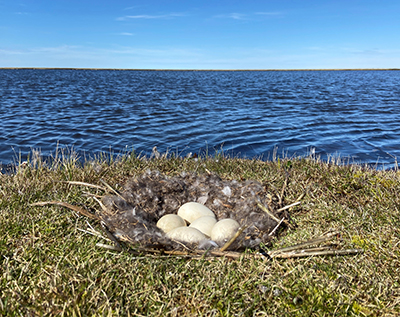 Taverner’s cackling geese have been thought to nest in coastal tundra habitats of western and northern Alaska. GPS collar data, paired with information from genetic species determination, have revealed that these habitat associations are generally correct, though there are exceptions to every rule.
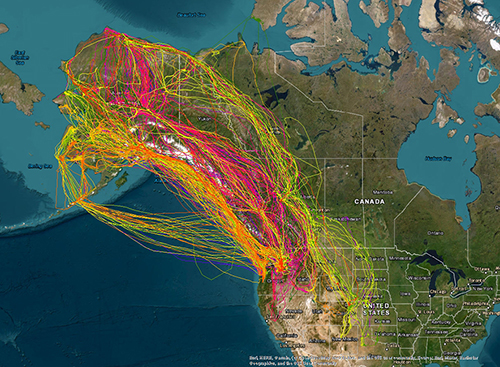
In the late 1990’s, researchers working with these species, but lacking the advantages of GPS collars and genetic species determination, concluded that the Cascade Mountain Range in Washington and Oregon separated these species during winter, with Lesser Canada geese occupying habitats to the east of the mountains and Taverner’s cackling geese occurring to the west. Data from the present study have revealed this to be incorrect. In fact, outside of the nesting season, these species are interspersed throughout their entire annual cycle, with the highest degree of interspersion likely occurring during winter. Further, GPS collared geese have shown that while the Willamette Valley and Columbia Basin form the primary winter ranges for these geese, birds actually spread as far south as Albuquerque, New Mexico and as far east as the Dakotas, with collared geese having visited every western state except Arizona.
The transition between summer and winter ranges is significant for these geese, with individuals often flying more than 2,000 miles in the spring and again in the fall. While some birds choose to migrate gradually over the course of several days or even a few weeks, making prolonged stops to feed and rest in locations such as Vanderhoof, BC or Peace River Valley, Alberta, others chose to make the entire journey in one continuous or near-continuous flight. Perhaps most impressive is the tendency for geese staging in Cold Bay, Alaska, in the fall to fly directly across the Gulf of Alaska to reach their wintering grounds in western Oregon and Washington.
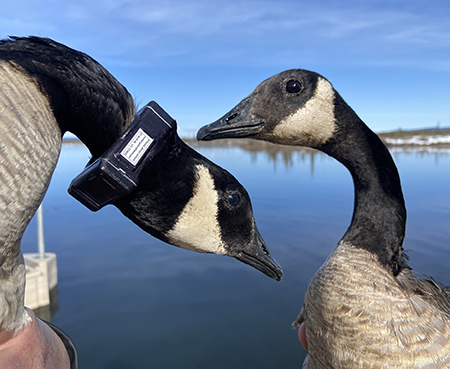
ADFG biologists plan for 2026 to be the final year of deploying GPS collars for this project though data will continue to come in for years to come. Ultimately, information from this project will be used to develop management plans that will guide future conservation efforts for these geese throughout western North America. You can contribute to this important research, as well as other efforts, by reporting band numbers for any banded bird you encounter at www.reportband.gov
Michael R. Guttery and Tasha J. DiMarzio are waterfowl biologists with the ADFG Statewide Waterfowl Program
More
Waterfowl management and research 
Waterfowl hunting in Alaska
Canada Goose species profile
Waterfowl habitat enhancement projects in Alaska
Biologist Michael Guttery looks over geese captured with a rocket net. Video shows Deploying a rocket net
Subscribe to be notified about new issues
Receive a monthly notice about new issues and articles.