
Alaska Fish & Wildlife News
May 2026
Mountain Lion Hunting in Alaska
Part 2 – How might this work?
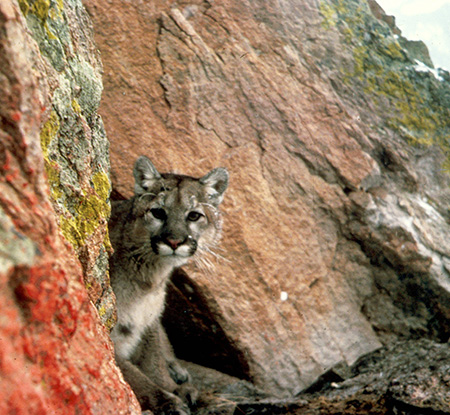
Mountain lion hunting will be legal in Alaska beginning Aug. 1, 2026, but wildlife managers don’t expect much hunting to take place.
Two mountain lions were documented in Southeast Alaska in recent years. In April 2025, and adult male was caught in a wolf snare on Kuiu Island; and in June 2024, a hunter opportunistically killed a young male on a Wrangell Island Beach. Two similar incidents occurred in the same general area in 1989 and 1998. A handful of sightings in this area, between Wrangell and Ketchikan, rounds out the mountain lion presence in the state.
In January 2026, the Alaska Board of Game carried a proposal to establish a hunting and trapping season for mountain lions in Southeast Alaska. The new Alaska regulations classify mountain lions as both furbearer and big game, so they may be taken by trappers and hunters. If a mountain lion is harvested, biologists will have the opportunity to inspect it and learn more about these animals that have not historically been present.
Jim Baichtel is on the Alaska Board of Game and was involved in the decision to establish regulations. He’s a geologist living in Thorne Bay on Prince of Wales Island, just south of the area where mountain lions have been documented, and he’s aware of credible sightings.
He said that although there is not an established population of mountain lions in Alaska, regulations will enable state biologists to better understand the cats that are coming in from British Columbia, which has an established population. It also enables hunters and trappers to keep the animal. As it stood, they were required to turn the cats over to the state.
“Mountain lions are incidental and coming through,” he said. “We are not managing a population. If an animal is harvested, this is an opportunity for them not to lose it. Is there any reason not to allow a person to keep that animal?”
Other animal species are expanding their ranges as well. Moose are moving into parts of Alaska where they were not previously known. Fisher and mule deer are moving west and north from Canada into Alaska. Baichtel said the board looked at how wildlife managers are addressing these new arrivals.
“There was a lot of discussion about this,” he said. “They’re not invasive, they’re just expanding here. Not long ago we didn’t have the numbers of moose we have – they come down the rivers, Stikine and Unuk and others through the Coast Range, and they’re increasing here. We also had a discussion of fisher, and trapping around Juneau, comparing and contrasting the fact that we expanded opportunity for fisher in Juneau area.”
Fisher, large cat-like weasels, were not historically found in Alaska. In the1980s and ‘90s sightings and reports began in the Juneau area, and trappers began sporadically catching them in marten sets. In 2013 the Board of Game created a trapping season to encourage reporting and allow trappers to keep animals they caught. On average, one or two fisher are caught in the area each winter – and it is clear they are expanding their range and becoming established.
Baichtel added that there was a lot of public testimony and support for the decision. “It wasn’t so much to encourage hunting, but not have the animals turned over to the state if they were taken.”
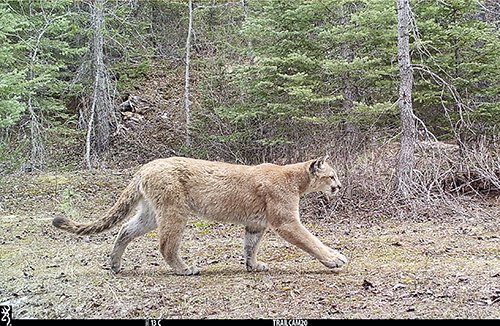
There were 36 submissions of written testimony from people and organizations; 28 in favor and eight opposed. The Alaska Chapter of Backcountry Hunters and Anglers supported the proposal and wrote: ADF&G emphasizes early monitoring and data collection when species expand into new ecosystems. The proposed season structure provides an enforceable mechanism to collect biological data on sex, age, distribution, and residency status.
Gwen Baluss of Juneau wrote in opposition: It is premature to establish a season when the presence of a breeding population has not been validated.
Hunting
The hunting season is August 1- June 15, with a bag limit of one. Trapping season dates in Units 1,3,4, and 5 are November 15 - March 31. Hunters and trappers will be required to comply with salvage and sealing requirements.
Sealing refers to a “seal” or tag that’s affixed to the hide after examination at a Fish and Game office, where the harvest is reported. In some cases, tissue samples are taken for genetics and disease testing; with bears, a small tooth is also taken to determine the animal’s age.
Frank Robbins is the wildlife biologist based in Petersburg and is the person most likely to be sealing a harvested mountain lion. He doesn’t anticipate that happening soon. He grew up in Texas – where his grandfather called them panthers (and had lots of panther stories) – and he’s familiar with mountain lion hunting.
“Hands down the most effective way to hunt lions is with hounds,” he said. “There was a handful of avid lion hunters in West Texas, and they were hunting with dogs. The drawback is the hot and dry conditions, which is not good for scenting, but there was a great density of cats in that part of Texas.”
Those are specially trained dogs, he said, “lion hounds” that work in a pack.
Most of the cougars harvested in British Columbia are taken by hunters with dogs. Garth Mowat is the Large Carnivore Specialist for the province of British Columbia and the lead author of the 2023 report, A Review of Cougar Biology and Management in British Columbia. He said hunters in Southern British Columbia kill about 200 animals annually and take occasionally exceeds 300. There is no cougar hunting season in Northern British Columbia, where the animals are still scarce.
“Without dogs it’s pretty much impossible to kill them,” Mowat said. “Calls sort of work in open areas, but by far the majority of hunting is done with dogs.”
That’s not an option in Alaska, where you may not hunt big game with the aid or use of a dog.
Oregon offers insights
Oregon has an estimated 7,060 cougars statewide, managed in six zones. Hunters in Oregon used dogs until it was prohibited by a ballot measure in 1994. Following that, cougar populations increased statewide.
“We’ve got a lot of cats,” said Derek Broman, a biologist with the Oregon Department of Fish and Wildlife.
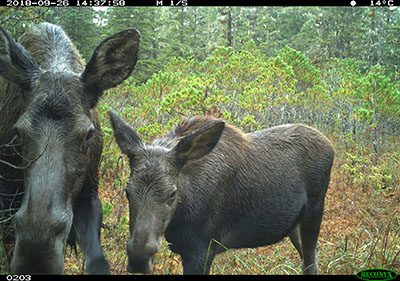
He said the cougar harvest over the past five years has averaged about 260, with a total mortality of about 470 cougars a year.
“Roadkill is 25 to 35 a year,” he said. “And there’s cougar removal for damage and human safety.”
Damage includes damage to livestock and property, and that take averages about 150 cougar/year. Roadkill also includes cougar that are found dead. Administrative removal, to protect bighorn sheep or improve conditions for elk, hasn’t been done for several years now, but in the mid-twenty-teens averaged about 65 animals/year.
The cougar season is year-round, but most cougars are taken opportunistically by elk and deer hunters during the fall. Trapping is not allowed for cougars in Oregon.
Broman said hunters purchase about 70,000 cougar tags every year. The tags are bundled with other species’ tags in a combination “Sports Pac,” and about three-quarters are purchased in that manner, with a quarter or so purchased individually. The result is that many hunters are covered legally if an opportunity arises to take a cougar, but only a very few actually target the animals.
“If all those people did hunt cougars, you could see a substantial harvest,” he said. “You can take two a year, and there are people who know how to do it. They know the habitat, have the patience, they do a lot of calling, and they hone those skills.”
Cougars respond to predator calls, and Broman said with the spring bear season in progress, they’ll likely see some cougar harvest as well. “People are calling, and cougars come in to predator calls like bears do,” he said.
Hunters are required to check in to an ODFW office the hide of any cougar taken, with skull, and proof of sex attached, as well as the reproductive tract of any female cougar. The Department evaluates sex and age structure of all cougar mortalities, (including cougar taken on damage) to monitor the overall health of the population.
Broman said the department has about a dozen cougars collared for research, and cougars are moving into some new areas in the Oregon Coast Range. An amendment to the Oregon Big Game Regulations states that the cougar population has been increasing slowly over time, and cougar management zones continue to near the estimated carrying capacity.
Broman added that establishing a hunting season in Alaska with sealing requirements was a good move to enable the department to gather more information on the animals.
Wildlife Biologist Chris Bottom is the ADF&G area biologist based in Soldotna on the Kenai Peninsula. He had experience with bobcats and mountain lions before coming to Alaska - and worked with Derek Broman.
He noted that biologists are observing high densities and survival rates of mountain lions in Oregon. “They are efficient and good at what they do,” he said.
He had the opportunity to collar a mountain lion during a mule deer research project in Southern Oregon. The signal from a collared fawn indicated mortality, and when he investigated he caught a glimpse of a mountain lion at the site.
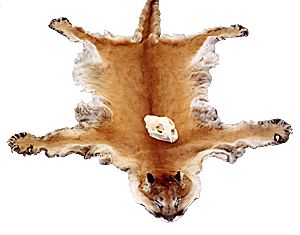
“He had cached the fawn,” he said. “I walked in and there was a log and a big pile, and I dug out the fawn, and there was no collar. I started digging around looking for the collar, and then on the other side of the log, there was a second dead fawn with the collar. I put out some foothold traps and caught him.”
He said mountain lions (and bobcats) are not difficult to trap, compared to canines, especially when you know one is there. Coyotes and wolves are wary and suspicious of traps and bait; cats are very curious and readily investigate visual attractants and enclosures.
Mountain lions can move great distances from source populations. Genetic testing on mountain lions caught in Illinois showed they came from the Dakotas. “Even mountain lions showing up in Massachusetts and New Hampshire are Dakota cats.”
Mountain lion sightings are reported on the Kenai Peninsula, near the Kenai River and the Funny River, although it is quite far from a source population. Many turn out to be lynx. Cat tracks are pretty distinct as cats, but the species of cat is harder to determine from a track. “The stride length between a large lynx and a small cougar is similar,” he said.
“We get reports of sightings out on the Funny River every year,” he said. “I believe people think they saw one, but I want pictures and samples for genetics. I want to confirm it. We need objective proof.”
A picture, scat and hair could confirm the presence of a dispersing mountain lion exploring what might be a potentially new habitat. It would take a bit more to indicate a population.
“You’d have to see some kittens in the spring and summer to see they’re establishing,” he said.
Links to More
Mountain lion hunting in Alaska: Part 1 (AFWN April 2026)
Oregon: cougar season summaries and information
AFWN article features credible sightings and examples of animals that are mistaken for Cougars, and what to look for with sightings.
A Review of Cougar Biology and Management in British Columbia, PDF
Oregon Cougar Management Plan (2017)
Fisher species profile
Subscribe to be notified about new issues
Receive a monthly notice about new issues and articles.