
Alaska Fish & Wildlife News
May 2026
Mule Deer Harvested in Alaska
First Report of New Deer
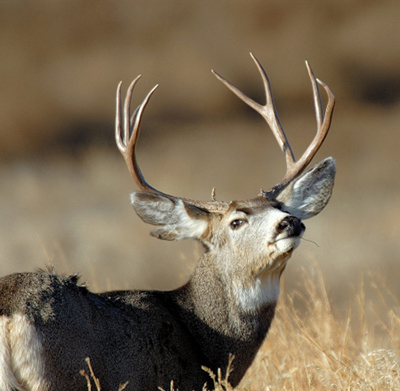
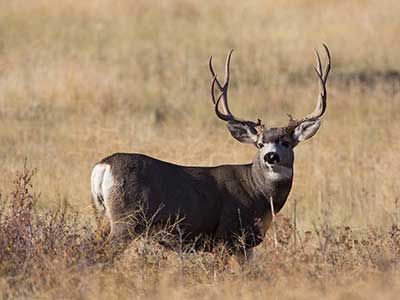
Mule deer are expanding their range beyond western Canada into Alaska, and in mid-April a hunter harvested a mule deer near Skagway. This is the first report of a mule deer harvested anywhere in Alaska.
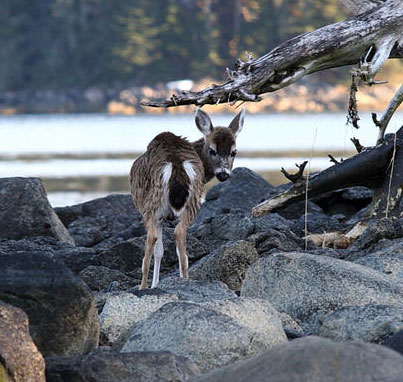
Mule deer and white-tailed deer are found in the Lower 48 and Canada but were not historically known to be in Alaska. Mule deer are the larger “cousins” of the Sitka black-tailed deer native to Southeast Alaska (black-tailed deer are a subspecies of mule deer). The smaller deer colonized coastal Alaska several thousand years ago as the glaciers receded, and in territorial days, people introduced these deer to Prince William Sound, Kodiak Island, Yakutat and a few other areas of Alaska with varying degrees of success.
In the past century mule deer and white-tailed deer have expanded their ranges north and west in Canada. Agriculture, climate change, roadbuilding, and wildlife management practices all helped these deer to increase in numbers and access new areas, and in recent decades they’ve been documented in parts of Alaska. But they aren’t coming alone. Deer can carry ticks, parasites and diseases that can have disastrous consequences when introduced to moose, caribou and other animals.
Biologists are monitoring this range expansion, and in 2019 new regulations allowed Alaska hunters to harvest these deer in those areas where they might be encountered. A successful hunter is required to provide a variety of organ and tissue samples for disease surveillance.
State Wildlife Veterinarian Dr. Kimberlee Beckmen said that the hunter did a fantastic job providing all samples. As it turns out, there’s a good reason. Westin Nelson of Skagway has been watching the mule deer in his area and was prepared.
“They’re in Skagway, I’ve seen quite a few,” he said. “About five years ago I saw the first one. My dad pointed it out, he said, ‘you can tell them from blacktails if you look at the ears.’ It’s a dead giveaway. Their ears are huge. If you’ve hunted Sitka blacktails, you’ll know they are undeniably different. These are much bigger deer, and you know it when you see them.”
He said that he and his best friend, who helped him dress the deer, have had an ongoing friendly competition to get one. They’ve actively hunted for them and are alert for opportunities.
“I’ve been watching for them,” he said. “I have a gun with me and I’m keeping an eye out. I know the regulations and everything about the samples and providing the information.”
Sitka black-tailed deer are rare in the Skagway area. Historically, Juneau was about the northern limit of their range on the mainland. There is no black-tailed deer season in the upper Lynn Canal area (Game Management Unit 1D).
“I’ve never seen a Sitka black-tailed in the Skagway area, and no tracks or sign,” Nelson said. “I know they are on Sullivan Island, not too far away, but I don’t see them. The only deer I’ve seen in Skagway are mule deer. We were seeing more a few years ago, single and in groups of two and four. We are pretty interested in them.”
He said it’s common to see mule deer in the Yukon and northern British Columbia, where he and friends go to fish and recreate outdoors. The Klondike Highway goes over the pass into Canada and serves as an access corridor for wildlife. Mule deer were first documented in the Yukon in the 1930s and in Interior Alaska in the mid-1980s. The mule deer population in the Yukon is now estimated at about 1,000 animals. Since 2005, mule deer have been sporadically documented in about a dozen locations in eastern Interior Alaska, mostly adjacent to roads such as the Alaska, Glenn, Taylor and Richardson Highways, singly and in groups.
Mule deer have recently been seen in border-area communities like Eagle, on the Yukon River. In May 2017, a mule deer was killed by a car near North Pole, and Dr. Beckmen was able to necropsy that deer. These areas of Eastern and Interior Alaska historically did not have deer at all, and any deer seen in these areas are likely to be the new arrivals. The story is similar for white-tailed deer, although they’ve not yet been documented in Alaska.
Carl Koch is the state wildlife biologist for the Juneau area and used to focus on the Skagway and Haines region. He received occasional reports of mule deer sightings near Skagway and was once sent a picture of a group of five mule deer.
“Two were fawns, so they were breeding,” he said. “But I don’t know if I’d call it colonizing.”
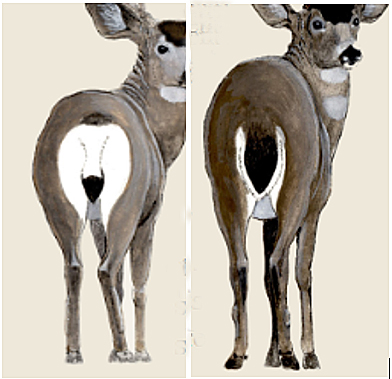
Koch also noted that the tail is a definitive feature of mule deer. A determination should not be based on the ears alone. A hunter should get a good look at both ends of a deer, as the tail and rump patch are distinctly different (see the graphic and description).
Wildlife Biologist Hannah Manninen works with Koch and currently manages wildlife in the Skagway and Haines area. She responded to the initial call from Westin Nelson about the deer.
“He left a message saying he’d harvested a mule deer, knew the regs, and wanted to know where to send the samples,” she said. “He knew in advance what to do, and he was not way out in the woods somewhere. He shipped them down chilled and we Goldstreaked them to Dr. Beckmen in Fairbanks.”
Neither biologist expects this to become a trend. “This might not be something we see again for a while,” Manninen said.
The deer was an adult female that had previously nursed a fawn but was not pregnant when harvested.
Nelson provided the hide, head and neck, liver, heart, both lungs with the trachea attached, the spleen, the lower colon and two lower legs with hooves. The organs were double bagged separately to avoid cross contamination, shipped in a hard-sided container and chilled but not frozen.
“Freezing makes things really difficult to interpret,” Dr. Beckmen said. “You can get a lot more information when you get it fresh. I was just amazed at this hunter getting all these samples and handling them appropriately.”
Beckmen necropsied the head and neck and carefully examined all the organs. She sent samples to five different labs for a variety of tests, including Chronic Wasting Disease. She said there was no sign of brainworm or lungworm, and a fecal sample (from the lower colon) will be tested in the labs for these and other parasites.
Brainworm is a high consequence disease, she said. “We don’t expect to find it but would be devasting. It kills moose, and mule deer can be a host.”
Another concern is a respiratory disease, deer adenovirus, which causes adenoviral hemorrhagic disease. It’s carried by deer and can be fatal to any deer-species calves, especially when they are stressed, including moose calves.
Moose Winter Tick is a high concern and Beckmen examined the hide, head and neck for evidence of ticks, mites and lice. Moose Winter Tick is not present in Alaska and can be devastating to moose populations by causing deaths of calves and yearling. A high percentage of deer in the Yukon carry the tick, and heavy infestations occur in winter causing hair loss, anemia and emaciation. The ticks drop off in early April to lay eggs, Beckmen said, so we can’t be certain the deer didn’t have any ticks on it early but it didn’t have any hair loss suggestive of a heavy infestation this past winter.
“The whole hide was really helpful - to see that there is no hair loss or breakage from scratching typically seen with lice or ticks,” she said. “We are planning to tan the hide for educational purposes, and I am cleaning the skull.”
Tissues will be archived at the University of Alaska, and Nelson will eat the venison.
More
Mule deer hunting in Alaska (and more on harvest reporting)
To report sightings of mule deer (photos greatly appreciated) email dfg.dwc.vet@alaska.gov or use the Wildlife Encounter form on the ADFG website.
More on ticks and moose winter tick
2017 article about mule deer range expansion and the roadkill mule deer found dead in Interior Alaska
Chronic Wasting Disease in North America (2025)
More on wildlife diseases
More on differentiating Sitka black-tailed deer and mule deer
Sitka Black-tailed buck follows doe – good view of tails and lack of rump patch
Subscribe to be notified about new issues
Receive a monthly notice about new issues and articles.