
Alaska Fish & Wildlife News
March 2026
New Habitat for the Bank Swallows
Banking on Creamer’s Field
Jerry Lipka is a retired UAF professor who sits on the board for Friends of Creamer’s Field and is a long-time birder. Creamer’s Field Migratory Waterfowl Refuge is 2,200-acres of managed state land in the heart of Fairbanks, featuring wetlands, ponds, and open fields that serve as prime habitat for waterfowl, songbirds, and other wildlife. It’s a popular spot for birders like Lipka. Last June, on one of his many walks around the area, he was excited to find a rare bird nesting along the outskirts of the refuge.
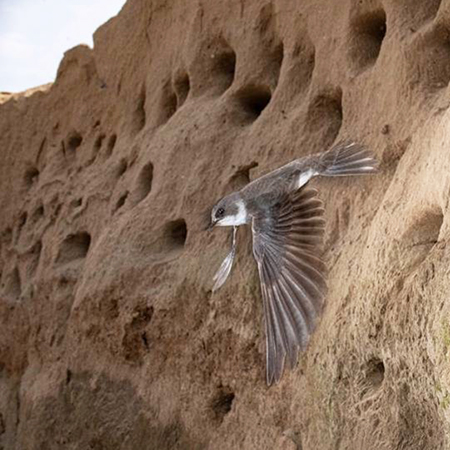
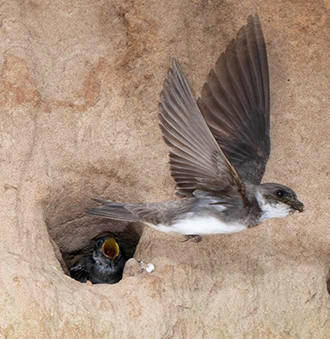
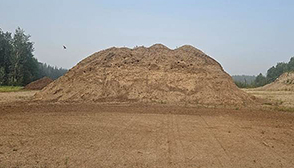
Large piles of peat had been mounded up near College Road as part of a mining project, and Lipka could see that Bank Swallows had dug nests into the soft material - and had likely been doing so for at least a year. The steep face of a tall peat mound was pockmarked with holes – burrows dug by these little ground-nesting birds. Bank Swallows are the smallest swallow species on the continent, and one of five swallow species seen in Alaska. The find was noteworthy because these swallows have undergone steep population declines (89%) since 1970. They are considered threatened in Canada, where the decline is 98%.
 As the summer passed, Lipka noticed that the mining project concluded in mid-July and the peat mounds were being dug up and moved away. Bank Swallows migrate out of Fairbanks about that time of year, and Lipka hoped the fledglings had moved on. He realized that when adult swallows returned in May of 2026, this prime nesting site would be gone. Finding a new site could jeopardize a potentially successful breeding season - something the tiny birds cannot afford to lose.
Breaking Ground for Bank Swallows
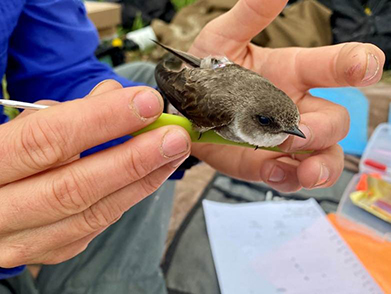
Concerned, Lipka reached out to ADF&G’s Dr. Julie Hagelin and Eva Allaby of the Threatened, Endangered, and Diversity (TED) Program, who monitor swallow colonies around Fairbanks. For the past three years, these researchers have captured more than 100 swallows by Eielson Air Force Base, equipping them with radio tags then releasing them and tracking their migration as they leave Interior Alaska. Their work is part of a cross-boreal partnership with Canada to study this species. They are also monitoring the four or so other Bank Swallow colonies around Fairbanks to track their numbers and distribution. These colonies can range from 25 to 100 burrows with some 200 Bank Swallows nesting inside. Hopefully, data from the small bird’s migration will reveal where they travel to in the winter and where conservation efforts can be focused to give breeding adults the best chance of returning to Alaska in the summer.
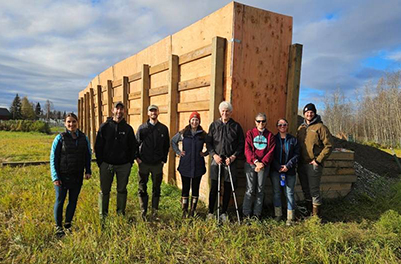
But what would the College Road swallows do, once they returned in the spring to find their peat mound gone? Together, Hagelin, Allaby, and Lipka came up with a concept to test whether it is possible to provide nesting habitat for the swallows. They formed a collaboration between Friends of Creamer’s Field, ADF&G, and the Alaska Songbird Institute to both replace the lost swallow habitat and increase public awareness of the declining birds. Taking shape in the northwest corner of Creamer’s Field, not far from the College Road colony, is a nascent artificial swallow colony. This new Northwest colony started as a pile of dirt on the chosen site but has been carefully built up and designed to appeal to Bank Swallows. Not only is it in a similar area as the lost colony, it is made of a very fine silt, compacted to encourage nest building and reinforced to prevent erosion and predation.
The new Northwest colony will be completed in time for the swallows to return to Fairbanks (usually around May 19) and will be 60 feet long, 40 feet wide, and stand 10 feet tall. In spring, the 4-foot timber frame will be removed from the mound to allow the swallows access, should they decide to move in. The silty substrate of the embankment material should be perfect habitat for the swallows, who usually nest by rivers and streams and dig little burrows into sandy riverbanks with their beak, wings, and specially adapted long toes and nails. Artificial swallow colonies have been successful for many other projects across the world and there’s good reason to expect the swallows to take to this new habitat. The site is also nearby to both year-round and seasonal ponds that will provide great foraging habitat for insects.
Hagelin and Allaby will continue their work on Bank Swallows this year, where a new protected colony in Creamer’s Field would be a valuable monitoring site. What are the next steps for the colony?
“It’s all up to the swallows” says Lipka, “Does it attract them? Is it safe for them?” How does the colony interact with other species in the area? Tree Swallows, falcons, foxes, etcetera.”
“It’s a very good project for the public and I’m just happy to do my little bit that I did, and really it’s their [Hagelin and Allaby] responsiveness that should be the highlight,” says Lipka, regarding the collaboration that has made his original idea a reality. “This is a great opportunity to learn…a new step for the refuge, and I think it’s a good one.”
Collaboration and Conservation
The Creamer’s Field Northwest Swallow Colony Project has been a unique opportunity to unite different entities around Fairbanks that focus on separate but sometimes overlapping aspects of conservation and bird education and research. While Friends of Creamers’ Field, Creamer’s Refuge, the Alaska Songbird Institute, and the Department of Fish and Game all support bird conservation and education, this swallow mound is a rare unification of these entities and a promising example of how partnership can make great ideas a reality. In the spring, the Northwest swallow colony collaborators hope that the swallows will begin digging burrows in the offered habitat. If successful, there are plans to integrate the Northwest colony into the programs at Creamer’s Field, including an educational sign and guided nature walks from naturalist volunteers. A successful colony would also be an addition to programs like Camp Habitat with Friends of Creamer’s Field, and the Songbird Institute’s youth mentoring program. Time will tell of the colony‘s success as birds begin migrating back to Alaska this spring and, as Lipka says, it’s all up to the swallows now.
Creamer’s Field: Fun for wildlife and humans, alike!
Friends of Creamer’s Field is an educational nonprofit in Fairbanks that serves the Creamer's Field Migratory Waterfowl Refuge. During the summer breeding season, the refuge is a hotspot of bird activity and a favorite visit of birdwatchers looking for Sandhill Cranes and waterfowl. It is also a popular stopover site for migratory birds during spring and fall migration where birders can spot Canada geese, Pintails, and Golden Plovers among many other species. Year-round the refuge also hosts chickadees, Redpolls, Ravens, and various owl species. Check out the schedule of educational events at Creamer’s Field for 2026.
Reach out to Dr. Julie Hagelin at julie.hagelin@alaska.gov if you have found any new Bank Swallow colonies so we can track their numbers and locations.
More on Swallows: Swallow Tales: The plight of aerial insectivores
Subscribe to be notified about new issues
Receive a monthly notice about new issues and articles.