
Alaska Fish & Wildlife News
February 2026
Repairs and Improvements Made
to the Oliver Inlet Tramway
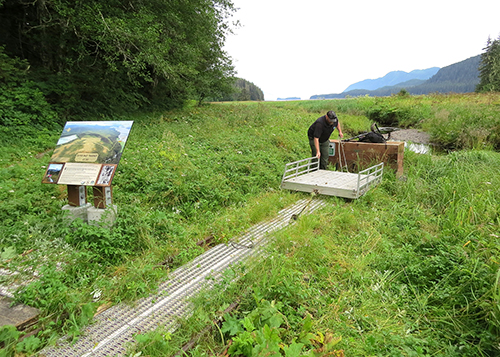
A project to improve the Oliver Inlet Tramway on Admiralty Island near Juneau has been completed.
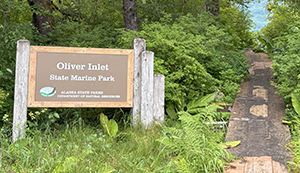
Admiralty Island is popular with deer hunters; it’s also home to a couple thousand brown bears and is well-known for bear viewing. The tramway is used by hunters during hunting season and by kayakers and visitors enjoying bear viewing and other outdoor recreation opportunities in Seymour canal and on the island. The Seymour Canal Public-Use Cabin, administered by Alaska State Parks, is located at one end of the tramway. The tramway and cabin are in Oliver Inlet State Marine Park, a slice of state land surrounded by the vast Admiralty Island National Monument – Kootznoowoo Wilderness.
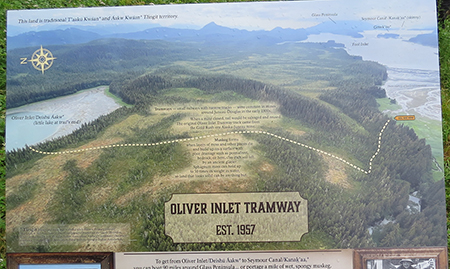
The route of the tramway is a one-mile portage between Oliver Inlet (north end) and Seymour Canal (south end). Oliver Inlet is readily accessible by boat from Juneau, and Seymour Canal is a waterway about 40 miles long running up Admiralty Island. The famous Pack Creek Bear Viewing area is on Seymour Canal. The route was used historically by Tlingit people who laid skids to haul canoes across the portage to access Seymour Canal and areas on the east side of Admiralty - areas known for rich hunting opportunities. Accessing the head of Seymour Canal from Oliver Inlet is a 100-mile boat trip around Glass Peninsula on Admiralty - or this one-mile portage.
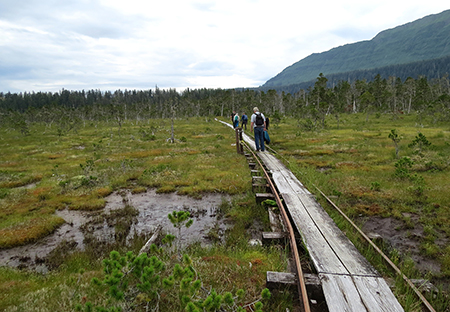
The tramway was originally built in 1957 along that route by The Territorial Sportsmen of Juneau, using rails and materials salvaged from the goldrush era Alaska-Juneau mine. Tramways – small railways with narrow tracks - were common in early mines in the area in the early 1900s. The tramway is essentially a boardwalk with rails.
A pushcart can be loaded with a kayak, canoe or small skiff, or a couple hundred pounds of gear, and then (ideally several) people push the cart down the railway. Simply walking the railway end-to-end takes about 45 minutes. The portage is relatively flat and straight and crosses wet, boggy muskeg with patches of forest. The existing cart is relatively new.
The tramway is functional but some sections were in serious need of repair. It’s a patchwork of original railway and planking, and improvements and upgrades done periodically over the decades. In the mid-1980s, Alaska Army National Guard members straightened the track and installed some new rails and timbers.
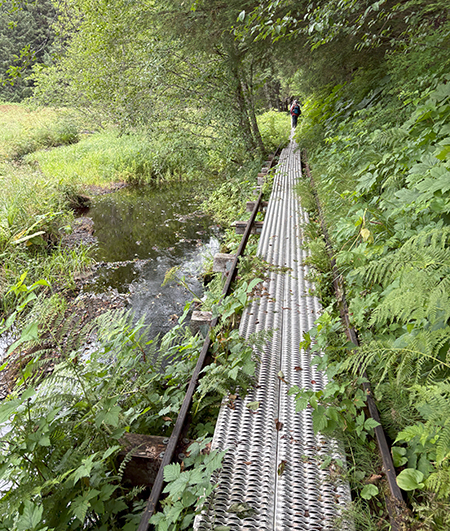
Work began in 2024 on this project and a several-hundred-yard portion on the Seymour Canal side was completed. Rotten wood was replaced with expanded aluminum grating, and additional work was done in preparation for potential future improvements.
The project was managed by the ADF&G Hunter Access Grant Program and Alaska State Parks Design & Construction. Funds were provided through the Federal Aid in Wildlife Restoration Act (also known as the Pittman-Robertson Act), which provides federal money to state fish and wildlife agencies. Funds are used for wildlife management and research; for projects like this providing public use and access to wildlife resources; for hunter education, and for the development and management of shooting ranges. Ranges in Juneau and Fairbanks were substantially improved in recent years through this program.
In 1937, legislation created this "user pay/user benefit" program through federal excise taxes and import duties placed on firearms, ammunition, and archery equipment.
The program covers up to 75% of the cost of an eligible project and requires a 25% non-federal match. ADF&G also often partners with other state agencies, local governments, and non-governmental entities to meet match requirements. The partner on this project was the Division of Parks and Outdoor Recreation, within the Alaska Department of Natural Resources.
Other current hunter access projects in Southeast Alaska include work in Sitka on the Starrigavan Valley Off-Highway Vehicle (OHV) trail system, the Treadwell Ditch trail in Juneau, and improvements to the Wrangell Skeet and Shooting Range.
The plan for the Wrangell project is to design and construct an eight-station skeet range at the City and Borough of Wrangell’s Outdoor Shooting Range. This will include brushing, installation of high and low house enclosures, skeet machines for sporting activity, signs, and parking area improvements. The skeet range will be constructed with the intent to accommodate a future trap range. This project will expand capacity and community use of the outdoor shooting range, improve the lifespan of the range, establish skeet shooting sport activities, set the stage for future trap shooting sport for public use, and support hunter safety and education.
More on the Hunter Access Program
More on Oliver Inlet State Marine park
Subscribe to be notified about new issues
Receive a monthly notice about new issues and articles.