
Alaska Fish & Wildlife News
February 2026
Are Bears in Winter Okay Buried Under Deep Snow?
Ask a Wildlife Biologist
A massive dump of snow buried Southeast Alaska in December 2025, and a Juneau resident shared her concern about buried bears.
“I am worried about bears hibernating. With all the snow blocking their dens, are they going to have enough oxygen while they are sleeping? Are they going to be able to get out of their den if it’s packed ice?”
Several knowledgeable wildlife biologists pitched in to answer. Anthony Crupi, based in Juneau, spent decades studying brown bears in coastal Alaska. He noted that even if a bear’s den is completely snow covered, it’s not sealed. Snow that covers the entrance of an earth-excavated den diffuses the essential gases and air permeates the snow fairly well.
“If the snow is just naturally accumulating over a den entrance, it will preserve the porous structure and stay permeable to gases and allow diffusion,” he said. “Plus, evidence also shows that the snowpack is ‘vented’ during wind events, when the wind kind of pulls out the air from within the snowpack.”
Deep snow can also be a good thing, he added. It adds a layer of insulation and tempers fluctuations and the effects of extreme temperatures.
Crupi said it might be possible for an ice cap to seal the entrance to a den. A heavy, mid-winter rainstorm, dumping water that freezes as a solid layer of ice, could potentially create a seal impervious to gas. But as long as the snow is snow and not 100% ice, gases will be able to diffuse to some degree. But dens often have more than one opening.
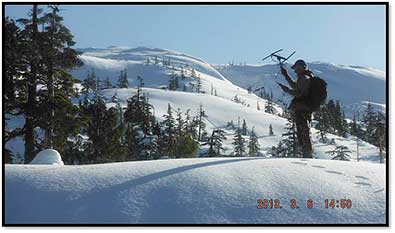
“I have seen in some cave dens or root wads that there are actually multiple holes through the ground so there are multiple avenues for gas transport.”
Sealed and trapped?
Wildlife Biologist Boyd Porter, based in Ketchikan, researched denning black bears for years on Prince of Wales Island. He carefully documented more than 100 bear dens and handled, collared and tracked at least 65 black bears over multiple winters. Bears will use the same dens over many years; they’ll also change dens, sometimes in the same winter. He’s now retired and retains a keen interest in bears.
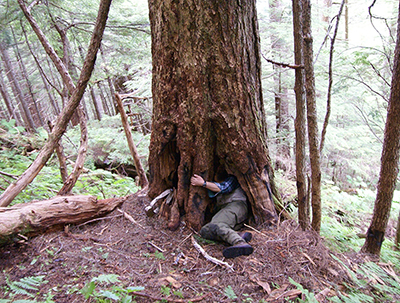
He said 98 percent of the dens he saw were in woody structures – chambers in live trees, standing dead trees, fallen dead trees, and under tree roots; bears were not sealed in excavated underground tombs. “It’s not a tight box like you might think,” he said.
Bears do some digging and modification of a natural chamber in a tree and they consistently bring in bedding for the floor. He thinks of bears as cavity nesters, akin to marten, mink and many birds.
“They bring in nesting material, pile some at the entrance to make a door, you might call it, with branches and woody debris, but it’s not a tight seal and it’s something that could be easily pushed when they want to get out.”
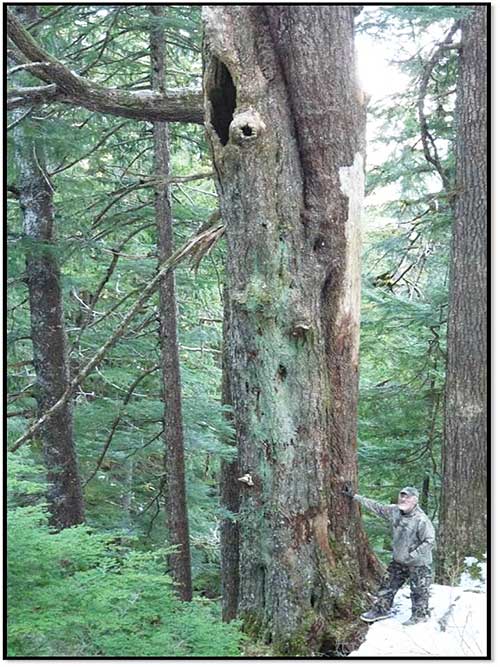
He said in many cases, the entrance was partially or fully open during the winter. Even up north, where it’s much more common for bears to excavate dens underground, the entrance often does not get completely covered.
Even if a bear was in an underground, excavated den, completely buried by snow, it could get out. “A bear can easily push out of a snow-covered den,” Porter said. “It’s not going to be trapped. They’ve got excavator front paws, they can dig through compacted soil - those claws are quite the digging tool.”
“Bears have been doing this for a long time,” he said. “They’re good at it.”
More on bear research
Winter Wildlife Series: Brown Bear Denning Ecology in the Rainforests of Southeast Alaska
Brown bear denning ecology in the rainforests of Southeast Alaska
In this live presentation from 2022, Anthony Crupi dives into some of his research on the denning habits of brown bears in the temperate rainforests of Southeast Alaska. This talk outlines hibernation strategies brown bears have adapted — including types of sites and some common characteristics, to name a few — in order to survive and thrive in the region’s harsh winter weather.
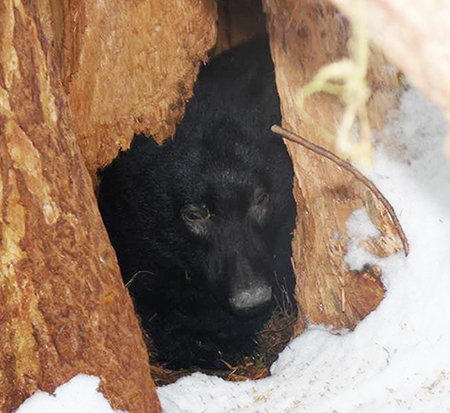
An Alaska Fish and Wildlife News article highlights Boyd Porter's work on POW:
Nesting Bears: Bear Dens on Prince of Wales Island
The wildlife research report is also available
More articles
Mysterious Brown Bear Appearance and Southeast Bear Research
Bear Rub Trees and Scent Marking
Bears on the Move: Brown Bear Dispersal and Home Ranges
Subscribe to be notified about new issues
Receive a monthly notice about new issues and articles.