
Alaska Fish & Wildlife News
February 2026
Caribou can Thrive in Winter
Lactating females can gain fat
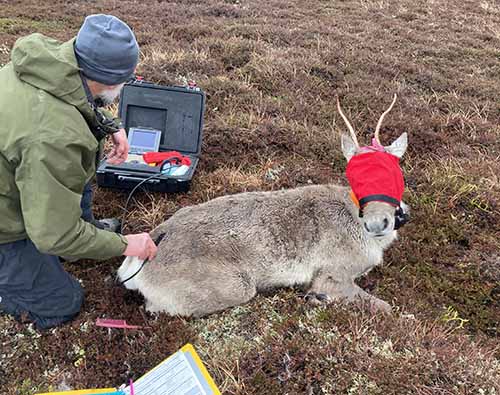
Animals in the North put on fat for winter, not in winter – according to conventional thinking. But wildlife researchers in Alaska found that caribou on the snow-covered and windswept tundra of Southwest Alaska gained body fat and muscle mass in winter.
Biologists examined lactating and pregnant caribou in the fall, and again in late winter, twice a year for two-and-a-half years. They consistently gained body fat between October and March, averaging about a three-percentage point gain, with some individual gains over eight percentage points. These findings are part of an ongoing project involving 60 caribou and focused on about 25 females that were nursing calves born in June, though the numbers can vary annually depending on how many females survive and raise calves.
Kristin Denryter and John Crouse recently published the findings in a paper, Overwinter gains in body fat challenge assumptions about winter nutrition in northern ungulates.
“We collared 60 animals and we’re catching all 60 twice a year,” Crouse said. “The publication focuses on lactating females. We looked at over-winter changes in the same individuals over a three-year period.”
Denryter and Crouse are wildlife research biologists with the Alaska Department of Fish and Game. They are wildlife physiologists keenly interested in nutrition, with years of experience handling large ungulates like moose and caribou. Denryter is the director of the Foraging Ecology and Wildlife Nutritional Analysis Lab in Palmer and Crouse is the director of the Kenai Moose Research Center near Sterling.
As a longtime moose researcher, Crouse is familiar with the “assumptions about winter nutrition,” since moose are a northern ungulate that experience winter as a lean season, when they’re drawing on the stores they built up over the summer. From their own work, he and Denryter knew something was up with those female caribou.
“Lactating females are thin in the fall and we knew that,” he said. “We were scratching our heads - why are survival rates and pregnancy rates high when animals are going into winter so lean and skinny?”
“We set out to figure out what the impact of their range would be,” Denryter said. “Was it limiting them? Was the winter range bad? Was it just maintaining them? How are they even making through winter if they don’t have much fat at the beginning of winter?
Caribou in fall and winter
In recent years, for two weeks in October and February-March, Crouse and Denryter spend their daylight hours flying out of Dillingham or Bethel in a helicopter, locating their subjects on the tundra, amid the rivers, mountains, and rolling hills of Southwest Alaska. GPS and radio transmitters on the caribou collars are a big help, as is support from a Cessna 185.
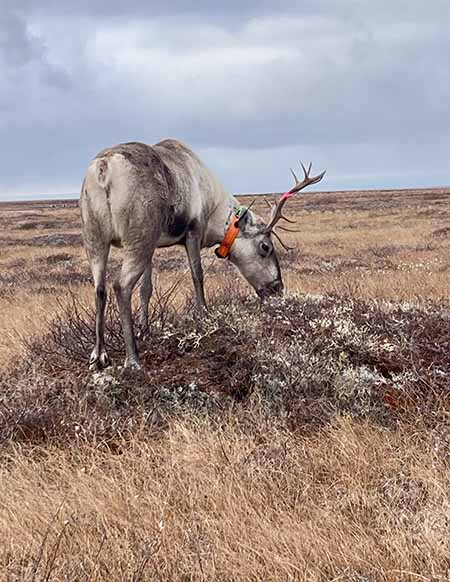
“We have a fixed-wing pilot and he radio-tracks them (collared caribou),” Denryter said. “He goes out first, about half an hour before, and radios back to us where they are so we can go right to them in the helicopter.”
They can work very efficiently under the right conditions. Caribou are darted from the helicopter, which then drops them off with their gear to do their work. Animals are briefly immobilized by the drugs, which are then reversed.
“We plan for two weeks to catch the animals,” Crouse said. “It’s not unusual for us to handle ten animals a day if we’ve got good conditions. Weather is the challenge out there. Last fall we were going in on the tail of that big typhoon.”
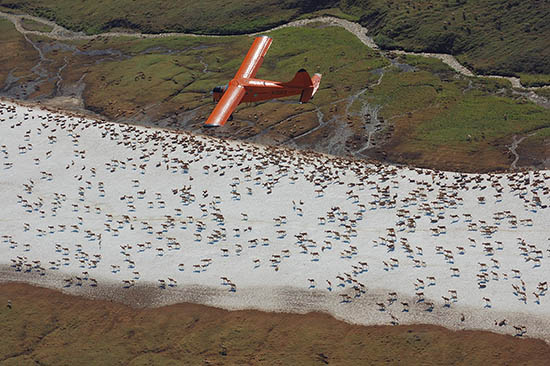
The animals are part of the Mulchatna Caribou Herd, which ranges across a swath of Southwest Alaska about the size of New Mexico – the area north of Dillingham and east of Bethel, between the Kuskokwim and Mulchatna rivers. The size of the herd fluctuates over the years and it currently numbers about 16,000 animals, a decrease in recent decades, and biologists want to better understand factors involved in the decline.
“When the herd was close to 200,000 animals, it ranged across that whole area,” Crouse said. “Now it’s smaller, unevenly distributed, and there’s an eastern group and a western group. We work on the eastern from Dillingham, the western from Bethel, and catch 30 on each side.”
October is the mating season and caribou are grouped up. Cows are still nursing their young-of-the-year, five-month-old calves. Bulls are rutting, and many of those cows will soon be pregnant. As they go into winter, they’re pregnant and nursing.
“In October we determine who is lactating or not,” Crouse said. “We’re confirming lactation status by examining the udders of females on the ground. Then we caught them again that following February or March, when we can determine pregnancy by taking a blood sample and scanning with the ultrasound.”
The ultrasound is a veterinary model using the same technology as the familiar medical device. They measure body fat (maximum thickness of fat on the rump), muscle mass (maximum thickness of the loin, also known as the backstrap), and in late winter they sometimes see a viable fetus with a heartbeat.
“It takes just a few seconds to determine pregnancy,” Crouse said. “By February or March they still have calves with them but they’re not lactating. And over 90 percent were pregnant in late winter.”
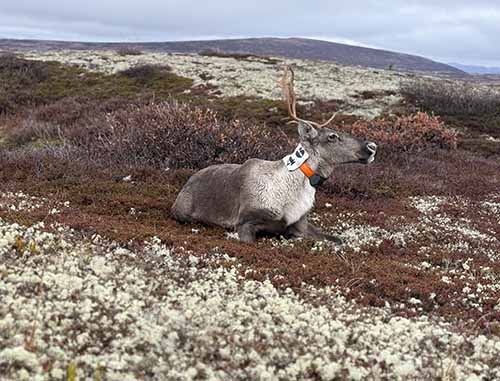
“When the calf is coming up on its first birthday females are giving birth to a new calf,” he added.
In the bigger picture, the researchers are also looking at adult survival, calf survival, and diseases like brucellosis that can affect the herd. The collar devices help researchers gather data for that as well. Pregnant cows have a VIT, a vaginal implant transmitter, paired with the transmitter in the collar. During birth when the device is pushed out, the temperature change and exposure to light triggers a signal that immediately notifies researchers of the newborn calf.
Denryter said these devices have been used on moose for years, but this project is the first time they’ve been used with caribou. They can check the calf on the ground to see if they’re born alive, if they show signs of brucellosis or other issues, and if they are healthy enough to get up and follow mom.
They can also gain insights on mortality. The collars have an activity sensor, which provides a “mortality signal” indicating an animal has died. The researchers found that most mortality is due to predation and occurs independent of body fat. Sick or weak animals may be easier for predators to catch, but they take down healthy caribou too.
“We’re not seeing that susceptibility to predation is related to body fat,” Denryter said. “Animals in good condition are being predated as well.”
What are caribou eating?
In summer, May-September, caribou eat the leaves of willows, sedges, flowering tundra plants, and mushrooms. In the fall they switch to lichens, dried sedges (grasslike plants), and the twigs and stems of small shrubs like blueberry.
Lichen is sometimes called “reindeer moss,” but that’s a misnomer. Moss has almost no nutritional value, and lichen is a good food for caribou.
“The caribou lichen is highly digestible and has a high energy content,” Crouse said. “Caribou are ruminants, they have microbes that digest the lichen, and then the microbes turn over, and the caribou digest the microbes and get the nitrogen from that, so they can make their protein.”
The lichens are buried under snow, but caribou are very good at cratering, a term that references their winter feeding. Crouse described flying above the tundra in winter and coming upon a cratering scene with a big group of caribou:
“When we’re flying out there, you see tracks through the snow, single file, then they get to an area and boom, they spread out, and you see them foraging on lichens, cratering the snow. It looks like little moon craters; they paw down through the snow to the lichens to forage. Usually one makes a crater, then Holy Cow! There’s 200 or 300 animals, all digging multiple craters – there’s pockmarks all over the tundra.”
While winter can be a lean time for wildlife, summer can impose significant nutritional limitations on northern ungulates as well.
“The metabolism of animals changes across the year,” Denryter said. “In summer they have highly elevated requirements for energy and protein to replenish their body reserves, and they need to process that food. So, their metabolic rate is elevated. When winter comes and not much food is available, the metabolic rate is lower and they’re more efficient.”
And in summer, caribou experience intense harassment by insects. Snow patches and windswept ridges offer some relief, and caribou tightly group up in these areas. But those areas might not provide good forage.
“Even if they have good food available to them, they might not be able to access because of insects,” Denryter said. “It [insect harassment] can be really severe in summer.”
What’s next?
This year, Crouse and Denryter are beginning a similar study of the Nelchina Caribou herd, which ranges west of the Copper River and Glennallen. And they will be returning to the range of the Mulchatna herd this winter for the third year of this work.
“We still have more diet and intake information to get,” Crouse said. They want to learn more about caribou energetics in winter – how they may be conserving energy, how being social animals that forage in groups might benefit them and help them locate patches of lichens.
“What is it about the winter range that’s allowing them to put on fat?” Denryter asked. “Is what’s happening in the Mulchatna typical of caribou? Is this how caribou have adapted to their environment and seasonality?”
“There are lots of questions and there’s a lot of interest in this herd,” Crouse said.
More
Counting Caribou a birds-eye view video of caribou and an inside look at caribou research.
Article on aerial photocensus
Subscribe to be notified about new issues
Receive a monthly notice about new issues and articles.